Off-channel communications have become one of the most visible compliance risks in financial services. Regulators are no longer treating them as edge cases or isolated policy violations. Instead, off-channel communications are now a core focus during exams, enforcement actions, and ongoing supervision reviews across broker-dealers, investment advisors, and other regulated fintech firms.
It really comes down to one thing: visibility. A lot of business gets done outside the systems a firm monitors. People fire off texts, use their personal email, jump into WhatsApp or Signal, or drop a quick note in a chat tool, and none of it gets captured. Once those messages slip through, the firm has no way to supervise them or keep records of conversations tied to real business activity.
This article breaks down what fintechs must track when it comes to off-channel communications. It covers how regulators define the issue, which rules apply, where firms typically fall short, and how to build a control framework that holds up in an exam.
What Are Off-Channel Communications in Fintech
Off-channel communications refer to business-related messages that occur outside a firm’s approved, monitored, and retained systems. This usually includes texts, personal email, messaging apps like WhatsApp or Signal, and direct messages within collaboration tools that are not captured by the firm’s compliance infrastructure.
What matters is not the app or device. It comes down to whether the firm can actually monitor and keep those records. If a message is tied to business activity, regulators expect it to be captured and available for review. That expectation applies across the board, from client conversations to internal discussions about products or transactions.
Fintech teams rarely work in a single system. Sales teams rely on texting. Founders often communicate directly with partners. Internal coordination happens in chat tools. When those conversations take place outside approved environments, they move beyond the firm’s visibility.
Why Communications Depend on Firm-Approved Systems
Whether a message is off-channel depends on how the firm is set up. A tool only counts as “on-channel” if the firm has approved it, configured it to capture records, and included it in its supervision process. The same platform may be acceptable at one firm and a compliance problem at another.
This is where many fintechs get tripped up. Teams move quickly and adopt new tools before compliance has caught up. A messaging platform may be part of everyday work, but if those messages are not archived or reviewed, the firm may have no real control over them.
A practical way to think about it:
Scenario | Status | Reason |
|---|---|---|
Email sent through the company domain with archiving | On-channel | Captured and supervised |
Slack used with retention and monitoring tools | On-channel | Approved and controlled |
WhatsApp used for client communication without capture | Off-channel | Not retained or supervised |
Personal Gmail used for deal discussions | Off-channel | Not retained or supervised |
For fintechs, this is less about restricting tools and more about defining boundaries. Approved systems set the perimeter of what the firm can see, supervise, and produce when required. Everything outside that perimeter becomes a compliance risk.
Why Off-Channel Communications Are a Regulatory Focus
When communications are not captured, firms lose the ability to supervise what is happening, investigate problems, and produce records when regulators ask for them. Regulators do not view off-channel communications as a minor policy issue. They see them as a failure in basic compliance controls.
In the last few years, this stopped being a matter of guidance and became one of enforcement. Large settlements and exam findings have driven the point home: regulators expect firms to know where business conversations are happening and to keep records to match. That applies to broker-dealers, RIAs, and other regulated entities running on fintech models.
Recordkeeping and Supervision Obligations
At the center of this issue are recordkeeping and supervision requirements. Firms are expected to retain communications related to their business and to review them as part of ongoing supervision. That includes emails, messages, and internal discussions tied to transactions, advice, or operations.
When a communication cannot be retained or reviewed, it creates a gap in both areas. That is exactly the kind of gap regulators look for during exams. It raises basic questions about whether the firm can see what is happening inside its own business and whether its controls actually work.
This does not apply only to client-facing messages. Internal conversations about deals, product changes, or customer handling may also fall within scope if they relate to regulated activity.
For fintechs, where important decisions often happen in chat tools, this can quickly become a core compliance issue. Impact on Exams, Investigations, and Disputes
Off-channel communications often come to light after a problem arises. An exam request, investigation, or customer dispute may prompt the firm to review its communications. If key messages are missing, the firm is left with an incomplete record of what happened.
Regulators expect firms to be able to produce communications on demand. When those records are incomplete, it can lead to findings even if the underlying activity was appropriate. The absence of records becomes the issue.
The fallout isn't limited to regulatory reviews. In arbitration or litigation, missing communications can weaken how a firm defends itself. Some firms have ended up facing sanctions or losing ground in a case because their message retention had gaps. Internal vs. External Communications Risk
A lot of firms train their attention on client communications and miss what's happening internally. That's where the gap opens up. Internal conversations are full of approvals, instructions, and decisions tied to regulated activity.
Off-channel communications are not limited to external messaging. In fintech teams, internal chats often cover product changes, marketing language, onboarding flows, and incident responses. If those discussions are not captured, there is no clear record of how key decisions were made.
External communications still matter, especially in sales and customer support. But if firms focus only on those channels, they leave a large part of the risk untouched. A complete approach gives firms visibility into how teams communicate with each other, as well as how they communicate with clients.
Area | What Regulators Expect | Where Issues Arise | Why It Matters |
|---|---|---|---|
Recordkeeping and Supervision | Firms retain and review all business-related communications, including internal discussions | Messages occur on unapproved channels and are not captured or reviewed | Creates gaps in supervision and raises questions about control effectiveness during exams |
Exams, Investigations, and Disputes | Firms can produce complete communication records on demand | Missing or incomplete records during regulatory requests or disputes | Leads to exam findings, enforcement exposure, and weaker legal or arbitration positions |
Internal Communications | Internal decisions, approvals, and instructions are documented and reviewable | Teams rely on chat tools without capture or retention controls | No audit trail of how key decisions were made |
External Communications | Client-facing communications are retained and supervised | Use of texting, personal email, or messaging apps without oversight | Incomplete records of client interactions and potential conduct issues |
Key Regulations Governing Firm Communications in the US
Regulatory expectations around off-channel communications are not new. US regulators have long required firms to retain and supervise business communications, regardless of format or channel. The recent focus is on how firms apply those rules to modern communication tools.
SEC Requirements (Broker-Dealers and RIAs)
The Securities and Exchange Commission (SEC) sets the baseline for recordkeeping across broker-dealers and investment advisors. These rules apply broadly to communications tied to business activity:
Rule | Applies To | What Must Be Retained |
|---|---|---|
Rule 17a-3 & 17a-4 | Broker-Dealers | Business-related communications, including emails, messages, and internal discussions |
Rule 204-2 | RIAs | Communications tied to advice, recommendations, and client relationships, including internal discussions |
Rule 17a-3 & Rule 17a-4 (Broker-Dealers)
SEC Rule 17a-3 addresses the records to retain, including communications related to their business. SEC Rule 17a-4 addresses how long to retain these records for broker-dealers. This includes emails, messages, and other written communications with clients and internally.
The rule focuses on retention and accessibility. Firms must store records in a format that prevents alteration and allows prompt retrieval. This becomes difficult when employees use personal devices or unapproved apps where messages are not captured or archived.
From an exam perspective, regulators will often request samples of communications. If those records are incomplete, it raises questions about the firm’s supervisory framework.
Rule 204-2 (Investment Advisors)
SEC Rule 204-2 places similar obligations on RIAs. Advisors must keep records of communications connected to advice and client relationships.
That includes more than direct client outreach. Internal discussions around investments, onboarding, and portfolio decisions are often part of the recordkeeping requirement.
For fintech firms, this becomes a mapping exercise. Advisory activity may sit inside apps, chat tools, or automated workflows, which makes it harder to define what needs to be captured.
FINRA Rules on Supervision and Recordkeeping
Financial Industry Regulatory Authority (FINRA) complements the SEC requirements with a focus on supervision. The expectation is not just to retain records, but to actively review them.
Rule | Focus Area | What Firms Must Do |
|---|---|---|
Rule 3110 | Supervision | Establish and maintain a supervisory system, including a review of business communications |
Rule 4511 | Books and Records | Create and preserve records required under SEC and FINRA rules |
Rule 3110 (Supervision)
FINRA Rule 3110 requires firms to establish and maintain a supervisory system for their business activities. This includes reviewing communications to detect and address potential issues.
Supervision only works if communications are captured within the firm’s systems. When off-channel communications occur, they fall outside review processes, which weakens the overall supervisory framework.
For fintechs, this often shows up in fragmented tooling. Messages may exist, but not in a place where compliance teams can review them consistently.
Rule 4511 (Books and Records)
FINRA Rule 4511 reinforces the requirement to create and preserve books and records as required under SEC rules. It ties directly into recordkeeping obligations and exam expectations.
Firms are expected to maintain complete and accurate records of their business activities. Missing communications can be viewed as incomplete recordkeeping, even if other documentation exists.
CFTC Recordkeeping Expectations
For firms involved in derivatives, commodities, or certain crypto-related activities, the Commodity Futures Trading Commission (CFTC) imposes its own recordkeeping standards.
The CFTC requires firms to retain communications related to trading, orders, and execution activity. This includes written communications and, in some cases, voice records. The expectation is similar to the SEC framework but applied to a different set of activities.
In practice, firms operating across multiple regulatory regimes must align their communication controls with applicable requirements. For fintechs expanding via new products or markets, meeting all of those obligations becomes particularly complex.
For teams managing these obligations, the challenge is applying the rules consistently across modern communication channels.
Common Compliance Failures with Off-Channel Communications
Most issues around off-channel communications come from gaps between what is written and how teams actually communicate. Firms often have rules in place, but those rules are not reflected in day-to-day behavior.
The most common failure points regulators focus on:
Policies that exist but aren’t enforced: Firms document approved channels but don’t monitor whether employees follow them. Attestations are collected, but there is little validation behind them.
Use of personal devices without controls: Employees rely on their own phones for business communication. Without mobile capture or restrictions, those messages sit outside the firm’s systems.
Lack of monitoring and testing: Messages may be captured, but not actively reviewed. In other situations, firms assume their tools are working without testing coverage across different channels.
Gaps in message capture and retention: Certain apps or workflows are not integrated into archiving systems. Messages may be partially captured or missed entirely.
Over-reliance on vendors: Firms assume that implementing a technology solution resolves the issue. In practice, tools require ongoing oversight, configuration, and validation to align with regulatory expectations.
Learn how Regly’s vendor management module helps fintechs track, organize, and assess vendor relationships →
What Fintechs Must Track for Communications
Knowing the rules is only the starting point. The real challenge is applying them in day-to-day operations. Fintechs need clarity on what to track, where communications occur, and how oversight is handled. Without that, the risk of off-channel communications remains, even when policies are in place.
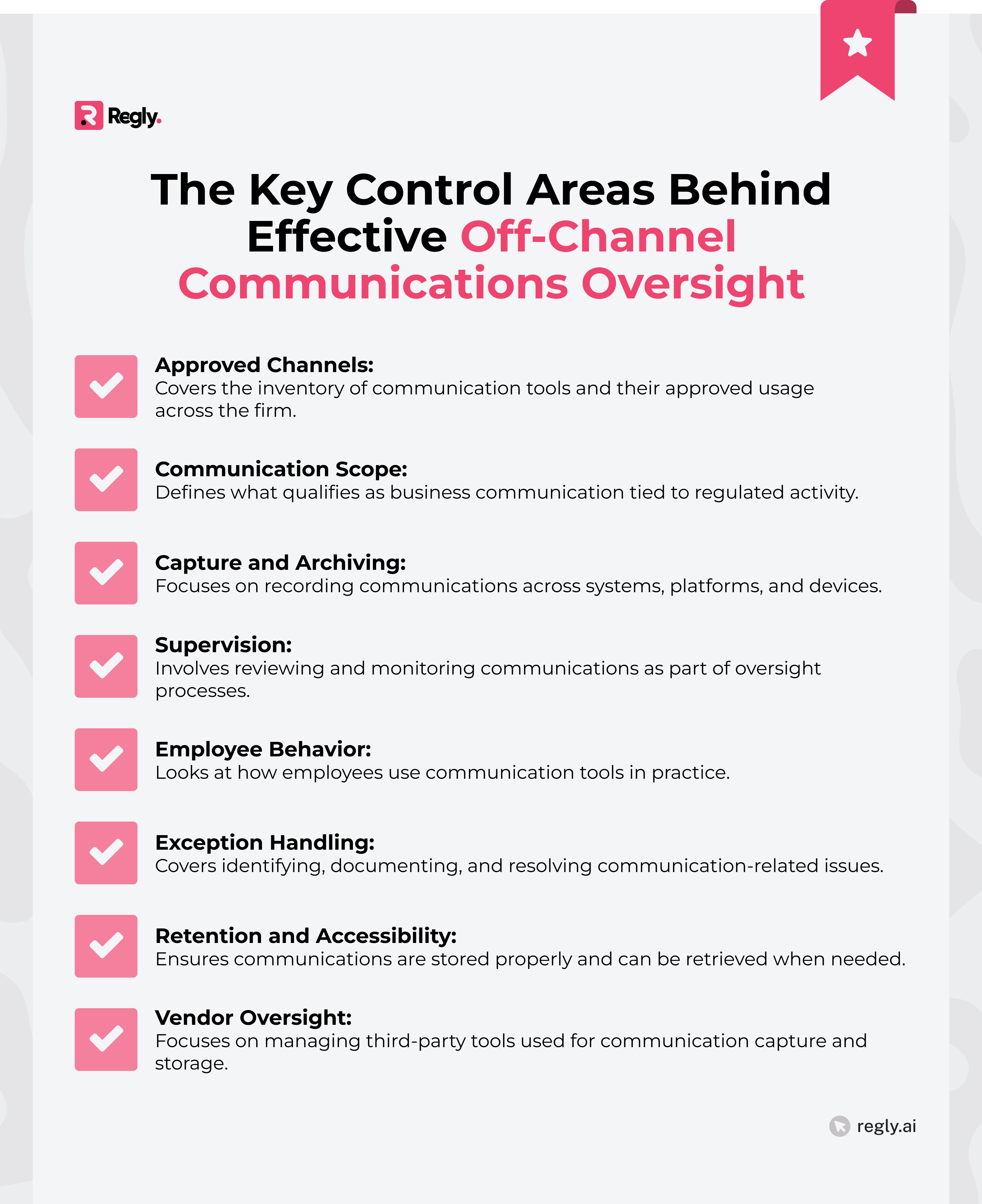
1. Approved vs. Unapproved Communication Channels
Firms need a clearly defined set of approved communication tools that line up with their compliance framework.
That usually means email systems, messaging platforms, and the collaboration tools people use for business. The hard part isn't naming those tools; it's keeping an accurate, current picture of what's actually in use across the organization. A channel only counts as approved when the firm formally recognizes it, configures it correctly, and brings it under supervision.
In practice, this requires ongoing oversight. New tools are often introduced quickly in fintech environments, especially as teams scale or adopt new workflows. Without a structured approval process, these tools can fall outside capture and retention systems. Maintaining a central record of communication channels, along with clear ownership and usage boundaries, helps firms keep control as their technology stack evolves.
2. Business Communications Scope
Firms are not expected to retain everything, but they do need a clear definition of what counts as business communication. This generally includes messages tied to regulated activity, from client engagement to internal decision-making.
In practice, those messages are spread across different tools and teams. A single workflow may involve multiple systems and participants, making it harder to isolate what falls within scope.
Fintech firms need to map these communication flows carefully. When that mapping is incomplete, important messages tied to business activity may not be captured.
3. Message Capture and Archiving
Once the scope is defined, firms need to capture those communications across all approved channels in a consistent way. Coverage needs to extend across devices and platforms, including mobile usage where relevant.
Partial capture creates the same exposure as no capture at all, because key conversations may still be missing.
This is where technical complexity becomes more visible. Communication tools need to integrate with archiving systems, and those integrations need to be monitored over time. Failures, gaps, or outages can result in missing records if they are not detected and addressed.
4. Supervision and Monitoring
Capturing communications is only half the job. Firms are also expected to review what they capture as part of their supervisory framework. That review should follow a defined structure and match the firm's risk profile. Supervision rests on two things: access to the data and a clear process for working through it.
A lot of times, the gap is in what happens to the data afterward. Messages get archived, but reviews are inconsistent or never documented. Without a structured approach, a firm can't show that supervision is happening in any meaningful way. That's often where regulatory exams put their attention.
5. Employee Usage and Behavior
Even well-designed controls break down if employees do not follow them. Firms need to understand how communication tools are used in everyday work, especially when conversations shift to personal devices or unofficial channels.
These risks are often subtle. They show up in patterns of behavior rather than clear policy violations. Without visibility into those patterns, gaps can go unnoticed.
For fintech companies, this becomes more challenging as teams scale and adopt new tools. Training and oversight need to keep pace with how people actually communicate.
See how Regly’s employee compliance tools help fintechs centralize documentation →
6. Exception Handling and Escalation
Even strong controls have gaps. Employees may use unapproved tools, or systems may fail to capture certain communications. The risk is how the exception is managed.
Firms need a clear approach to identifying and reviewing these situations. That includes documenting the issue, understanding its cause, and deciding on next steps.
When this process is consistent, it shows that the firm is actively managing its controls. That documentation often becomes a key reference point during regulatory reviews.
7. Retention and Accessibility
Captured communications need to be kept for the required period and be available when requested. Regulators expect firms to produce records quickly and in a usable format. Missing or delayed responses can raise concerns, even if the activity itself was appropriate.
Storage alone is not enough. Firms need to be able to locate and retrieve specific communications without difficulty.
This means having systems that support search, retrieval, and clear record tracking. Retention timelines should match regulatory requirements, and access to records should be logged over time.
Learn how Regly Compliance helps companies centralize documentation and provide an audit trail →
8. Vendor and Technology Oversight
Most firms rely on third-party solutions to capture and archive communications. While these tools are necessary, they also introduce additional risk. Vendors become part of the firm’s control environment and need to be actively managed.
This means understanding how tools operate across different channels, verifying that they capture data as expected, and monitoring for outages or gaps. Ongoing oversight is required to confirm that systems continue to function as intended, especially as communication patterns and technologies change.
See how Regly’s vendor management tool helps fintechs track, organize, and assess third-party relationships →
How Off-Channel Risk Shows Up in Fintech Operations
Off-channel communications risk rarely appears as a single, obvious failure. It tends to show up through everyday workflows where speed and convenience take priority over process. In fintech environments, communication often moves faster than controls, which creates gaps over time.
Here are common places where off-channel communications risk builds:
Founder and sales communications: Early-stage teams often rely on direct outreach through texts, messaging apps, or personal email. These conversations may include deal terms, product positioning, or client discussions that fall within regulatory scope.
Product and engineering chats: Internal decisions about features, onboarding flows, or user experience often happen in chat tools. These discussions can have compliance implications, especially when tied to financial products or customer interactions.
Customer support and messaging tools: Support teams frequently use chat-based platforms to interact with users. If these tools are not captured or integrated into recordkeeping systems, key customer communications may be missing.
Bank and partner communications: Fintechs often work closely with banks, vendors, and strategic partners. These conversations may happen across email, messaging apps, or shared platforms, making it harder to maintain consistent records.
Off-channel communications risk is often tied to how the business actually operates, not just how it is structured on paper. For fintechs, this means controls need to account for real communication patterns across teams, not just formal client interactions.
How to Build an Off-Channel Communications Control Framework
Policies are rarely the main issue. The difficulty is matching them to how communication happens across teams and tools. When controls do not reflect real workflows, gaps start to appear.
The following framework breaks down how fintechs can approach off-channel communications in a structured way:
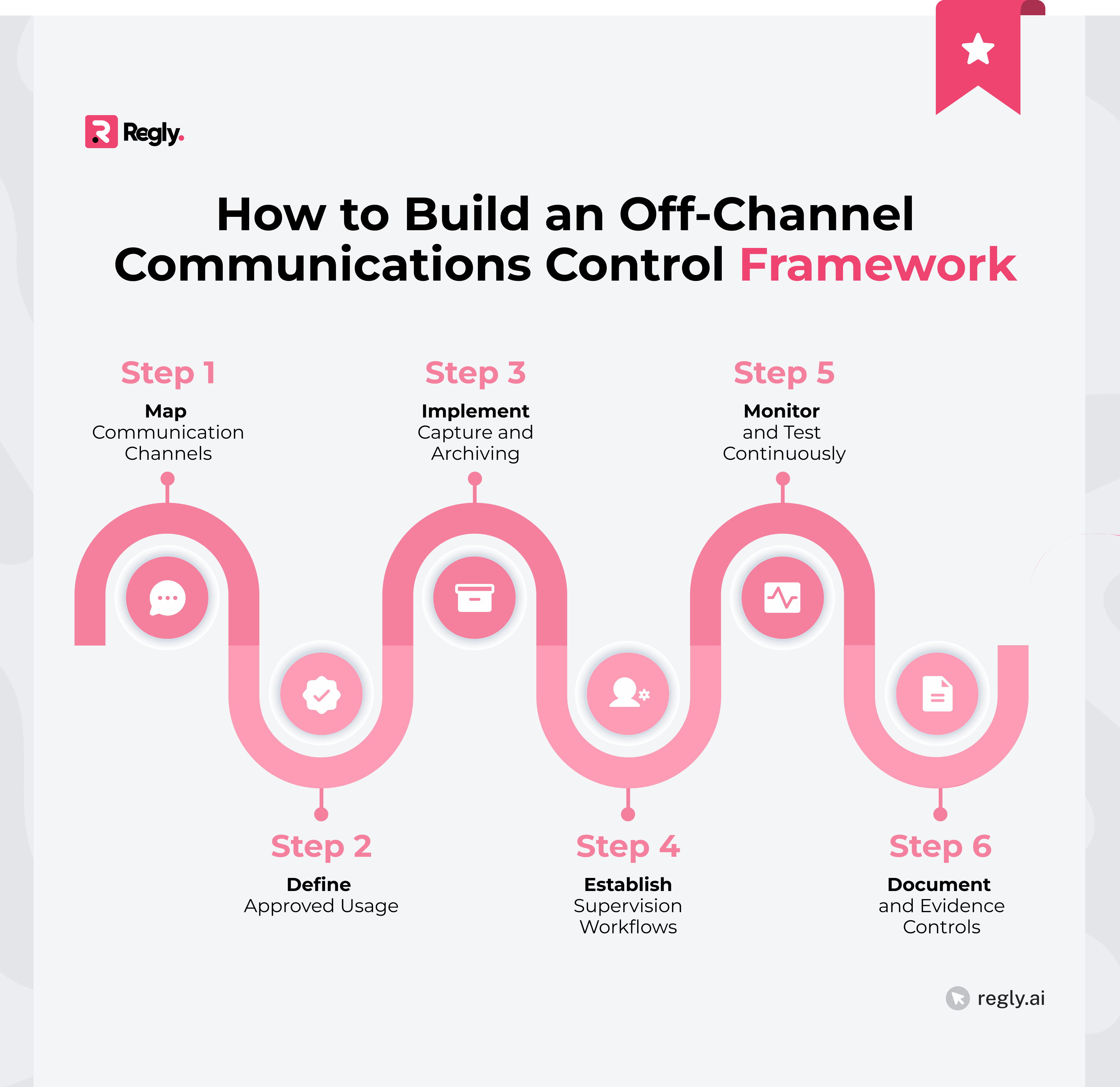
1. Map Communication Channels
The starting point is understanding where communication happens. This includes email, messaging apps, internal chat tools, and any platform used for business activity.
Firms often underestimate how many tools are in use across teams. Sales, product, support, and leadership may all rely on different systems. Without a full channel map, it is difficult to identify where off-channel communications risk exists.
This exercise should capture both approved and unapproved tools, along with who uses them and for what purpose.
2. Define Approved Usage
After mapping communication channels, firms need to define how each one can be used. This means identifying which tools are approved for business communication and the conditions tied to that use.
Approval should depend on whether the tool supports capture, retention, and supervision. If it does not, its use should be limited or clearly defined.
Setting clear boundaries reduces confusion and helps control the use of off-channel communications, especially in fintech environments where new tools are adopted quickly.
3. Implement Capture and Archiving
After defining approved usage, firms need to align capture systems with those channels. Communications tied to business activity should be recorded across all approved platforms and devices.
This often involves integrating email, chat, and messaging tools into archiving systems. It also requires validating that those integrations work as expected over time.
Capture gaps are one of the most common sources of off-channel communications risk. Even small failures can result in missing records.
4. Establish Supervision Workflows
Captured communications need to be reviewed as part of ongoing supervision. This requires a structured process that defines how messages are monitored, who is responsible, and how issues are escalated.
Supervision should reflect the firm’s risk profile and business model. Some areas may require more frequent review based on activity type or exposure.
A defined review process allows firms to demonstrate that supervision is taking place in practice. Without it, archived data has limited value.
5. Monitor and Test Continuously
Controls around communication need to be checked on a regular basis. That means verifying Ongoing validation is part of managing communication risk. Firms need to confirm that capture systems work as intended and that employees are not drifting into unapproved channels.
This often involves reviewing samples of communications, checking system activity, and looking at how tools are used in practice.
The goal is to identify issues early, while they are still manageable.
6. Document and Evidence Controls
Documentation ties the entire framework together. Firms need to maintain records of their policies, channel approvals, supervision activities, and any exceptions that occur.
This documentation is often reviewed during exams or audits. It provides evidence of how the firm manages communication risk in practice.
Well-maintained records help demonstrate that controls are active and that issues are addressed when they arise.
—
Off-channel communications are not a new concept, but the expectations around them have changed. Regulators now look beyond written policies and focus on how firms manage communication in practice. If business conversations are happening outside approved systems, that gap becomes a compliance issue.
For fintechs, the challenge is not limiting communication, but controlling it. Teams will continue to use multiple tools and channels. The focus should be on visibility, supervision, and the ability to produce records when needed.
Firms that approach this as an operational problem, rather than a policy exercise, are better positioned during exams and internal reviews. Off-channel communications risk is ultimately about understanding how the business communicates and building controls around that reality.
Ready to Get Started?
Schedule a demo today and find out how Regly can help your business.