Communications compliance is a core operational issue for fintech firms. Regulators expect firms to supervise, retain, review, and govern business communications across the channels employees and customers actually use, including email, text messages, collaboration tools, social media, mobile apps, and AI-driven systems.
The challenge is that modern fintech communication flows rarely fit neatly into traditional regulatory frameworks, as most companies use multiple communication channels. Customer interactions now happen through apps, text messages, collaboration tools, social platforms, customer support systems, and AI-powered interfaces, often within the same user journey.
For compliance teams, that creates a difficult oversight problem. Rules from regulators such as the SEC, FINRA, CFPB, FTC, FCC, CFTC, and NFA may all apply depending on the firm's activities. In recent years, regulators have paid closer attention to unmonitored communications, weak retention practices, misleading online promotions, and the growing use of automated communication tools.
This article explains what communications compliance means in the fintech industry, which regulations commonly apply, what communications are typically in scope, and where firms often run into problems.
Communications Compliance Explained
Communications compliance refers to the policies, controls, supervision, and recordkeeping processes firms use to manage business-related communications.
In fintech, that includes more than advertising or marketing reviews and covers how firms communicate with customers, prospects, regulators, counterparties, and even internally across regulated business activities.
For many fintech firms, communications compliance sits at the intersection of compliance, operations, marketing, customer support, and technology. A customer onboarding email, chatbot interaction, push notification, social media post, or internal discussion about a customer issue may all become relevant from a regulatory perspective depending on the firm's business model.
Financial firms used to operate through a relatively small group of approved communication channels. That is no longer the case. Teams now communicate across Slack, mobile devices, support platforms, social media tools, internal messaging systems, and AI-powered applications as part of normal business operations.
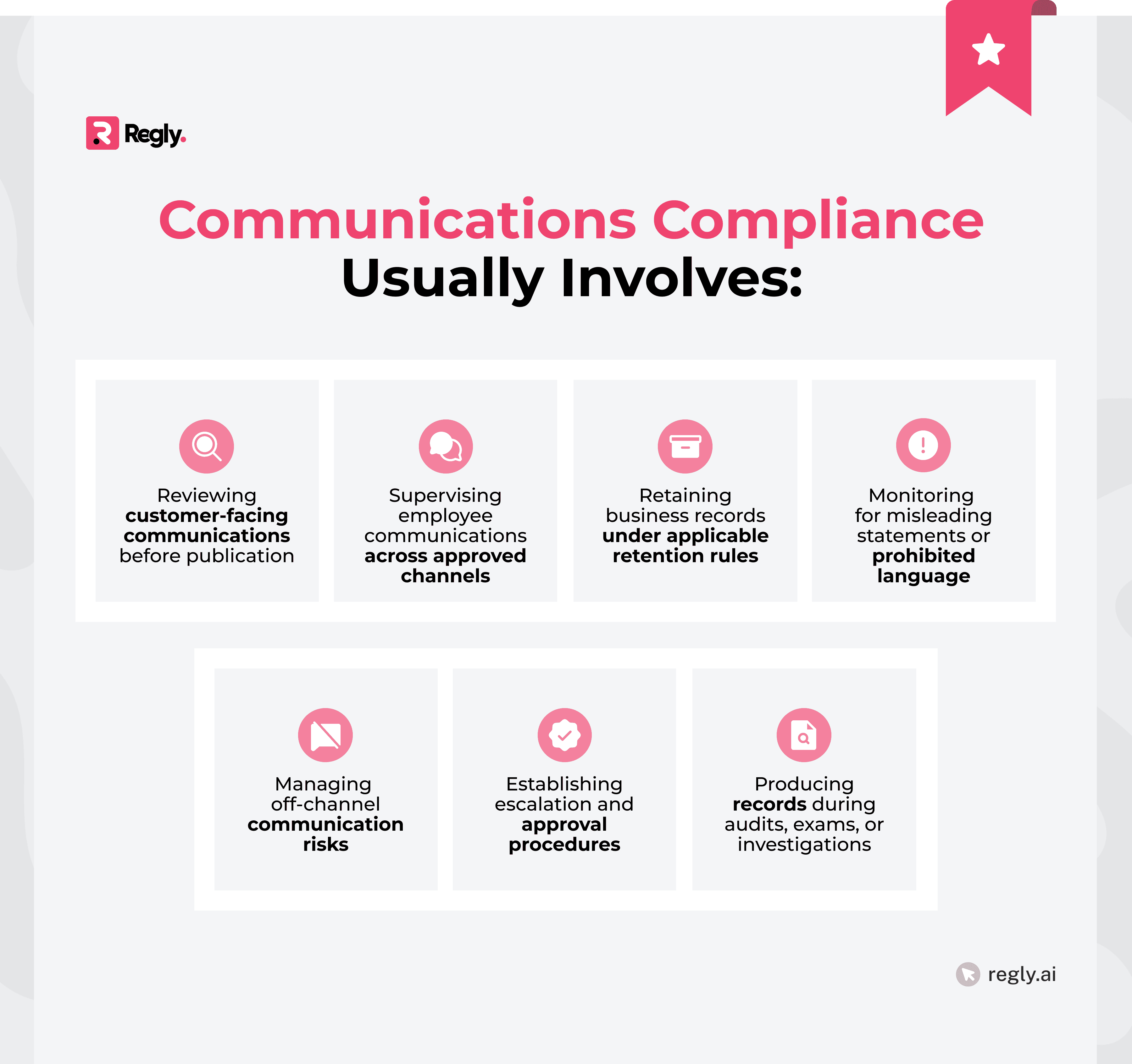
Importantly, communications compliance is not only about what firms say, but also how communications are supervised, retained, reviewed, and retrieved. A communication can create regulatory risk because of misleading content, missing disclosures, inadequate approvals, or a firm's inability to preserve and produce records during an exam or investigation.
For many fintech firms, communications compliance is tied directly to how the business operates day to day. Customer communications may move across different platforms, departments, vendors, and technologies within a single workflow. That can make supervision and recordkeeping harder to manage using traditional compliance approaches.
Requirements can also change depending on the firm's regulatory structure, as similar communications may be treated differently for broker-dealers, RIAs, payments firms, crypto businesses, or bank-partnered fintechs.
What Counts as Communications for Fintech Firms?
In fintech, communications compliance can apply to far more than traditional marketing materials or company email accounts. Regulators may treat customer-facing content, internal business discussions, mobile app messaging, support interactions, social media activity, and AI-generated communications as regulated business communications depending on the firm's activities and regulatory structure.
Customer-Facing vs. Internal Communications
When firms think about communications compliance, they often start with customer-facing content. Marketing campaigns, onboarding emails, website copy, app notifications, social media activity, and support conversations are usually the most visible areas of risk because they directly impact customers and may raise disclosure or consumer protection concerns.
At the same time, internal business communications can also become relevant from a regulatory standpoint. Conversations between employees about transactions, customer issues, product functionality, complaints, or operational decisions may still be subject to supervision and retention requirements.
This distinction is important because firms sometimes assume communications compliance only applies to public-facing content. In practice, regulators often focus on the business purpose of the communication rather than whether the communication was internal or external.
Digital Channels
Most fintech firms no longer communicate through just email and recorded phone calls. Teams now use Slack, Microsoft Teams, text messaging, customer support platforms, social media tools, mobile apps, and other digital systems throughout normal business operations.
That creates a communications compliance issue because regulated conversations can happen almost anywhere. A customer complaint in a support chat, a product discussion over text message, or a mobile app notification may all become relevant from a supervision or recordkeeping standpoint, depending on the firm's activities.
This can create oversight gaps when firms add new communication tools without updating supervisory procedures, retention processes, or approval workflows.
Emerging Formats
Fintech firms increasingly communicate with customers through newer formats that fall outside traditional email and website workflows. That can include AI-generated content, chatbot interactions, influencer promotions, embedded messaging tools, and automated customer engagement systems.
For example, a chatbot response, influencer video, or AI-generated product description may still be treated as a regulated business communication if it relates to financial products or services. That can create risk when firms do not fully supervise how automated systems or third parties communicate with customers.
In practice, many firms do not immediately update supervisory procedures when adopting new communication technologies. As AI tools, automation systems, and influencer-driven marketing become part of daily operations, gaps can emerge between how communications are actually handled and how they are supervised internally.
Communications Compliance vs. Marketing Compliance
Most fintech firms already have some form of a marketing review process. Communications compliance usually involves a larger operational framework that includes supervision, retention, approvals, escalation procedures, and monitoring across different communication channels.
However, a lot of communication risk shows up in ordinary day-to-day activity rather than formal advertising. A support ticket, an internal message about a customer issue, or a conversation tied to onboarding can still become relevant during a regulatory review.
Core Pillars of Communications Compliance
A communications compliance program is typically made up of several operational components working together. The sections below cover the main areas firms usually need to address, from content standards to supervision and recordkeeping.
Content Standards
One of the core parts of communications compliance is reviewing how financial products and services are described to customers. Firms are generally expected to avoid misleading claims and present information with appropriate context around risks, fees, limitations, and product functionality.
This becomes harder in fintech environments where communications move across multiple teams and platforms. Marketing copy, app notifications, customer support responses, and onboarding messages may all shape how customers understand a product.
See how Regly’s marketing compliance software helps fintechs review marketing materials and flags potential risks using AI-powered tools →
Supervision and Approvals
Communications compliance also involves how firms supervise communications before and after they are sent. Depending on the firm's regulatory obligations, certain communications may require formal approval, periodic review, escalation procedures, or ongoing monitoring.
Not every communication is supervised the same way. Firms may apply stricter approval procedures to advertisements and promotional content, while operational conversations are reviewed through monitoring programs, escalation procedures, or targeted sampling.
That oversight can become more complicated when communication activity is spread across several departments and platforms. Marketing, support, operations, and product teams may all use different systems to interact with customers and each other.
Recordkeeping and Retention
Communications compliance eventually becomes a recordkeeping issue. Regulators may expect firms to retain business-related communications and produce them when requested as part of an exam, investigation, or supervisory review.
The challenge for fintech firms is that business communications are often spread across multiple systems and devices rather than stored in one centralized environment. Emails, support chats, collaboration tools, text messages, app-based communications, and third-party platforms may all become part of the firm's recordkeeping obligations depending on the business activity involved.
In recent years, regulators have focused heavily on firms that failed to preserve communications taking place outside approved systems. Personal devices, disappearing messages, and unmonitored communication tools have all become recurring enforcement themes.
See how Regly Compliance helps fintechs by centralizing records and enabling them to produce audit trails →
Monitoring and Surveillance
Communications compliance also involves ongoing monitoring of business communications after they occur.
Firms may review communications to identify potential issues involving customer complaints, misleading statements, unapproved language, conduct concerns, or activity taking place outside approved channels.
For fintech companies, visibility can become harder to maintain as more communication channels are introduced. Customer interactions may happen through several systems and departments within the same workflow.
Retrieval and Audit Readiness
Firms are not only expected to keep records. They may also need to demonstrate that records can be retrieved, reviewed, and produced during an exam or investigation.
That process becomes more complicated when communication activity happens across several platforms at once. Internal discussions, customer interactions, support records, and approval history may all exist in separate systems.
For fintech firms, retrieval problems often surface when communication workflow changes outpace documentation and retention practices.
Key Regulations Driving Communications Compliance
Communications compliance requirements can come from several regulators at once. Which rules apply usually depends on the firm's products, services, and regulatory structure.
The sections below cover some of the main regulatory frameworks that commonly affect fintech communications.
SEC and FINRA Rules
Broker-dealers operate under some of the most detailed communications compliance requirements in the financial industry. SEC and FINRA rules govern how firms supervise, retain, review, and distribute communications tied to securities-related business activity.
FINRA Rule 2210 is one of the main rules covering broker-dealer communications with the public. It requires communications to be fair, balanced, and not misleading. Depending on the type of communication involved, firms may also need to follow approval, filing, disclosure, and recordkeeping requirements.
Broker-dealers also have to maintain extensive books and records under SEC Rules 17a-3 and 17a-4. A growing number of enforcement cases have involved employees discussing business matters through text messages or apps that were never captured by the firm's retention systems.
See how Regly helps broker-dealers manage advertising reviews, policy enforcement, and supervision →
SEC Marketing Rule and Recordkeeping Requirements
Registered investment advisors also face significant communications compliance obligations, particularly around marketing and investor communications. One of the most important frameworks is the SEC Marketing Rule under Rule 206(4)-1 of the Investment Advisers Act.
The SEC Marketing Rule covers many types of investor-facing communications, including websites, social media content, advertisements, testimonials, endorsements, and performance discussions. RIAs are also expected to keep supporting records tied to marketing statements, disclosures, and related communications.
Many compliance issues arise when firms increase digital marketing activity without updating internal review and documentation procedures. Performance-related content, influencer campaigns, and online advertising can create problems when approvals and supporting records are handled inconsistently.
See how Regly helps RIAs review marketing materials and align with SEC books and records requirements →
CFPB and FTC Marketing Standards
The CFPB and FTC both play major roles in how consumer fintech firms approach communications compliance. Their focus often centers on misleading claims, consumer disclosures, marketing practices, and digital customer interactions.
In practice, this can affect much more than advertisements. Product descriptions inside apps, onboarding messages, customer support conversations, promotional emails, and social media content may all become relevant depending on the firm's activities.
Over the last several years, regulators have paid increasing attention to digital marketing tactics, influencer promotions, AI-generated messaging, and app designs that may steer or confuse consumers.
FCC Requirements for Calls and Texts
Customer communications sent through phone calls and text messages can create additional compliance obligations for fintech firms. The Federal Communications Commission (FCC) rules and the Telephone Consumer Protection Act (TCPA) are commonly relevant when firms use automated outreach tools, promotional text campaigns, or prerecorded messaging systems.
Consent management is often one of the biggest operational challenges. Firms may need to track when customers agreed to receive communications and whether opt-out requests were processed correctly.
As communication programs expand, oversight can become more difficult across marketing platforms, customer databases, and vendor-managed outreach systems.
See how Regly vendor management tool helps fintechs track and evaluate vendor relationships →
CFTC and NFA Rules
Fintech firms involved in derivatives, commodities, forex, or certain crypto-related activities may also face communications compliance obligations under CFTC and NFA rules. These requirements often apply to futures commission merchants, introducing brokers, commodity trading advisors, commodity pool operators, and some digital asset businesses.
Communications tied to trading and investment products are typically expected to present risks and potential rewards in a balanced way. Firms may also need to maintain records of those communications and supervise how they are distributed.
A common issue involves firms promoting high-risk products through digital marketing channels that move faster than compliance review processes. Social media campaigns, affiliate promotions, and online trading communities are frequent examples.
Communications Compliance by Fintech Business Model
Different fintech companies face different communications compliance risks. A broker-dealer, crypto platform, payments company, or RIA may all communicate with customers differently and operate under different rules.
Broker-Dealers
For broker-dealers, communications compliance usually touches several parts of the business at once. Marketing teams, registered representatives, support personnel, and operations staff may all communicate with customers through different systems and platforms.
That creates oversight challenges when firms rely on mobile messaging, collaboration software, social platforms, or other digital communication channels that are harder to supervise consistently.
Our platform, Regly, is designed to help fintechs overcome these challenges. Regly is built by compliance experts who have helped 100+ innovative fintehs and who have years of hands-on experience working on supervisory and compliance programs for broker-dealers.
Investment Advisors
RIAs often manage communications across a wide mix of channels and content formats. Client emails, social media activity, educational materials, podcasts, webinars, newsletters, and website content may all become part of the firm's communications compliance obligations.
One operational challenge for many advisors is that marketing activity now happens continuously across several channels rather than through occasional advertising campaigns. A single employee may publish market commentary on LinkedIn, participate in a podcast, respond to investor questions through email, and contribute to website content within the same week.
Many firms struggle to maintain consistent oversight once content starts moving quickly across websites, social media, podcasts, webinars, and third-party marketing channels.
See how Regly helps RIAs →
Payments and Lending Fintechs
Payment companies and lending fintechs often communicate with customers constantly throughout the customer lifecycle. Product disclosures, onboarding flows, payment notifications, servicing communications, collections activity, customer support interactions, and promotional campaigns may all create communications compliance considerations.
A major challenge in this sector is that many customer communications are embedded directly into apps, automated workflows, and third-party systems rather than handled through traditional communication channels. Product, marketing, operations, and support teams may all influence how information is presented to customers.
In this sector, regulators commonly look at whether customers received clear information about costs, repayment obligations, consent terms, and account functionality. Communications delivered through apps and automated workflows are often part of that review.
Crypto and Digital Asset Firms
Crypto firms often communicate with customers through channels that move much faster than traditional financial marketing. Social media threads, Discord servers, Telegram groups, podcasts, influencer campaigns, and online communities may all become part of the firm's communications environment.
That creates additional compliance pressure when firms discuss token value, staking rewards, yield opportunities, trading activity, or future product functionality. Messages published casually through community channels can still attract regulatory attention.
Many firms also operate across several jurisdictions at once, which can make communication standards harder to manage consistently as rules continue changing across the digital asset sector.
Bank-Partnership and Embedded Finance Models
Communications compliance can become more complicated in embedded finance arrangements because customer interactions are rarely handled by one entity alone. Fintech companies, banks, vendors, and program managers may all participate in how products are marketed and explained to customers.
This can create operational confusion around who reviews communications, who approves disclosures, and which party is responsible for ongoing supervision.
Firms also run into problems when customer messaging changes across apps, onboarding flows, support channels, and marketing campaigns managed by separate teams or external partners.
Communications Compliance Challenges for Fintechs
Communications compliance issues in fintech are often operational as much as regulatory. Below are some of the most common problem areas firms face.
Channel Fragmentation and Rapid Product Iteration
One of the biggest communications compliance challenges for fintech firms is that communication activity rarely happens in one place anymore. Customer interactions may move across apps, support systems, collaboration tools, email platforms, social media, SMS systems, and third-party vendors within a single workflow.
At the same time, fintech products and customer experiences often change quickly. New onboarding flows, marketing campaigns, support tools, product features, or communication channels may be introduced before supervisory procedures and retention processes are updated internally.
That combination can create visibility gaps where firms lose track of how customer communications are being reviewed, retained, monitored, or approved across the organization.
Marketing vs. Compliance Tension
In many fintech firms, marketing and compliance teams work at very different speeds. Marketing may want to launch campaigns quickly, test messaging, and react to customer behavior in real time, while compliance teams are expected to review disclosures, approvals, and regulatory risk before content goes live.
That gap can create problems when communication output increases across social media, onboarding flows, app notifications, paid advertising, and customer emails.
Some firms eventually run into issues because communication reviews happen too late in the process or only after campaigns are already moving publicly.
AI-Generated Communications and Automation Risks
More fintech firms are relying on AI-driven systems to help create and deliver customer communications. That can include chatbot responses, marketing copy, onboarding materials, support messaging, and automated app communications.
One challenge is that AI-generated content can change quickly and at scale. Messaging may be modified dynamically across different customer interactions, sometimes without the same review and approval processes used for traditional communications.
Firms may also struggle to document how automated communications were generated, reviewed, updated, or supervised over time. That can create communications compliance issues when regulators ask firms to explain how customer-facing content was monitored or approved.
Cross-Border and Multi-Regulator Complexity
Many fintech platforms support several regulated activities at once. A customer communication tied to lending, investing, banking, or crypto services may fall under different rules depending on the product and jurisdiction involved.
The situation becomes more complicated when one platform combines several financial services. Investing, payments, lending, banking, and crypto features may all share the same customer interface while falling under different regulatory expectations.
As firms expand internationally, communications compliance can become harder to manage consistently across legal teams, business units, vendors, and localized customer experiences.
Off-Channel Communications
Off-channel communications have become one of the biggest enforcement themes across financial services in recent years. Regulators have brought numerous actions involving employees conducting business conversations through personal phones, messaging apps, and communication tools that were not captured by the firm's retention systems.
For fintech firms, the issue is often tied to how employees actually work day to day. Teams may communicate through text messages, WhatsApp, Slack, Telegram, Signal, or personal devices because those tools are faster and more convenient operationally.
Problems usually appear when firms approve certain communication channels formally, but employees continue using unmonitored systems for customer interactions or business discussions related to regulated activity.
Learn more about off-channel communications →
Tools and Technology Supporting Communications Compliance
Most fintech firms rely on a combination of policies, workflows, and technology to manage communications compliance across different teams and communication channels.
The sections below cover some of the common systems and tools firms use to support supervision, retention, monitoring, approvals, and audit readiness.
Archiving and Recordkeeping Systems
Archiving and recordkeeping systems are often one of the foundational parts of a communications compliance program. Firms may use these systems to retain emails, chat messages, mobile communications, support records, approvals, and other business-related communications across different platforms.
The challenge for many fintech firms is that communication activity is rarely centralized. Customer and employee communications may move across collaboration tools, CRM systems, support platforms, social media channels, cloud applications, and mobile devices throughout normal operations.
As communication environments expand, firms often need recordkeeping systems that can capture communications consistently across several technologies while still allowing records to be retrieved during audits, exams, or investigations.
Monitoring and Surveillance Tools
Firms often use surveillance tools to review business communications after they have been sent or received. These systems may be used to flag customer complaints, policy violations, risky language, or activity taking place outside approved communication channels.
Some firms still rely heavily on manual reviews, while others monitor communications through automated systems connected to email platforms, chat tools, support systems, or archived records.
As communication activity spreads across more platforms, firms often face operational challenges around visibility, alert fatigue, inconsistent escalation procedures, and reviewing large volumes of communication data efficiently.
Workflow and Approval Systems
Many fintech firms rely on internal workflows to manage communication reviews before content reaches customers or the public. Approval systems are often used for advertisements, onboarding materials, disclosures, customer communications, policy updates, and escalation tracking.
Communication reviews also tend to involve several departments at once. Compliance, marketing, legal, product, and operations teams may all participate in editing, reviewing, commenting on, or approving the same communication.
Without structured approval processes, firms may struggle to maintain visibility into which communications were reviewed, who approved them, and whether changes were made after approval.
Use of AI
AI is increasingly being used to support communications compliance workflows across fintech firms. Some companies use AI tools to review marketing materials, identify risky language, flag potential disclosure issues, monitor communications, or organize large volumes of communication data.
At the same time, AI introduces additional supervision and governance questions. Firms may need to evaluate how automated systems are trained, how outputs are reviewed, how changes are documented, and whether employees rely too heavily on automated decision-making.
Many firms are still determining how AI fits into existing compliance frameworks, especially as regulators continue to increase focus on automated communications, digital marketing practices, and AI-related governance controls.
Regly Compliance
Regly was built specifically for regulated fintech companies that need practical ways to manage compliance across fast-moving operational environments. The platform was designed by compliance experts from InnReg with direct experience supporting 100-plus broker-dealers, RIAs, payments firms, crypto companies, and other regulated fintech businesses.
Instead of treating communications compliance as a separate process, Regly helps firms integrate reviews, documentation, and recordkeeping into day-to-day operations. Teams can manage workflows, track reviews, centralize records, and identify potential communication risks across different business functions and communication channels.
Because Regly grew out of real-world compliance operations, it speaks to the operational challenges fintech firms commonly face as communications scale across products, teams, vendors, and digital systems.
—
Modern fintech companies communicate with customers constantly across several platforms, products, and technologies at once. That reality has changed how firms approach communications compliance.
Regulators now expect firms to supervise, retain, review, and monitor communications across much broader communication environments than traditional email and phone systems alone. Messaging apps, AI-generated content, social platforms, support tools, and embedded communications may all become part of the compliance landscape depending on the firm's business model.
As communication activity continues expanding, many fintech firms are rethinking how compliance workflows, technology systems, and operational oversight fit together across the organization.
Ready to Get Started?
Schedule a demo today and find out how Regly can help your business.