Digital communications sit at the center of how broker-dealers communicate today. From emails and text messages to in-app prompts and chatbot interactions, most client touchpoints now happen through digital channels.
For compliance teams, that creates a layered challenge: the same message can trigger recordkeeping, supervision, and advertising obligations at the same time.
Regulators have been clear that the format or device does not change the obligation. If a communication relates to the firm’s business, it must be captured, reviewed, and, when applicable, presented in a fair and balanced way. As firms adopt new tools and build digital-first products, the gap between how teams communicate and how rules are applied becomes more visible.
This article breaks down how digital communications are defined in a broker-dealer context, the rules that apply, and the common issues regulators continue to flag. It also looks at how these requirements play out in modern fintech environments, where communication is often embedded directly into the product experience.
What Are Digital Communications in Broker-Dealers?
In a broker-dealer setting, digital communications refer to any electronic message related to the firm’s securities business, regardless of the channel used.
Regulators focus on content: if the communication relates to “business as such,” it is subject to recordkeeping and supervision requirements. This means that if a message involves client interaction, investment discussion, marketing, or operational instructions, it may fall within regulatory scope.
For traditional firms, communications were easier to map, as mail and phone calls covered most interactions. On the other hand, fintech platforms often embed communication directly into the product. Users receive alerts, prompts, recommendations, and confirmations in real time.
This creates overlap across compliance areas. For example, a push notification can be classified as marketing content, a chatbot response can be client communication, and an in-app message can become part of the firm’s books and records.
The challenge lies in the classification and control. Fintechs need to understand how each type of digital communication fits into regulatory categories and how it will be captured, reviewed, and retained.
Types of Digital Communications Firms Must Manage
Digital communications in broker-dealers span a wide range of channels. Some are obvious. Others are embedded in workflows or product features and are often overlooked.
Typical digital communication channels fintechs must account for include:
Email and internal messaging: Still the baseline for most firms. Includes external client emails and internal communications tied to securities activity.
Text messages and mobile communications: SMS, iMessage, WhatsApp, and similar tools. These are a major focus area in enforcement due to off-channel usage.
Collaboration tools: Slack, Teams, and similar tools are widely used in fintech environments. Often contains both operational and client-related discussions.
Social media and public platforms: LinkedIn, X, Reddit, and similar platforms. Includes posts, comments, direct messages, and shared content.
Mobile apps, push notifications, and in-app messaging: Core to many fintech products. These communications often combine UX design with marketing and disclosures.
Chatbots, AI tools, and automated communications: Include scripted chat flows and AI-generated responses. Increasingly used for support, onboarding, and engagement.
Video, voice, and meeting recordings: Zoom calls, recorded demos, voice messages, and webinars. These may need to be retained depending on the content.
Each channel carries its own compliance demands. Some messages have to be reviewed before they go out; others get monitored after the fact. A few formats are easy to archive, and the rest bring technical headaches.
Problems usually appear where usage outpaces oversight. Firms often have controls in place for email and social media, but newer channels like collaboration tools, mobile apps, or AI-driven interactions are not always covered the same way.
Why Digital Communications Are a Regulatory Focus
Digital communications play a central role in how regulators assess conduct, supervision, and investor protection. Moving these interactions to digital channels does not change the rules, but it does make oversight more complex and harder to manage.
Investor Protection and Market Integrity
At a basic level, regulators focus on how firms communicate with clients. Messages must be fair, balanced, and not misleading. This applies whether the communication is a formal email or a short in-app notification.
Digital channels make it easier to distribute content quickly and broadly. That increases the risk of incomplete disclosures, exaggerated claims, or inconsistent messaging.
Even small pieces of content, such as a push notification or social media post, can be treated as investor-facing communication.
Transparency and Auditability
Regulators expect firms to maintain a clear record of business communications. This supports oversight, dispute resolution, and enforcement when needed.
Digital communications create challenges here: messages are spread across multiple platforms, devices, and formats. Some are structured. Others are informal or short-lived. If a firm cannot produce complete and accurate records, it creates a visibility problem during exams or investigations.
Role in Exams, Investigations, and Enforcement
Digital communications are often one of the first areas reviewed during regulatory exams. They provide direct evidence of how a firm operates in practice.
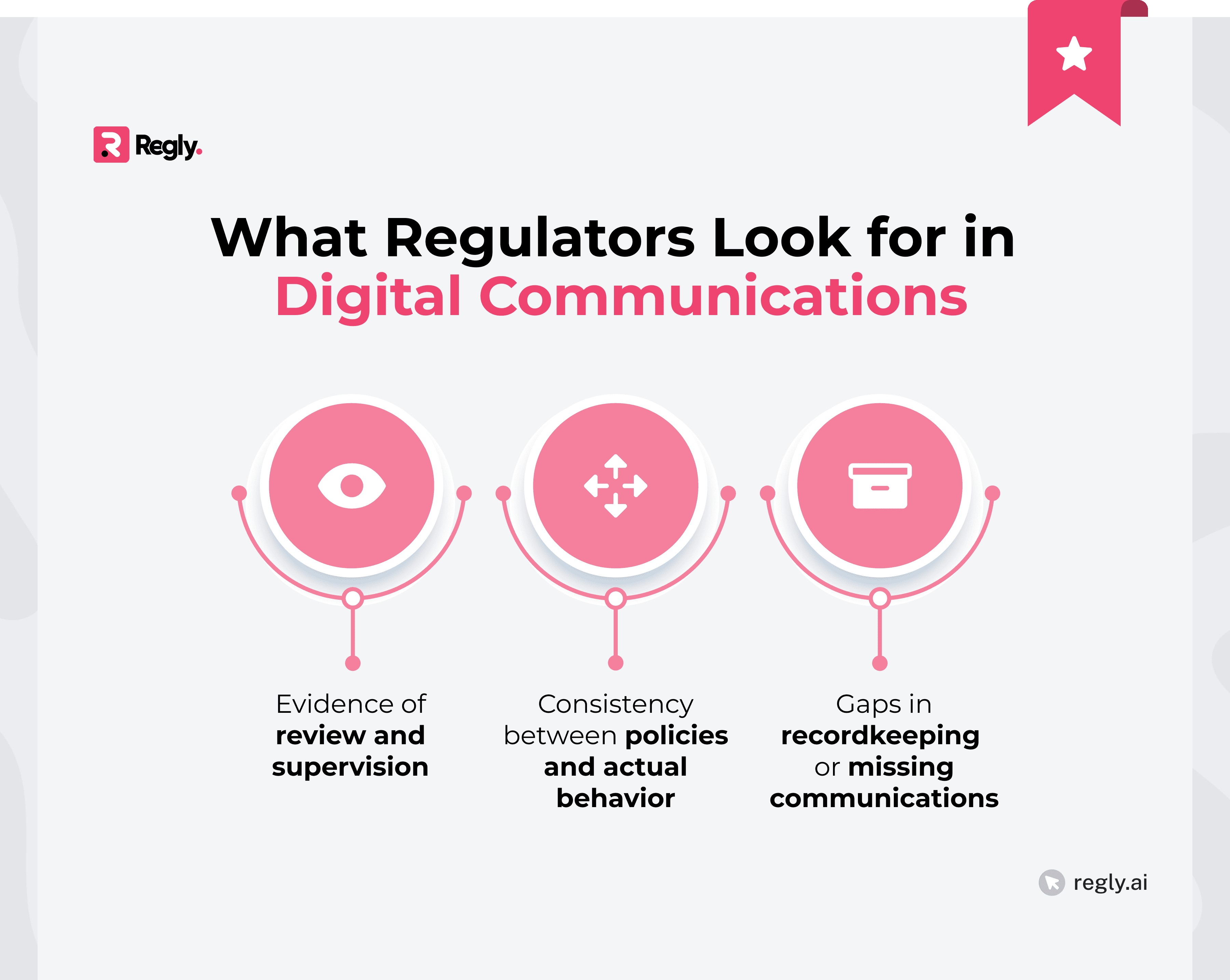
Many enforcement actions in recent years have centered on failures to retain or supervise electronic communications. These cases are not limited to large firms. They apply across the industry.
How Digital-First Fintech Models Increase Exposure
Fintech platforms rely heavily on digital communications as part of the product itself. Messaging is built directly into onboarding flows, trading experiences, and client engagement features.
This creates a layered risk profile. Product design decisions can trigger compliance obligations without always being recognized as such. Communications are often automated or delivered at scale, which increases exposure if something is misclassified or incomplete. At the same time, new features can introduce channels that existing policies were not designed to cover.
The more communication gets embedded into the product, the harder it is to separate technology from compliance. This is where a lot of firms need to step back and reassess how they map communications, controls, and responsibilities across teams.
Core Rules Governing Digital Communications
Digital communications in broker-dealers are governed by a combination of SEC and FINRA rules. These rules were not written specifically for modern fintech channels, but they still apply based on the content and purpose of the communication.
Most requirements fall into three core areas: recordkeeping, supervision, and communications with the public.
Books and Records Requirements (SEC Rules 17a-3 and 17a-4)
SEC Rules 17a-3 and 17a-4 form the foundation of recordkeeping obligations. They require broker-dealers to create and retain records of business-related communications.
The scope is broad. If a message relates to the firm’s securities business, it may need to be retained. This includes emails, texts, chat messages, and other forms of digital communication.
Retention is driven by content, not the channel. A message sent through a personal device or third-party app does not fall outside the rules simply because of how it was sent.
Below is a simplified view of how recordkeeping expectations apply:
Area | What It Means in Practice |
|---|---|
Scope | Business-related communications must be captured |
Format | Electronic records must be stored in compliant formats |
Access | Records must be retrievable for exams and investigations |
Controls | Firms must have systems in place to preserve integrity |
Recent updates allow firms to use different technical approaches for storage, including audit trail-based systems, as long as records can be reconstructed and verified.
See how Regly Compliance helps fintech centralize audit trails →
Supervision Requirements (FINRA Rule 3110)
Under FINRA Rule 3110, firms are expected to implement a supervisory system that covers their business communications. This involves establishing procedures, assigning responsibility to supervisors, and putting in place processes to review electronic communications.
The rule allows for different approaches, but the expectation is that supervision reflects how the firm actually operates. That typically involves deciding which communications require review before they are sent and which are reviewed afterward, applying monitoring techniques such as targeted searches or sampling, and keeping records that document supervisory activity.
One of the more common gaps is the assumption that supervision is happening when it is not. Reviewing a communication requires more than opening it. Firms need to demonstrate that the process is active, deliberate, and aligned with risk.
Communications With the Public (FINRA Rule 2210)
FINRA Rule 2210 governs how firms communicate with investors and the public. It applies to many forms of digital communications, including websites, social media, and app-based messaging.
The rule comes down to standards. Communications have to be fair, balanced, and not misleading. Disclosures have to be clear and presented appropriately.
Digital formats don't change that standard, but they do shape how it gets applied. Short-form content, interactive features, and embedded messaging can all make it harder to present complete information.
Communications fall into different types: correspondence, retail, and institutional. How a message gets classified directly affects how it needs to be reviewed and supervised.
Learn more about FINRA Rule 2210 →
Other Relevant Frameworks
Depending on the business model, additional frameworks may apply. Municipal securities activities fall under MSRB rules. State regulators may impose their own expectations, particularly for firms operating across jurisdictions.
Firms also lean on regulatory guidance and exam reports to interpret how the rules apply to newer communication methods. Those materials tend to highlight where regulators are focusing their attention.
For fintech firms, the challenge is not identifying a single rule. It’s understanding how multiple frameworks apply at the same time. Digital communications often sit at the intersection of these requirements, which is why alignment across compliance, legal, and product teams matters.
How Regulators Classify Digital Communications
Regulators do not treat all digital communications the same way. How a message is classified affects how it must be reviewed, supervised, and retained. Classification is about who receives the communication and how widely it is distributed.
Correspondence vs. Retail Communications vs. Institutional Communications
FINRA sorts communications into three main categories: correspondence, retail communications, and institutional communications. The line between them comes down to the size and type of the audience.
Correspondence generally means messages sent to a limited number of retail investors. Retail communications go out to a broader retail audience. Institutional communications go only to institutional investors.
Category | Audience | Typical Use Case | Key Consideration |
|---|---|---|---|
Correspondence | Limited number of retail investors | Direct emails, one-to-one or small group messages | Subject to supervision, typically post-use review |
Retail Communications | Broad retail audience (more than 25 retail investors within a 30-day period) | Website content, social media posts, marketing campaigns | Higher scrutiny may require pre-use review |
Institutional Communications | Institutional investors only | Market commentary, research, communications with funds or banks | Subject to supervision and recordkeeping, limited distribution to institutional investors only |
What Counts as “Business as Such”
A central concept in digital communications compliance is whether a message relates to the firm’s “business as such.” This phrase comes from SEC recordkeeping rules and is intentionally broad.
In practice, it covers any communication connected to the firm’s securities activities. That can include client discussions, trade-related instructions, marketing content, and even operational coordination tied to transactions.
The challenge is that the definition is not precise, which leaves room for interpretation. Firms need to establish internal guidelines that reflect their business model and risk profile.
This becomes more complex in fintech environments, where communication is often embedded in product features. A short message or system-generated prompt may still fall within scope if it influences client behavior or relates to a transaction.
When Internal Messages Become Regulated Communications
Not all internal communications are regulated the same way, but plenty still fall under supervisory and recordkeeping requirements.
Internal messages tied to client activity, trading decisions, or securities-related business operations can come under oversight. A message never meant for clients may still need to be retained and reviewed.
The key factor is relevance to the firm’s regulated activities, not the intended audience. This is where firms often underestimate exposure, especially when teams rely heavily on collaboration tools or informal messaging.
For fintech firms, this line is easy to cross. Product, engineering, and compliance teams often communicate in shared channels where business decisions are discussed in real time. Without clear boundaries and controls, these communications can fall into regulatory scope without being treated that way.
Recordkeeping Requirements for Digital Communications
Recordkeeping is at the center of digital communications compliance. If a message relates to the firm’s business, it needs to be captured, stored, and available if the firm has to produce it later.
That obligation is not tied to one specific tool or platform. It follows the business communication wherever it happens.
What Must be Retained
Recordkeeping requirements are broad. Firms are generally expected to retain communications connected to securities activity, client interactions, and business operations.
This includes obvious channels like email, but also extends to texts, chats, app-based messages, and other digital formats. If the communication reflects business activity, it is likely within scope, even if it takes place on a personal device or third-party platform.
The challenge often lies in accounting for all of them in practice.
Retention Timelines and Formats
Regulations define how long records must be retained and how they should be stored. Retention periods vary depending on the type of record, but the expectation is that firms can access and reproduce communications when requested.
Storage format also matters. Records must be preserved in a way that protects their integrity and prevents unauthorized changes. At the same time, they must remain accessible for regulators during exams or investigations.
This creates a balancing act between security and usability. Systems must protect data without making retrieval impractical.
WORM vs. Audit Trail Models
Historically, firms relied on WORM storage, which prevents records from being altered or deleted. This model is still used, but it is no longer the only option.
Regulatory updates now allow for audit trail-based systems, provided firms can reconstruct records and demonstrate a complete history of changes. This gives firms more flexibility in how they design their storage architecture, especially when working with modern cloud systems.
The decision between these models is not purely technical. It affects vendor selection, system design, and how firms demonstrate compliance during reviews.
See how Regly Compliance helps fintechs centralize audit trails →
Challenges With Modern Communication Tools
Modern communication tools were not built with compliance as the primary goal. Many prioritize speed, collaboration, or user experience over retention and supervision.
This creates gaps. Some tools do not support archiving in a compliant format. Others introduce features like encryption or disappearing messages that complicate capture.
The main risk is in the lack of alignment between those tools and the firm’s recordkeeping obligations. Firms need to evaluate whether each channel can be captured, retained, and produced before allowing it to be used for business purposes.
This is where a structured approach becomes important. Mapping communication channels to recordkeeping controls, testing retrieval processes, and validating vendor capabilities are all part of building a defensible setup.
Supervising Digital Communications in Practice
Supervision is where policy meets reality. It is not enough to define what digital communications are or where they occur. Firms need a clear process for reviewing them, as regulators expect supervision to reflect actual communication patterns.
Pre-Use vs. Post-Use Review
Not all digital communications are reviewed in the same way. Some require approval before they are sent, while others are reviewed after the fact.
Pre-use review is typically applied to retail communications, which is higher-risk content, including marketing materials or broadly distributed communications. Post-use review is typical for correspondence, i.e., 25 or fewer recipients, common for day-to-day interactions, where volume makes pre-approval impractical.
The key is aligning review type with risk, not convenience. If high-impact communications bypass pre-review, or if large volumes go unmonitored, supervision gaps tend to emerge.
Risk-Based Surveillance Models
Most firms rely on risk-based surveillance to manage digital communications at scale. This approach focuses resources on higher-risk areas instead of reviewing every message equally.
Risk factors often include the type of communication, the role of the employee, the product involved, and the communication channel. A trading-related message may carry more weight than an operational update. A public-facing post may require more scrutiny than an internal note.
This model only works when it reflects real usage. Surveillance rules that haven’t changed as communication channels evolve develop blind spots.
Keyword Monitoring and Sampling
Monitoring tools are widely used to scan digital communications and flag items that may need closer attention. Common approaches include keyword-based searches, pattern recognition, and selective sampling.
These methods can be useful, but they are not perfect. Keywords can miss meaning, and sampling may not reflect the full picture. The real value comes from how firms design and refine these systems over time, not simply from having them in place.
Documentation and Evidence of Supervision
Supervision is not just about performing reviews. It is also about demonstrating that those reviews took place and were meaningful.
Regulators look for clear records showing what was reviewed, who performed the review, when it occurred, and what actions were taken. Without that documentation, even a well-designed process can appear incomplete.
This is where a lot of firms struggle. The reviews may happen, but they don't get recorded consistently or tied back to follow-up actions. Over time, that opens a gap between the supervision actually taking place and what the firm can show during an exam.
See how Regly’s employee compliance tools help fintechs track forms and attestations →
Off-Channel Communications and Personal Devices
Off-channel communication typically refers to business-related messages sent through tools that are not monitored or archived by the firm. This often includes personal texting, messaging apps, or direct messages on social platforms.
The classification depends on usage, not intent. A casual message can still fall within scope if it relates to the firm’s business. If it cannot be retained and reviewed, it creates a compliance gap regardless of how informal it appears.
This is why regulators focus heavily on behavior rather than just written policy.
BYOD Risks and Employee Behavior
Bring-your-own-device (BYOD) setups introduce additional challenges. Employees tend to use personal phones or apps because they are faster and easier, particularly in fintech environments where speed matters.
This creates risk when business conversations happen outside firm-controlled systems. Those messages may not be captured, retained, or reviewed.
Many firms try to manage this by restricting certain apps, but behavior often adapts. Without a clear view into how teams actually communicate, policies can fall out of sync with reality.
Detection and Escalation Expectations
Regulators expect more than a policy that says, “Do not use off-channel communications.” Firms need a practical way to spot possible off-channel activity and respond when it happens.
This can involve reviewing communication patterns, identifying inconsistencies between channels, or investigating red flags that surface through supervision. The goal is not to eliminate all risk, but to show that the firm can identify and address issues when they arise.
A written prohibition without enforcement is not viewed as sufficient. Firms need to demonstrate that controls are active and that exceptions are handled in a structured way.
For fintech firms, this often requires coordination across compliance, IT, and product teams. Off-channel risk is rarely isolated to one function. It sits at the intersection of technology, behavior, and supervision.
Learn more about off-channel communications →
Digital Communications in Fintech Products
Digital communications are often built directly into fintech products. They are not separate from the user experience. In many cases, the product itself becomes the communication channel. This changes how firms need to think about compliance.
Mobile App UX and Disclosures
User interfaces often include messages that shape user decisions. These may appear as prompts, confirmations, or alerts during onboarding and trading.
Even when framed as part of the product experience, these messages can carry regulatory implications. If they influence investor behavior or present product-related information, they may be treated as communications with the public.
This is where product and compliance intersect. Design choices made to improve usability or engagement can also trigger regulatory requirements. As discussed in product compliance, how a feature functions, not how it is labeled, determines how it is regulated.
Learn more about product compliance →
Push Notifications and Behavioral Nudges
Push notifications are built for quick interaction. They show up instantly and are often tied to what a user is doing in the app.
That same speed can create issues. A message about market movement or a prompt to take action can start to look like marketing or investment guidance.
Even when the message is short, it still counts. When it goes out to a large group, regulators may look at how it was phrased, when it was sent, and how often it appears.
Embedded Communications in Trading Flows
Many fintech platforms include messaging within trading workflows. This can include confirmations, warnings, or contextual information shown before or after a transaction.
These communications often sit close to decision points. That increases their importance from a regulatory perspective.
When communication is tied directly to a transaction, it may be viewed as part of the firm’s interaction with the investor, not just a system message. This distinction can affect both supervision and recordkeeping.
Chatbots and AI-Generated Interactions
Chatbots and AI tools are increasingly used for customer support and onboarding. Some platforms also use them to answer product-related questions or provide guidance.
These interactions can be dynamic and personalized, which introduces complexity. Responses may vary based on user input, making them harder to standardize and supervise.
Firms need to consider how these systems are trained, what data they rely on, and how outputs are monitored. AI-generated communications still fall under the same regulatory expectations as human-generated ones.
Common Compliance Failures in Digital Communications
Most issues in digital communications compliance are built over time, usually from gaps between policy, technology, and actual behavior. Firms often have controls in place, but those controls do not fully match how communication happens in practice.
Below are some of the most common failure points regulators continue to identify:
Inconsistent policies vs. actual behavior: Policies often describe an ideal process, while employees operate in a more practical, informal way. When there is a gap between what the procedure says and what teams actually do, that disconnect can become difficult to explain during an exam.
Missing or incomplete recordkeeping: Communications take place on channels that are not captured or retained. This is especially common with newer tools or personal device usage.
Gaps in supervision and review: Processes may be in place, but they are not always followed in the same way across the firm. Some higher-risk communications slip through, and monitoring setups may not reflect how teams actually communicate.
Misaligned vendor solutions: Many firms use external vendors for recordkeeping or surveillance without taking a close look at whether the setup actually satisfies regulatory requirements.
Inconsistent policies vs. actual behavior: Policies often describe an ideal process, while employees operate in a more practical, informal way. When there’s a gap between what the procedure says and what teams actually do, that disconnect can become difficult to explain during an exam.
Failure to capture new communication channels: New tools are adopted by product or engineering teams without being incorporated into compliance frameworks.
These issues rarely appear in isolation. They are usually tied to growth, product changes, or shifts in how teams communicate.
—
Digital communications are part of how broker-dealers operate, interact with clients, and deliver products. That shift has not changed the rules, but it has made them harder to apply in practice.
The difficulty usually comes from connecting regulatory expectations with how teams actually communicate. Channels multiply, tools change, and behavior shifts over time. When policies, systems, and day-to-day practices are not aligned, gaps start to appear. Those gaps rarely stay hidden for long.
For fintech firms, this means taking a more connected view. Communication should be tracked, reviewed, and retained based on how it’s really used across the business. That often requires revisiting existing setups, adjusting controls as products change, and making sure responsibilities are clearly defined.
Ready to Get Started?
Schedule a demo today and find out how Regly can help your business.