AI Marketing Review Explained: Benefits, Risks, and Limitations
Published on
Sep 1, 2026
23
min read
Conducting an AI marketing review is quickly becoming part of how regulated fintechs manage marketing risk at scale. As companies expand across channels, the volume of content requiring review often outpaces traditional, manual compliance processes, resulting in a growing need for tools that can support faster, more consistent oversight without losing control.
The use cases of artificial intelligence (AI) in marketing reviews include flagging misleading language, detecting missing disclosures, and helping route content through approval workflows. In fintech, where marketing is supervised, strict regulatory expectations shape this process, and activity is subject to examination.
This article explains how an AI marketing review works in a fintech and regulatory context, including the rules that govern it, the benefits it can offer, and its limitations.
What Is an AI Marketing Review?
An AI marketing review uses artificial intelligence to evaluate marketing content for potential compliance risks before publication. In financial services, this sits within the broader advertising and communications review function, where firms are required to assess whether content is fair, balanced, and not misleading.
An AI marketing review provides an early-stage check on marketing content by identifying patterns commonly associated with compliance risk. This includes language that could be interpreted as misleading, claims that may require support, or missing or incomplete disclosures. It supports compliance teams by narrowing the scope of what needs closer review.
In regulated settings, it operates within a broader control framework. An AI marketing review is embedded in the approval process and ties together marketing activity, compliance oversight, and record retention. Each step leaves a trail, which becomes part of the firm’s regulatory evidence.
AI vs. Traditional Marketing Review
A traditional marketing review relies heavily on manual processes. Content is drafted, sent to compliance, reviewed line by line, revised, and approved. This approach works at low volume but becomes difficult to manage as marketing output increases across channels.
AI changes that process. Instead of starting with manual review, AI analyzes the content, flags potential risks, and categorizes issues before a human sees it. The result is a more structured workflow that surfaces higher-risk items.
Here is a simplified comparison:
Area | Traditional Review | AI Marketing Review |
|---|---|---|
Initial review | Manual, line-by-line | Automated first-pass analysis |
Speed | Slower, queue-based | Faster triage and prioritization |
Consistency | Depends on reviewer | Standardized rule application |
Scalability | Limited by team size | Scales with content volume |
Audit trail | Often fragmented | Centralized and structured |
The key difference is not automation alone. It’s the shift from reactive review to risk-based prioritization. AI helps surface issues earlier, but final decisions still sit with compliance.
Where It Fits in the Marketing Approval Lifecycle
An AI marketing review does not replace the existing approval lifecycle but sits within it as an additional control layer.
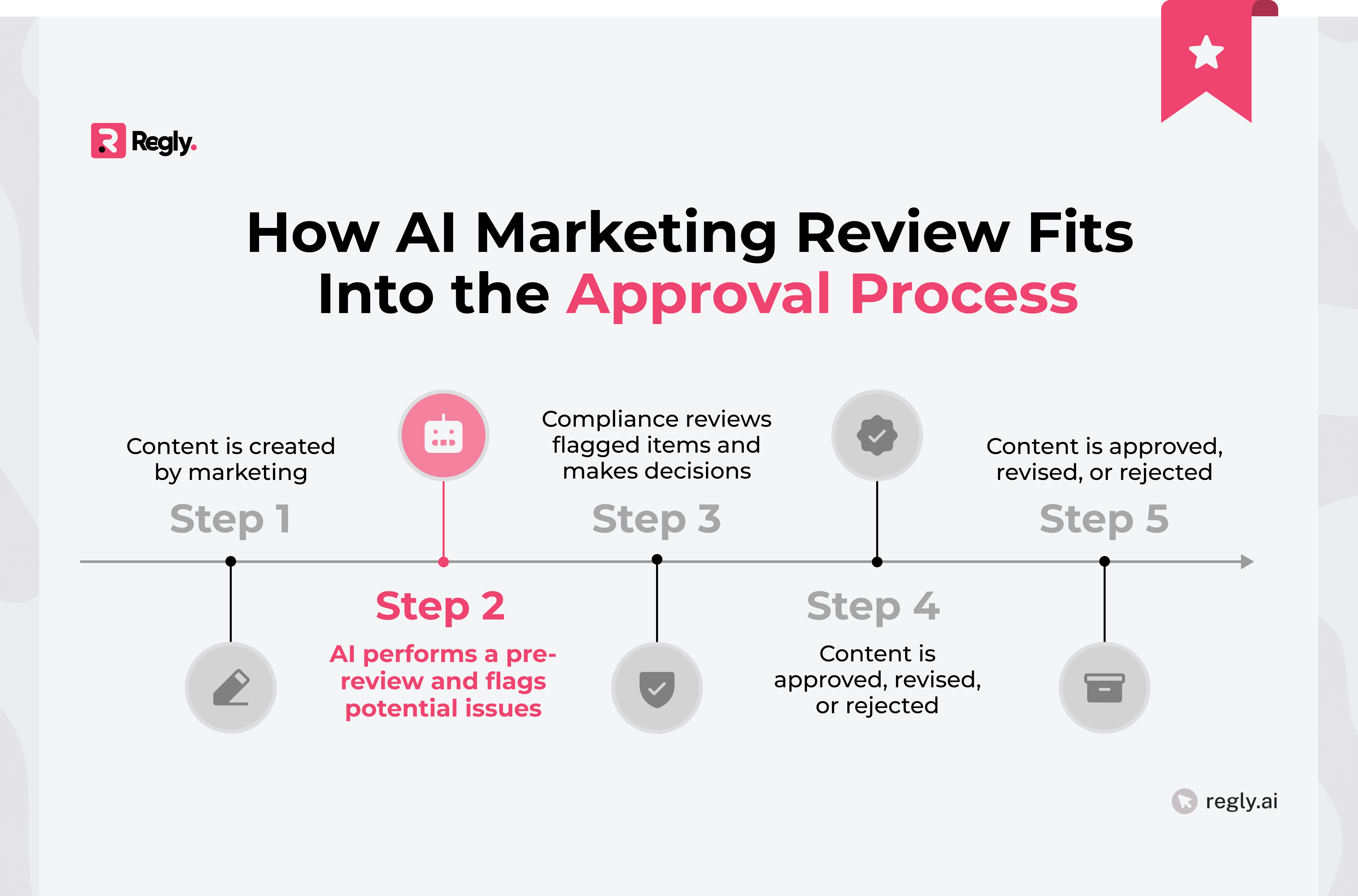
Within this process, an AI marketing review operates before and during human review, not after. It helps reduce the back-and-forth by catching common issues early.
This structure has regulatory implications. A marketing review is part of a firm’s supervisory framework. AI can assist with the process, but firms remain accountable for published content, the review process, and the records that support it.
Why AI Marketing Review Is Growing in Financial Services
The demand for an AI marketing review is tied to how fintech marketing has evolved. Content is no longer limited to websites and email campaigns. It now spans mobile apps, social media, partnerships, and real-time messaging.
As output increases, manual review processes start to slow down and create bottlenecks, especially when compliance teams are expected to review everything with the same level of detail.
At the same time, regulatory expectations have not relaxed. If anything, they have expanded across channels and formats. Firms are expected to supervise communications consistently, regardless of where or how they are delivered. This combination of higher volume and steady regulatory pressure is what drives interest in AI-supported review.
Key factors behind this shift include:
Volume and speed of modern marketing channels: Marketing activity now moves quickly across multiple platforms. Content is created and revised often, and campaigns rarely stay static. Manual review alone can become a bottleneck as volume increases.
Shift to real-time and multi-channel communications: Content now appears across apps, social platforms, SMS, and third-party channels. Each format introduces different risks and review considerations. Consistency becomes harder to maintain without structured support.
Pressure from regulators and exams: Regulators expect firms to demonstrate control over marketing communications. This includes how content is reviewed, approved, and stored. Firms are not only evaluated on what they publish, but on how they supervise the process behind it, which increases the importance of structured and traceable workflows.
For many fintechs, an AI marketing review is not about replacing compliance. It’s about adapting the review process to match how marketing actually operates today.
How an AI Marketing Review Works in Practice
At a high level, an AI marketing review introduces an early risk-filtering layer before human review begins. Instead of reviewing everything manually from scratch, compliance teams receive content that has already been analyzed and categorized by risk type.
1. Content Creation
Marketing content usually starts with the business side. The people writing it are focused on growth, engagement, or teaching users about the product, and the output covers everything from website copy and emails to social posts, in-app messages, and partnership materials. At this stage, the priority is moving fast and iterating.
Because that content spans so many channels, each one comes with its own format and its own limits. A campaign shifts, users push back on something, the product ships an update, and the messaging changes again. So you end up with a lot of content and a lot of variation in it, all of which lands downstream on whoever has to review it.
From a compliance standpoint, this is where many risks first take shape. The claims being made, how those claims are worded, and whether disclosures are included all start at the content creation stage. Even before compliance reviews the material, the way content is drafted can affect how simple or difficult the approval process becomes.
2. AI Pre-Review and Risk Detection
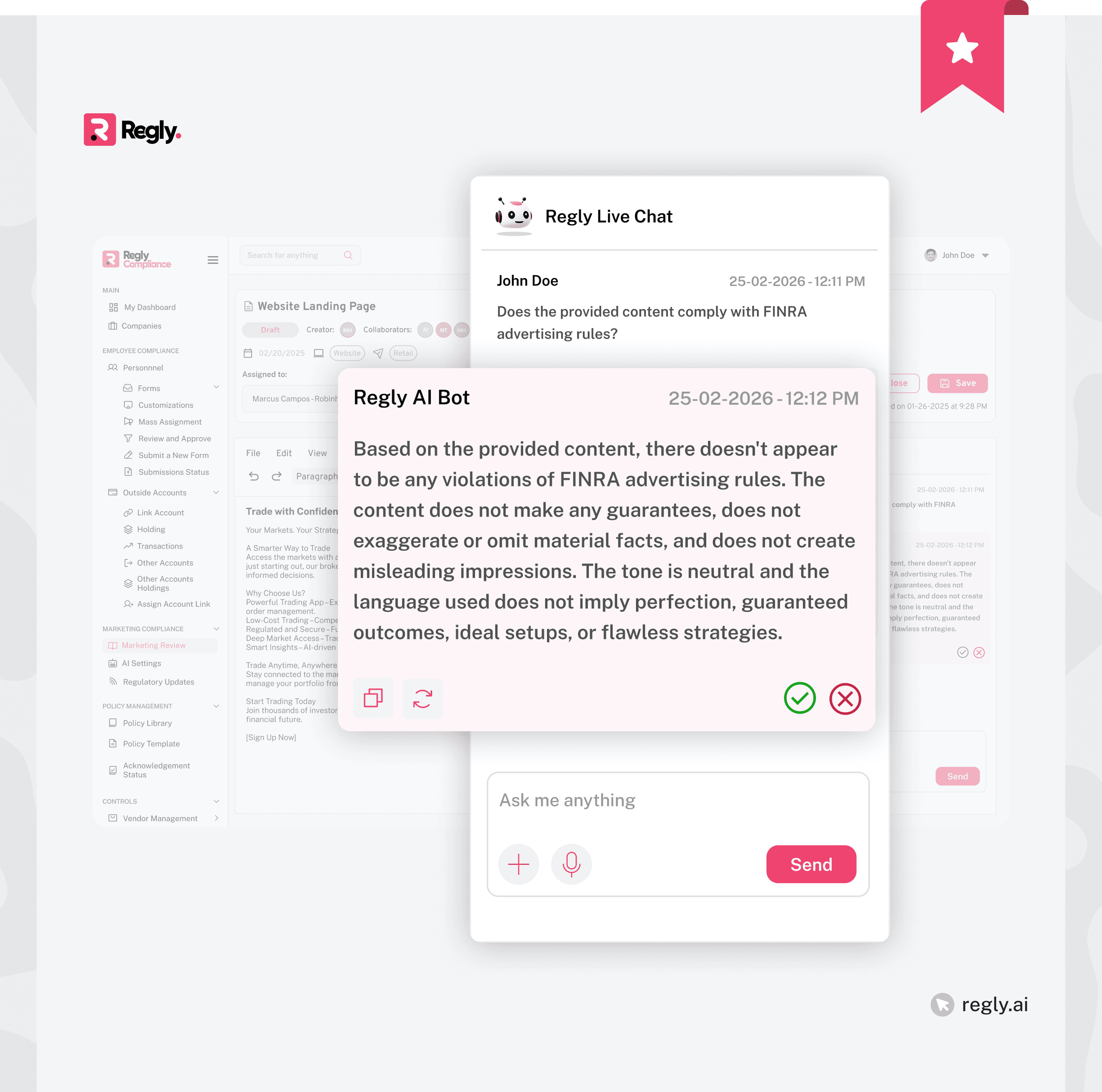
After content is created, AI marketing review tools run an initial pass to surface potential compliance concerns. This includes spotting language that could be seen as misleading, identifying claims that may require support, or highlighting missing disclosures.
The system does not approve or reject content. Instead, it highlights and organizes potential issues, often grouping them by type or level of risk. This gives compliance teams a clearer starting point, rather than requiring a full manual review without guidance.
The effectiveness of this step depends on how well it reflects the firm’s policies and regulatory requirements. Outputs are more useful when the system is tuned to the firm’s products, communication channels, and specific obligations.
3. Human Compliance Review
Following the AI scan, compliance teams review the content in detail. This step involves applying regulatory judgment to the issues that were flagged. Not every alert leads to a revision, and some risks only become clear when viewed in context.
Compliance reviewers focus on validating claims, checking disclosures, and confirming that the content meets relevant standards. This remains the key decision point in the workflow, where accountability is clearly defined.
With AI providing initial structure, teams can direct their attention to higher-risk content. This helps reduce time spent on lower-risk items while keeping control over final outcomes.
4. Approval, Publishing, and Archiving
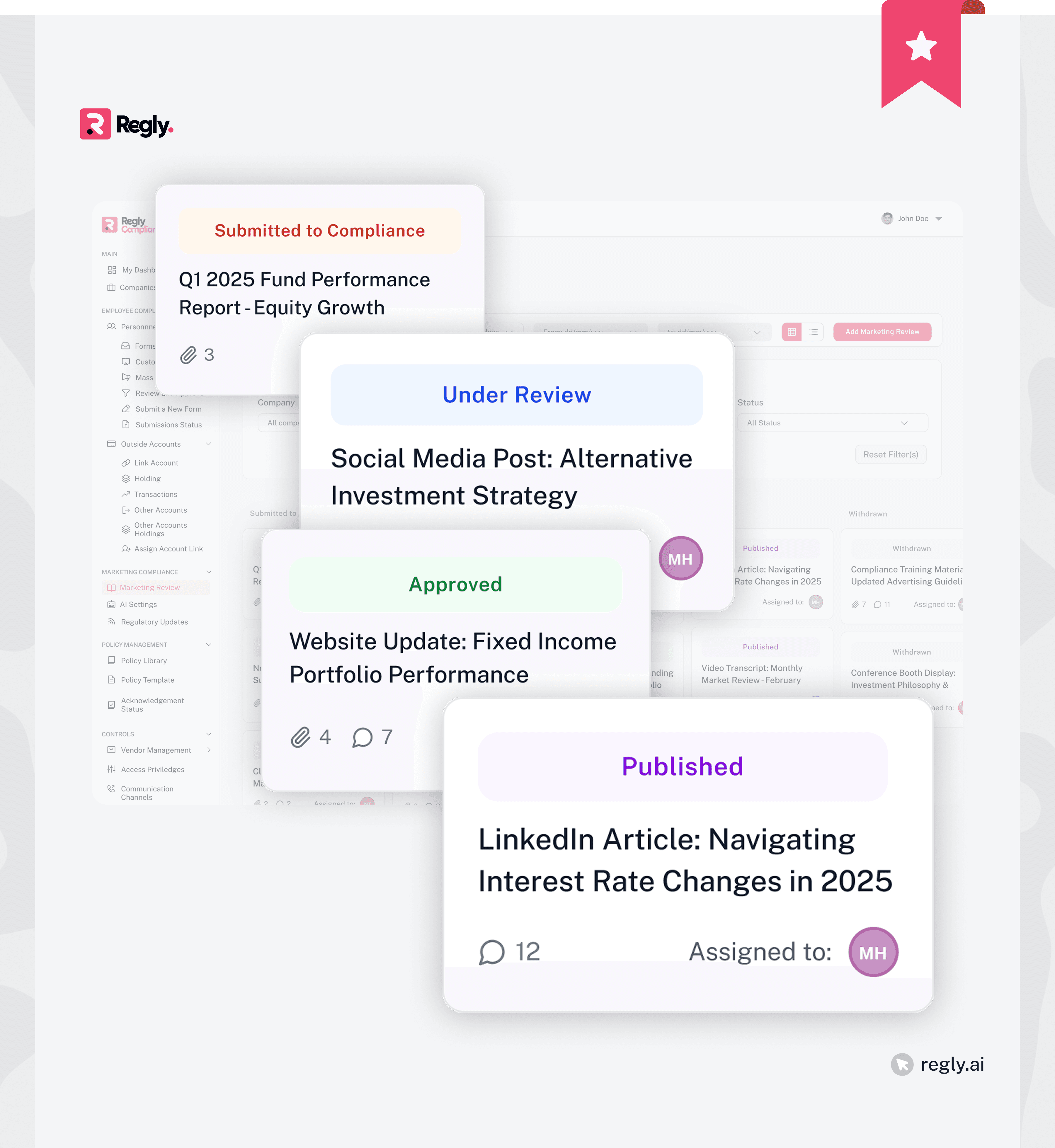
At this point, the content reaches a decision stage. It can be approved, revised for further review, or not approved. This step confirms the result of the review process and determines whether the content moves forward.
Once approved, the content is released across its intended channels. Alongside publication, records of the review process are retained, including comments and approval history. This step ties the outcome to documented evidence, which is a key part of compliance.
A structured approval record makes a difference. Tracking who approved content, what was changed, and when decisions were made provides clarity if the process is examined later.
5. Recordkeeping and Audit Trail

After the content is published, the process does not end. All related materials, including drafts, comments, approvals, and final versions, are retained as part of the firm’s records.
This audit trail provides visibility into how decisions were made. It allows firms to reconstruct the review process if requested during an exam or internal audit. Recordkeeping is not just administrative. It is part of regulatory compliance.
A common challenge is fragmentation. If content, approvals, and communications are stored across different systems, it becomes difficult to produce a complete record. Structured workflows help centralize this information and make it easier to access when needed.
—
For fintech teams, the challenge is rarely just reviewing content. It’s managing volume, maintaining consistency across channels, and keeping a clear record of decisions. A fragmented process makes this difficult. A structured workflow gives teams more visibility and control without bringing marketing to a crawl.
That's where platforms like Regly's marketing compliance solution are meant to fit. Rather than treating review, approval, and archiving as three separate tasks, the platform pulls them into one environment. AI-assisted risk detection supports that early-stage review, while built-in workflows and audit trails help teams track decisions and keep records in one place.
What AI Actually Reviews
AI marketing review is only as useful as the content it can evaluate. In practice, that scope is broad. It covers most customer-facing communications that fall under advertising or marketing rules in financial services.
Content types typically include:
Marketing copy: This includes landing pages, product descriptions, paid ads, and email campaigns. These materials often contain claims about performance, fees, or product features, which require careful review.
Social media and influencer content: Social posts and third-party promotions often move quickly and vary in tone. Despite this, they are still held to the same standards for accuracy and disclosure as more formal marketing materials.
Push notifications and in-app messaging: These are short-form communications delivered in real time. They often highlight product features or prompt user action, which can raise issues around clarity and balance.
Sales materials and investor communications: Pitch decks, one-pagers, and presentations used in sales or fundraising also fall within scope. These materials often include forward-looking statements or comparisons that require review.
Each content type comes with different risks. A long-form webpage allows space for disclosures. A push notification does not. Social media posts may be reshared or taken out of context. Influencer content may not be fully controlled by the firm.
So, an AI marketing review has to weigh format, channel, and audience, not just the words on the page. The same message can carry very different risks depending on how and where it lands.
For fintech companies operating across multiple channels, this broad scope is one of the main reasons AI marketing review becomes relevant. It helps bring different types of content into a consistent review process, even when the formats vary.
Common AI Capabilities in Marketing Review
AI marketing review focuses on identifying patterns, organizing risk, and supporting workflows, rather than making approval decisions. The capabilities below are the ones most commonly used in regulated environments.
Risk Flagging
A core task is highlighting wording that may raise compliance questions. This can include statements that appear exaggerated, unclear, or not backed by sufficient support.
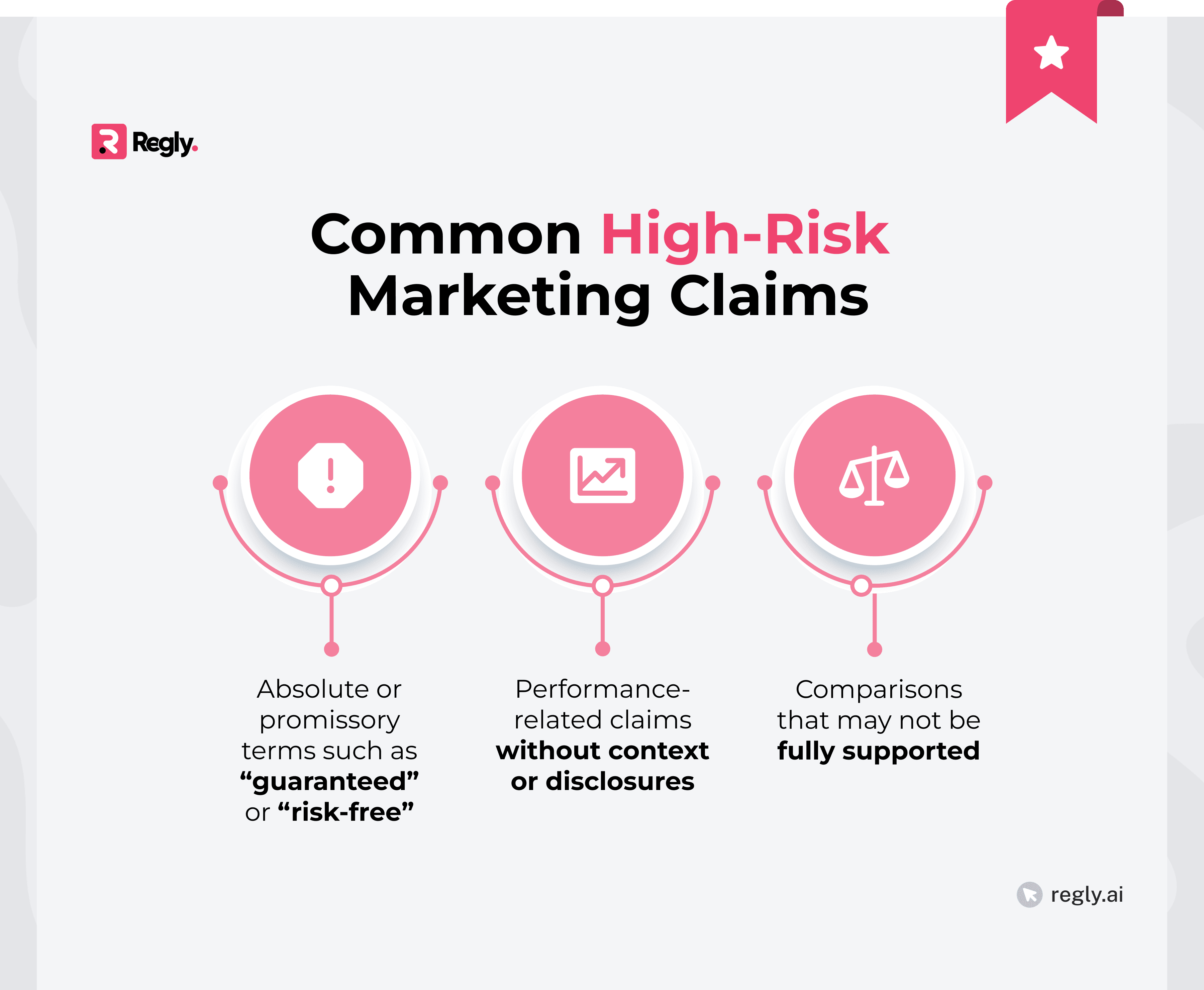
The system flags these elements so reviewers can take a closer look. Surfacing them early keeps potential problems from slipping further down the approval line.
Policy and Rule Mapping
AI marketing review tools are usually set up to reflect both internal policies and outside regulatory requirements. That way, a flagged issue connects to a specific rule or piece of guidance instead of showing up as a generic alert.
For example, a flagged claim might tie back to your internal disclosure standards or to external marketing rules. That gives reviewers context and helps similar issues get handled the same way from one team to the next.
Mapping risk to defined policies is what creates that consistency, and it matters most when several reviewers are in the mix or when content is going out across different channels.
Audit Trails and Reporting
Another key capability is capturing and organizing the review process. This includes tracking content versions, reviewer comments, approvals, and timestamps.
Rather than storing this information across separate systems, AI marketing review tools typically centralize it within the workflow. This makes it easier to retrieve records if needed.
Audit trails are not just operational records. They are part of compliance evidence, especially during exams or internal reviews. Clear documentation of how decisions were made supports a more defensible process.
Regulatory Framework Behind Marketing Compliance
AI marketing reviews sit inside an established regulatory framework that governs how financial firms communicate with the public. These rules apply regardless of whether content is created or reviewed using AI.
SEC Requirements (Investment Advisors)
For registered investment advisors, marketing is governed by the SEC Marketing Rule (Rule 206(4)-1). This rule sets the baseline for how marketing content should be presented and what is considered misleading.
General Prohibitions
The SEC Marketing Rule sets the expectations for how firms present marketing content. Put simply, your communications can't make false statements, leave out something material, or be framed in a way that misleads the audience.
These expectations apply to all types of content, from long-form pages to short ads or notifications. What matters is not only whether a statement is accurate, but how it is likely to be understood by an investor. Even correct facts can raise concerns if the overall message is misleading.
This is a key area in AI marketing review workflows. Systems may surface wording that seems absolute or incomplete, but it is up to compliance teams to evaluate the full context and make the call.
See how Regly marketing compliance helps businesses flag potential risks →
Testimonials, Endorsements, and Ratings
Testimonials, endorsements, and ratings can be used in marketing materials, but they come with conditions. The goal is to make sure the audience understands what they’re seeing and that they have the right context.
Key information must be included, such as compensation arrangements, relationships, and whether the experience shown is representative. When these disclosures are not clearly presented, the risk of misleading communication increases, particularly in influencer campaigns.
An AI marketing review can spot these elements in the content, but it can't confirm that every disclosure requirement is met. That comes down to how the information is structured and communicated.
Performance Advertising Rules
Regulators watch performance marketing closely. Any statement about returns or outcomes has to come with context and clear disclosures.
The usual problems are cherry-picked data, missing time periods, and no transparency around how the results were calculated. What's under review is the whole presentation, not just the numbers on their own.
An AI marketing review can help identify where these claims appear, but it does not verify the underlying information. Human review remains critical in this area.
Learn more about the SEC Marketing Rule →
FINRA Requirements (Broker-Dealers)
For broker-dealers, marketing communications are governed by FINRA Rule 2210 and supported by supervisory requirements under Rule 3110. Together, these rules define how firms communicate with the public and how those communications must be reviewed and controlled.
Rule 2210 (Communications with the Public)
Rule 2210 requires that all communications be fair and balanced. Firms cannot omit key information or present content in a way that creates a misleading impression.
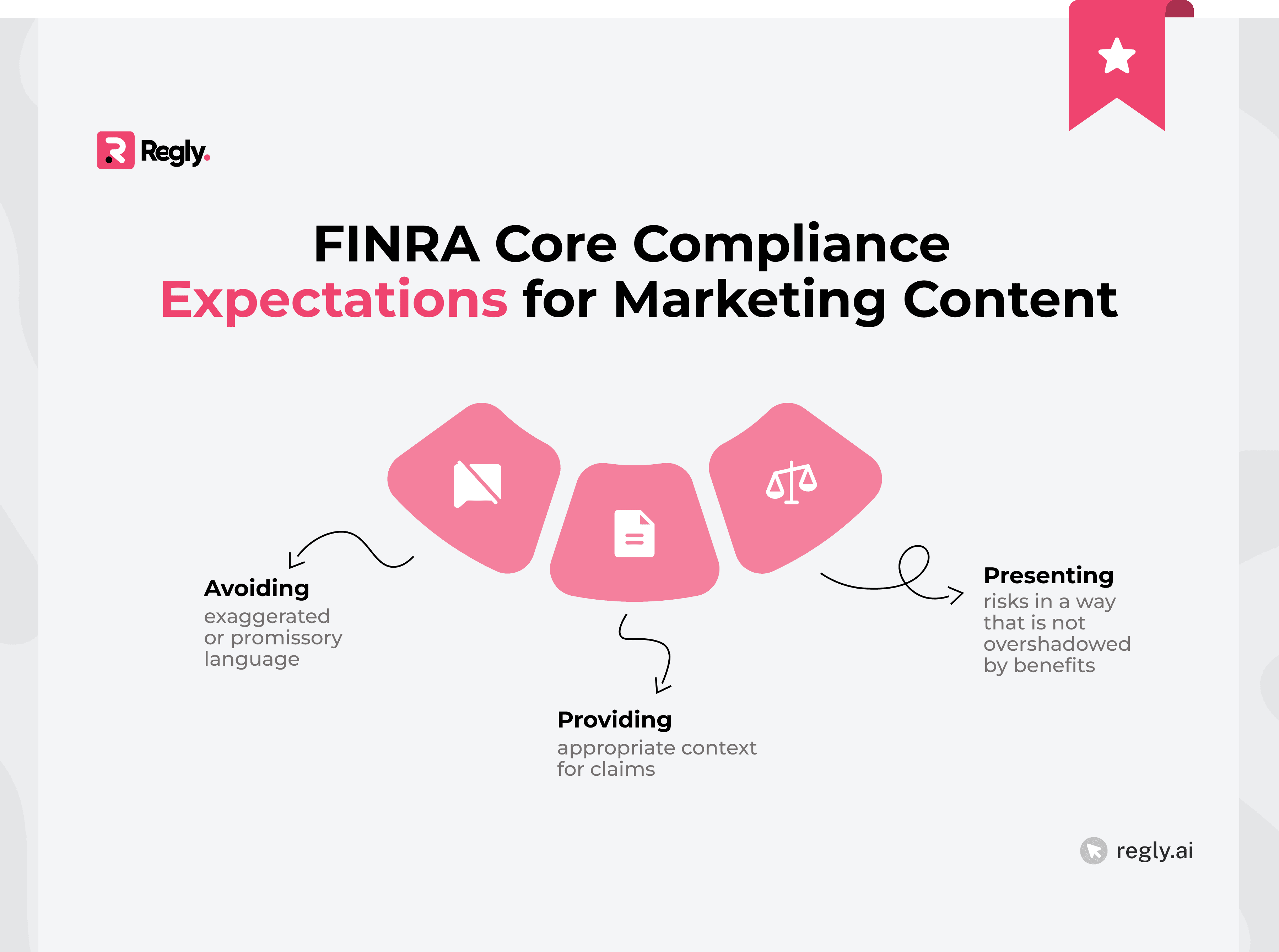
The standard is based on how a retail investor would interpret the content, not just whether individual statements are technically correct.
AI marketing review tools tend to focus on catching these kinds of issues. They can flag language that warrants a closer look, but it takes a human to judge whether the communication as a whole meets FINRA expectations.
Learn more about FINRA Rule 2210 →
Supervision Under Rule 3110
FINRA Rule 3110 requires firms to maintain a supervisory system that covers their communications. This includes processes for reviewing, approving, and retaining marketing materials.
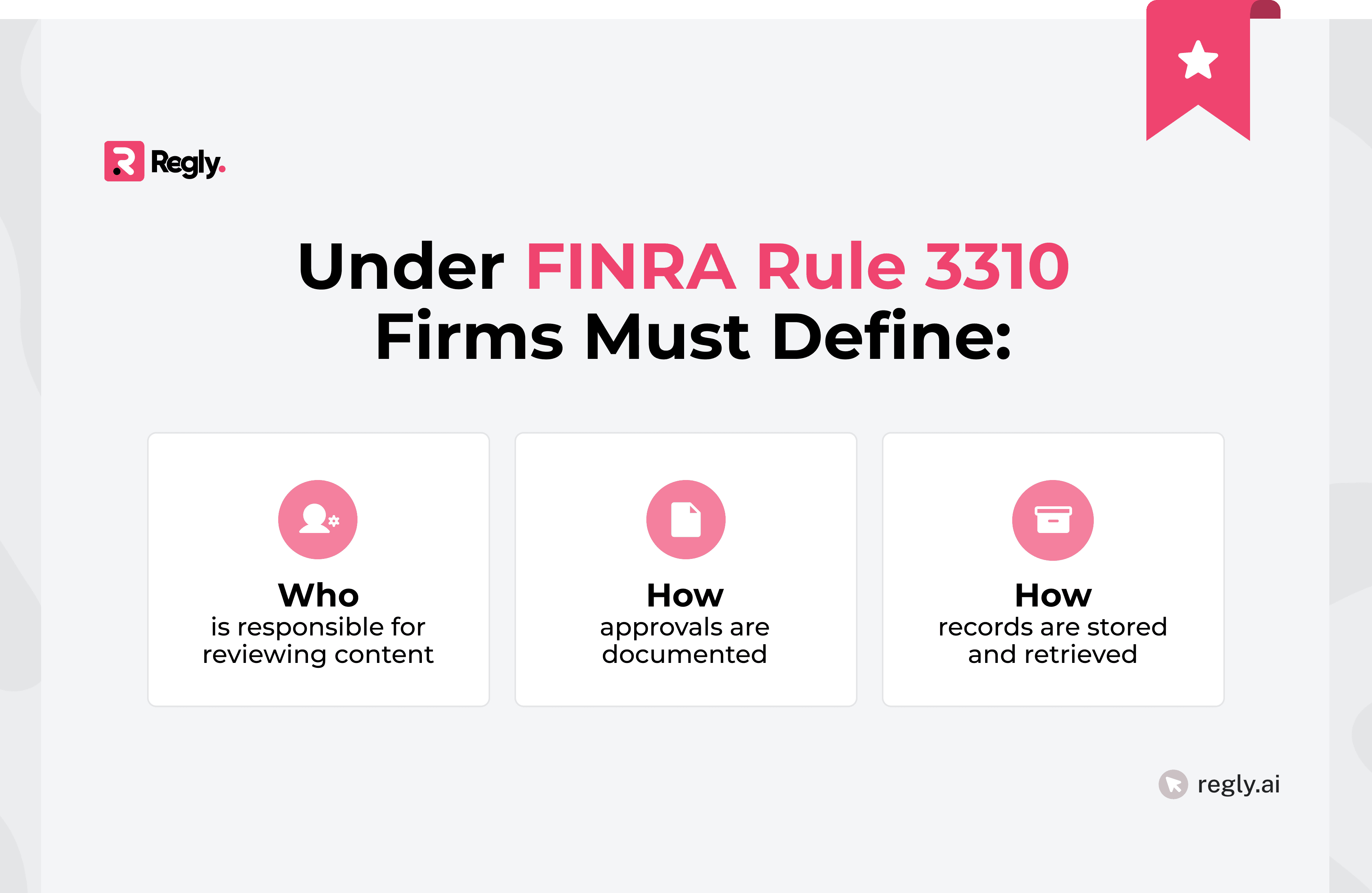
Supervision is not just about reviewing content. It’s about demonstrating that a consistent process is in place. This is often tested during exams.
An AI marketing review can help support supervision by organizing workflows, centralizing approvals, and keeping review activity in one place. But it does not transfer responsibility. The firm is still accountable for supervising its communications. Treatment of AI-Generated Communications
FINRA has made clear that using AI in marketing does not change the rules. Content created by AI, or reviewed with the help of AI, is still considered firm communication and must meet the same standards as any other marketing material.
In practice, firms need to treat AI-generated content the same way they treat any other firm communication. It still has to meet Rule 2210 standards, fit within the firm’s control framework, and go through the proper review and approval process before it is published.
AI does not shift responsibility. It extends the scope of what must be supervised. For broker-dealers, the focus is on how AI is integrated into existing processes and how those processes are documented.
Learn more about FINRA advertising rules →
Other Relevant Regulators
AI marketing review in fintech rarely sits under a single regulator. Depending on the product, audience, and distribution channel, additional regulatory frameworks may apply:
FTC (Advertising and Endorsements)
The Federal Trade Commission focuses on preventing deceptive or misleading advertising. This applies broadly across industries, including financial services.
Key expectations include:
Claims must be truthful and not misleading
Material connections, such as paid endorsements, must be disclosed
Disclosures must be clear and easy to understand
The FTC places strong emphasis on how disclosures are presented, especially in influencer and social media content. Even if a disclosure exists, it may not be sufficient if it is hard to notice or understand.
An AI marketing review can help identify endorsement language and missing disclosures, but evaluating whether a disclosure is clear enough depends on context, placement, and formatting.
CFPB (UDAAP for Consumer Fintechs)
For fintechs that offer consumer financial products, the CFPB applies standards around unfair, deceptive, or abusive acts or practices, known as UDAAP.
Marketing is a central focus. Content that misstates fees, overstates benefits, or creates confusion about how a product works can raise concerns under these rules.
The CFPB evaluates how a typical consumer would interpret the message, not just the literal wording. Tone, framing, and what is left unsaid can all influence that assessment.
AI marketing review tools may highlight language that seems aggressive or unclear, but determining whether content is misleading or abusive requires a broader view of how consumers are likely to perceive it.
NFA / MSRB (Where Applicable)
Certain firms fall under additional regulators depending on their activities. Forex and derivatives firms may be subject to National Futures Association rules, while municipal securities activities fall under the Municipal Securities Rulemaking Board.
These frameworks include their own expectations around marketing, disclosures, and communications with the public.
For firms operating across multiple regulatory regimes, marketing review becomes more complex, as content may need to meet different standards at the same time.
An AI marketing review can help organize and surface potential issues, but firms still need to align their review processes with the specific rules that apply to their business model.
Regulator | Who It Applies To | Key Focus Areas | What AI Marketing Review Can Support |
|---|---|---|---|
SEC | Investment advisors | Misleading statements, disclosures, performance advertising, testimonials | Flags risky language, identifies missing disclosures, and surfaces performance-related content |
FINRA | Broker-dealers | Fair and balanced communications, supervision, and approval workflows | Highlights imbalanced messaging, supports structured review and approval processes |
FTC | All businesses (including fintech) | Deceptive advertising, endorsements, influencer disclosures | Detects endorsement language, flags missing or unclear disclosures |
CFPB | Consumer fintechs (lending, payments, etc.) | UDAAP (unfair, deceptive, abusive practices), consumer interpretation | Identifies potentially misleading claims, flags unclear or aggressive messaging |
NFA / MSRB | Derivatives firms, municipal securities participants | Product-specific disclosures, communications standards | Surfaces risks based on communication patterns, supports multi-framework review |
Benefits of an AI Marketing Review
An AI marketing review is not about replacing compliance. It changes how marketing risk is managed, especially for teams dealing with high content volume and multiple channels.
For fintech companies, the main benefits include:
Faster Review Cycles
Manual review processes often slow down as content volume increases. Each piece of content moves through queues, revisions, and approvals, which can delay campaigns.
An AI marketing review helps by catching potential issues earlier in the process. That frees up compliance teams to spend their time on the higher-risk items instead of reviewing everything from scratch.
The payoff is shorter feedback loops between marketing and compliance, which move content forward without the unnecessary delays.
Consistency Across Channels
Fintech marketing now spans multiple platforms, including web, mobile, social, and partnerships. Each channel introduces different formats and risks.
An AI marketing review applies the same logic across these channels. This helps standardize how content is evaluated, even when messaging varies by format.
Consistency becomes easier to maintain when review criteria are applied in a structured way, rather than relying entirely on individual reviewers.
Better Risk Detection at Scale
As marketing output increases, manual review becomes more difficult to manage. Teams are often dealing with multiple campaigns, formats, and deadlines at the same time. In that environment, smaller issues can be missed, especially when they appear repeatedly across different pieces of content.
Patterns are not always easy to spot when reviews happen one piece at a time. A phrase may seem fine on its own, but if it appears across multiple channels or campaigns, it can start to create risk. The same is true for disclosures that are applied inconsistently or messaging that changes slightly from one campaign to the next.
An AI marketing review helps address this by scanning content in volume and identifying recurring signals. It can surface repeated phrasing, highlight missing disclosures, and point out inconsistencies that may not stand out during manual review.
This creates a more consistent way to detect risk across large volumes of content. Instead of relying on individual reviewers to catch everything, teams gain a broader view of how messaging is being used and where issues may be developing.
Improved Audit Readiness
Regulators often look beyond the content itself and focus on how it was reviewed, approved, and documented. This makes recordkeeping a critical part of marketing compliance.
AI marketing review tools typically capture review history, approvals, and comments within the workflow. This creates a structured record that can be referenced later.
Having a clear audit trail makes it easier to demonstrate how decisions were made, which is important during exams or internal reviews.
Integration Into Daily Operations
In traditional workflows, compliance review is treated as a final step. Content is completed first and then passed along for approval, which can create bottlenecks when changes are required.
An AI marketing review changes that structure by embedding the review earlier in the process. It allows teams to identify potential issues as content is being developed, not just after it’s finished.
This makes the review process more aligned with ongoing content production, where speed and frequent updates are part of daily operations.
—
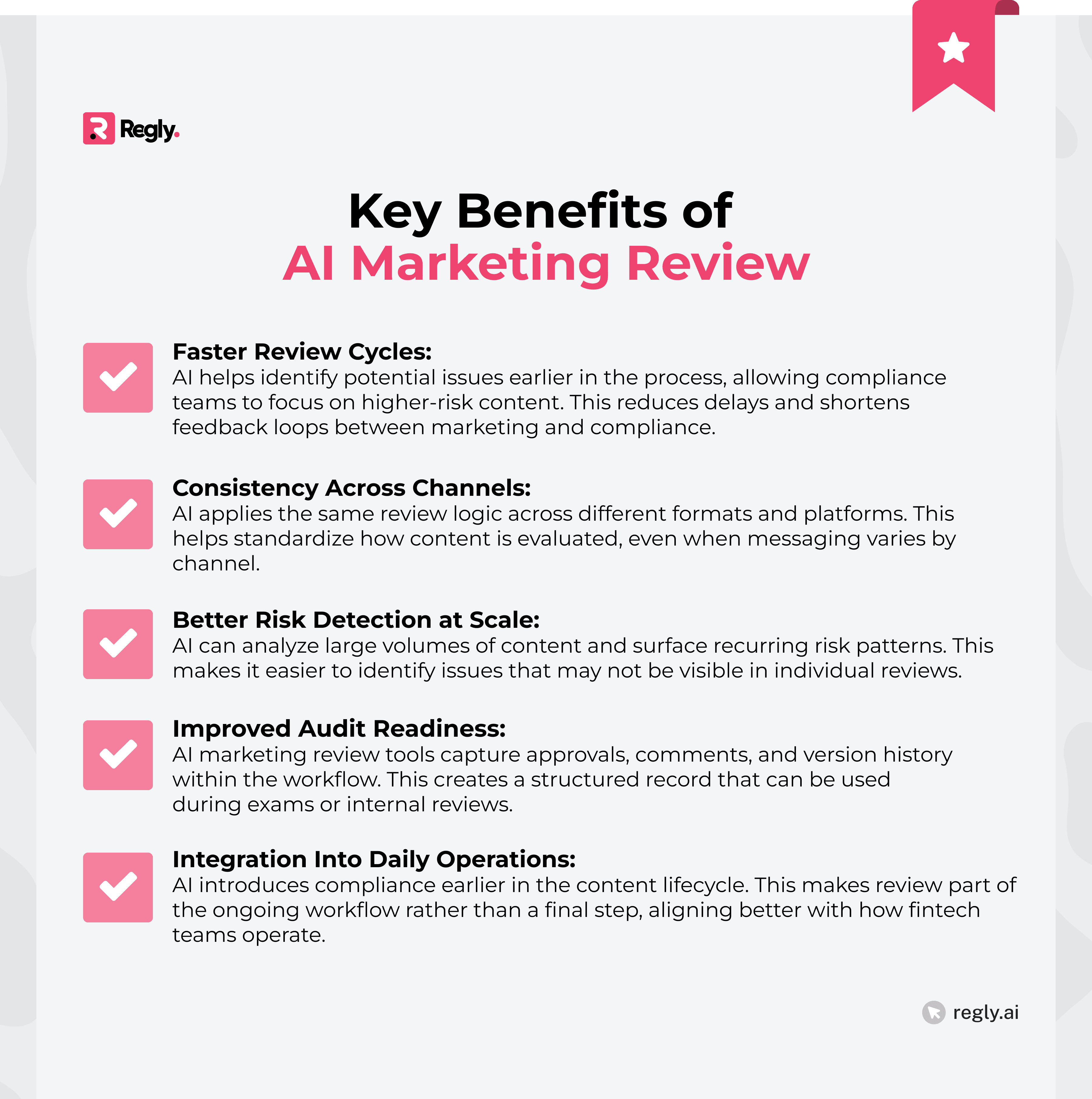
Taken together, these benefits show that an AI marketing review is less about automation and more about structure. It helps teams manage higher volumes of content, apply consistent standards across channels, and identify risks earlier in the process.
The result is a more controlled and scalable marketing review process, one that fits the way content is actually created instead of forcing teams into a slow or fragmented workflow.
Regly’s marketing compliance platform is built around this approach. It brings risk detection, review workflows, approvals, and audit trails into one system so that teams can manage the full lifecycle of marketing content in a single place.
See how Regly’s marketing compliance software can help you →
Limitations of AI Marketing Review
An AI marketing review helps structure and prioritize content analysis, but it’s not a replacement for decision-making. Its role is to support, not to determine outcomes. In regulated settings, this limitation is important because accountability cannot be transferred to technology.
AI Cannot Verify Truth or Substantiate
AI tools can identify language that may raise concerns, such as exaggerated claims or missing disclosures. They can also flag areas where supporting information may be incomplete.
What they don't do is judge whether those claims are true. Whether the data is right, whether the product works the way you say it does, whether the evidence actually backs the statement: all of that sits outside their reach.
So AI can point you toward a potential issue, but it can't tell you whether the issue is real. Verifying the content stays on the firm.
This means AI can direct attention to potential issues, but cannot confirm their validity. Firms remain responsible for verifying the content.
AI Cannot Replace Human Judgment
Regulatory compliance often depends on interpretation. The same statement may be acceptable in one context and problematic in another, depending on how it is presented and who the audience is.
AI marketing review tools operate based on patterns and predefined rules. They do not interpret nuance in the same way a compliance professional would. They may flag content that is acceptable or miss issues that depend on context.
Human review is still where the decisions get made, especially when the content involves complex disclosures, performance claims, or anything that calls for judgment.
AI Does Not Remove Regulatory Responsibility
Bringing AI into your marketing workflow doesn't change how regulators assign responsibility. The firm is still on the hook for every communication, no matter how it was created or reviewed.
That covers accuracy, disclosures, supervision, and recordkeeping. AI can support all of it, but it doesn't take on any of the underlying obligations.
What AI adds is another layer to supervise, not a stand-in for compliance. The firm still has to show control over both the content and the systems used to manage it.
—
These limitations do not reduce the value of an AI marketing review. They define how it should be used. When treated as a supporting layer within a structured process, AI can improve efficiency and visibility.
When treated as a replacement for compliance, it introduces risk. The most effective approach is combining AI-assisted review with human oversight and clear processes, aligned with the firm’s regulatory obligations.
What Regulators Are Focusing on Right Now
Regulators are not treating AI marketing review as a separate category. Instead, they are applying existing rules to new workflows and technologies. The focus is on how firms use AI, how they supervise it, and whether marketing content continues to meet established standards.
AI in Marketing and Communications
AI is now everywhere in how marketing content gets created and refined, and regulators are watching closely to see how that plays out in communications. The concern isn't the use of AI itself. It's whether AI introduces risk in how messages come across, especially once content is being produced at scale.
Firms are expected to treat AI-assisted content the same as any other communication. This means it must be reviewed, approved, and aligned with regulatory standards before it is published. Responsibility for the final content remains with the firm, regardless of how it was created.
Supervision is a major part of that responsibility. Firms need to be clear about how AI is being used, who reviews the output, and how those review decisions are documented. Regulators may look at whether AI use fits within the firm’s existing supervisory process and whether the same controls are applied consistently.
There is also growing scrutiny around how firms describe their use of AI. Claims about capabilities, automation, or outcomes must be accurate and supported. Overstating what AI can do can create the same type of risk as any other misleading marketing claim.
Marketing Rule and Advertising Exams
Marketing compliance continues to be a priority in regulatory exams, especially when it comes to how firms apply rules like the SEC Marketing Rule and FINRA advertising standards in real-world practice. Regulators are not just looking for written policies. They want to see how those policies actually work day to day.
Exams typically focus on how firms handle marketing in practice. This includes whether approval workflows are applied consistently, whether documentation is complete, and whether supervisory controls are clearly defined. The focus is on how the process operates day to day, including how content is reviewed before it is published.
Certain types of content receive additional scrutiny. Testimonials and endorsements are reviewed for proper disclosures and transparency, especially in influencer campaigns. Performance-related messaging is also examined, particularly when returns are presented without sufficient context.
AI marketing review can help organize and surface potential issues, but it does not replace evaluation. Firms must still confirm that disclosures are adequate and that performance claims are clearly supported.
Vendor Oversight and Data Protection
Third-party tools, including AI vendors, are now common in marketing workflows. Regulators are paying closer attention to how firms manage those tools, especially when outside systems are involved in creating or reviewing content. Firms are expected to understand how these tools operate, what data they process, and what risks they introduce. This includes evaluating vendor controls, monitoring performance, and maintaining oversight of how outputs are used. Vendor oversight is treated as part of the firm’s overall compliance responsibility, not a separate function.
Outsourcing the technology does not outsource accountability. Firms still need to review content before it is published, stay in control of decisions, and be able to explain how third-party tools fit into their supervisory process.
Data protection is another key area of focus. Regulators expect firms to manage data carefully, including how it is collected, stored, and used within AI-driven workflows. This applies whether the systems are internal or provided by external vendors.
See how Regly’s vendor management tool helps fintechs organize, track, and assess vendor relationships →
—
An AI marketing review is best understood as an operational tool inside an existing regulatory framework. It doesn't replace compliance, and it doesn't lighten the firm's responsibility. What it changes is how teams organize, prioritize, and work through the review process.
For fintech firms, the focus should be on structure. Clear workflows, consistent review standards, and strong documentation remain the foundation of marketing compliance. AI can support each of these areas, but it must be paired with human oversight and defined processes to be effective.
Ready to Get Started?
Schedule a demo today and find out how Regly can help your business.