The Importance of KYC Compliance in Mitigating Financial Crime Risk
Published on
Jul 28, 2026
19
min read
KYC compliance is one of the first real challenges fintech teams run into when dealing with financial crime risk. You can build a great product and onboard users quickly, but if you don’t know who those users are, the regulatory exposure adds up fast.
Where KYC compliance becomes challenging is in incorporating it into a firm’s day-to-day workflow. And the reason that’s critical is that it affects onboarding, risk decisions, monitoring, and reporting. The other layer of complexity is that KYC sits inside a broader AML framework.
This guide covers what KYC compliance involves, how it ties into AML, and what regulators want to see when they look at your program. We'll also get into how fintech companies can build something practical and scalable that fits the way their product works.
What Is KYC Compliance?
KYC compliance defines how financial institutions identify their customers, assess risk, and monitor activity over time. It’s one of the first building blocks in mitigating fraud, money laundering, and other financial crime risk.
Definition of KYC Compliance
KYC stands for “Know Your Customer.” It refers to the set of processes businesses use to collect and verify customer information before and during a relationship.
This usually includes basic identity details like name, date of birth, and address, along with supporting documents or data checks to confirm that information is accurate. Depending on the risk level, it can also involve:
Understanding what the customer does
Where their funds come from
How they plan to use the product
KYC compliance isn’t a one-time step. It continues over time as customer activity is reviewed and information is updated.
Learn more about KYC compliance best practices →
How KYC Fits Within AML Frameworks
KYC compliance is one part of a broader anti-money laundering (AML) program. While AML covers the full set of controls used to detect and report financial crime, KYC focuses specifically on understanding the customer.
It usually comes first. Before you can monitor transactions or flag suspicious activity, you need a clear picture of who the customer is and what level of risk they bring. That information feeds into the rest of the AML program, including transaction monitoring and reporting.
In other words, KYC gives context to everything that follows. Without it, it’s much harder to spot unusual behavior or explain decisions to regulators.
KYC Compliance vs. AML: What’s the Difference?
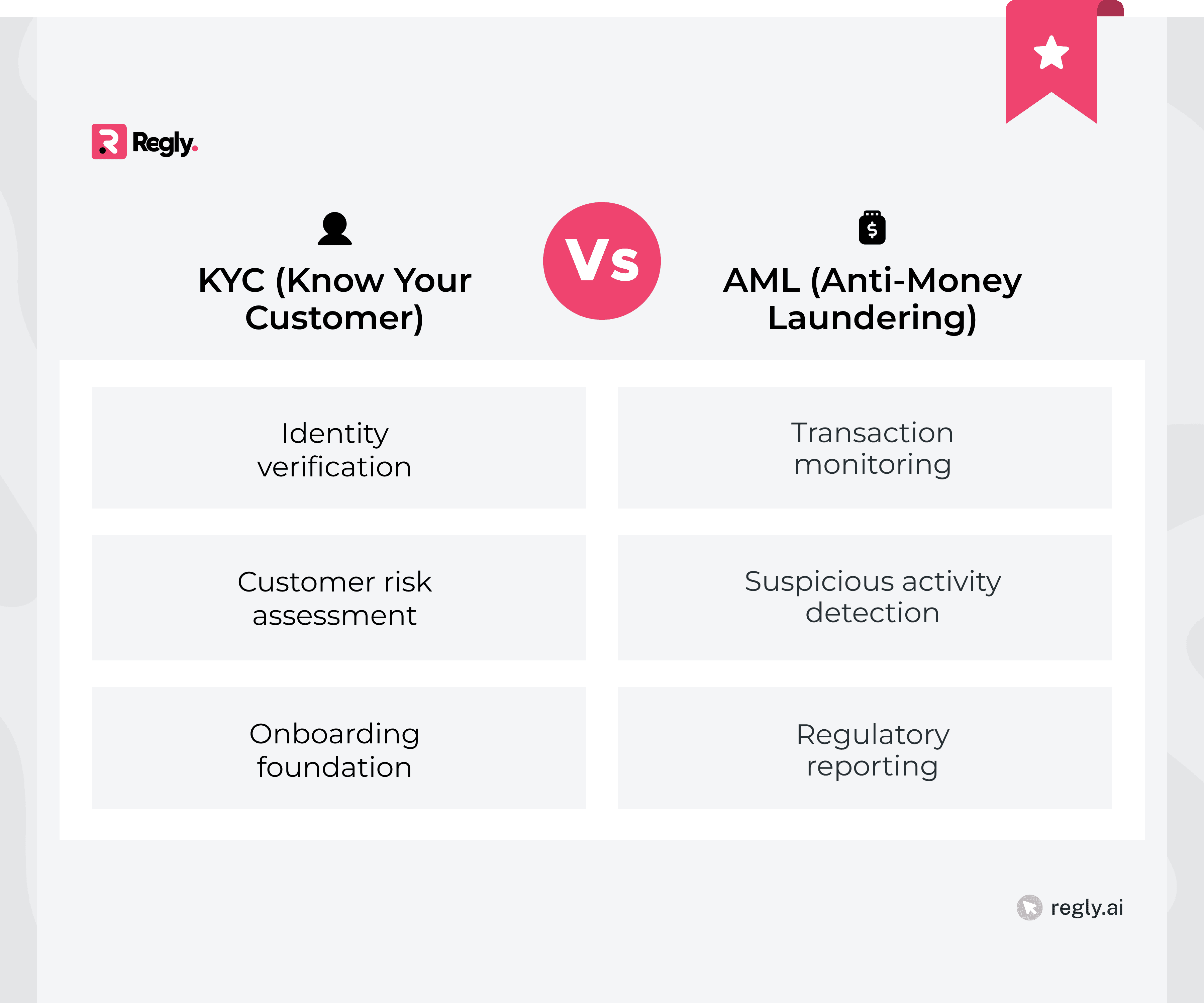
KYC compliance and AML are closely linked, but they don’t mean the same thing. KYC focuses on identifying customers and understanding their risk. AML covers the full program used to detect and respond to financial crime.
Think of KYC as the starting point. It helps you answer basic questions like who the customer is and whether they present a higher level of risk. AML builds on that by tracking transactions, flagging unusual behavior, and handling reporting obligations.
That relationship is critical as KYC decisions determine how you monitor and respond to alerts. When the two aren’t aligned, gaps tend to show up during audits or regulatory reviews.
KYC vs. AML vs. CDD vs. EDD
These terms often get used together, and it’s easy to mix them up. They’re related, but each one plays a different role in managing financial crime risk.
Term | What It Means | What It Covers |
|---|---|---|
KYC (Know Your Customer) | The process of identifying customers and confirming their identity | Collecting and verifying customer information, forms the basis of risk assessment |
AML (Anti-Money Laundering) | The broader framework for detecting and mitigating financial crime risk | KYC, transaction monitoring, suspicious activity reporting, internal controls |
CDD (Customer Due Diligence) | The process of assessing customer risk | Risk profiling based on factors like geography, occupation, and expected activity |
EDD (Enhanced Due Diligence) | A deeper review for higher-risk customers | Additional checks, such as source of funds, more documentation, and closer monitoring |
Why Does KYC Compliance Matter in Mitigating Financial Crime Risk?
KYC compliance plays a direct role in how financial institutions detect and mitigate financial crime risk. Without it, it’s difficult to understand who’s using your product or spot behavior that doesn’t align with expectations.
It helps you verify who your customers are: Before any transaction happens, you need confidence that the person or entity is real. Identity verification mitigates the risk of fraud, impersonation, and fake accounts entering your system.
It supports better risk decisions from the start: Not all customers carry the same level of risk. KYC allows you to classify users early so that you can apply the right level of monitoring and controls based on their profile.
It gives context to customer activity: Transactions don’t mean much without context. When you understand what a customer does and how they’re expected to behave, it’s easier to spot activity that doesn’t make sense.
It reduces exposure to money laundering and fraud schemes: Many financial crimes rely on weak onboarding controls. Strong KYC processes make it harder for bad actors to move funds or hide behind false identities.
It helps meet regulatory expectations: Regulators expect firms to show how they identify customers and manage risk. A well-defined KYC process makes it easier to demonstrate that your program is working as intended.
It supports ongoing monitoring and reporting: KYC doesn’t stop at onboarding. The data you collect feeds into transaction monitoring, alerts, and reporting, which are all key parts of a functioning AML program.
The Core Components of KYC Compliance
KYC compliance is made up of several key components that work together to identify customers, assess risk, and monitor activity over time. Each one plays a specific role, but they all connect back to the same goal of understanding who you’re dealing with and how they use your product.
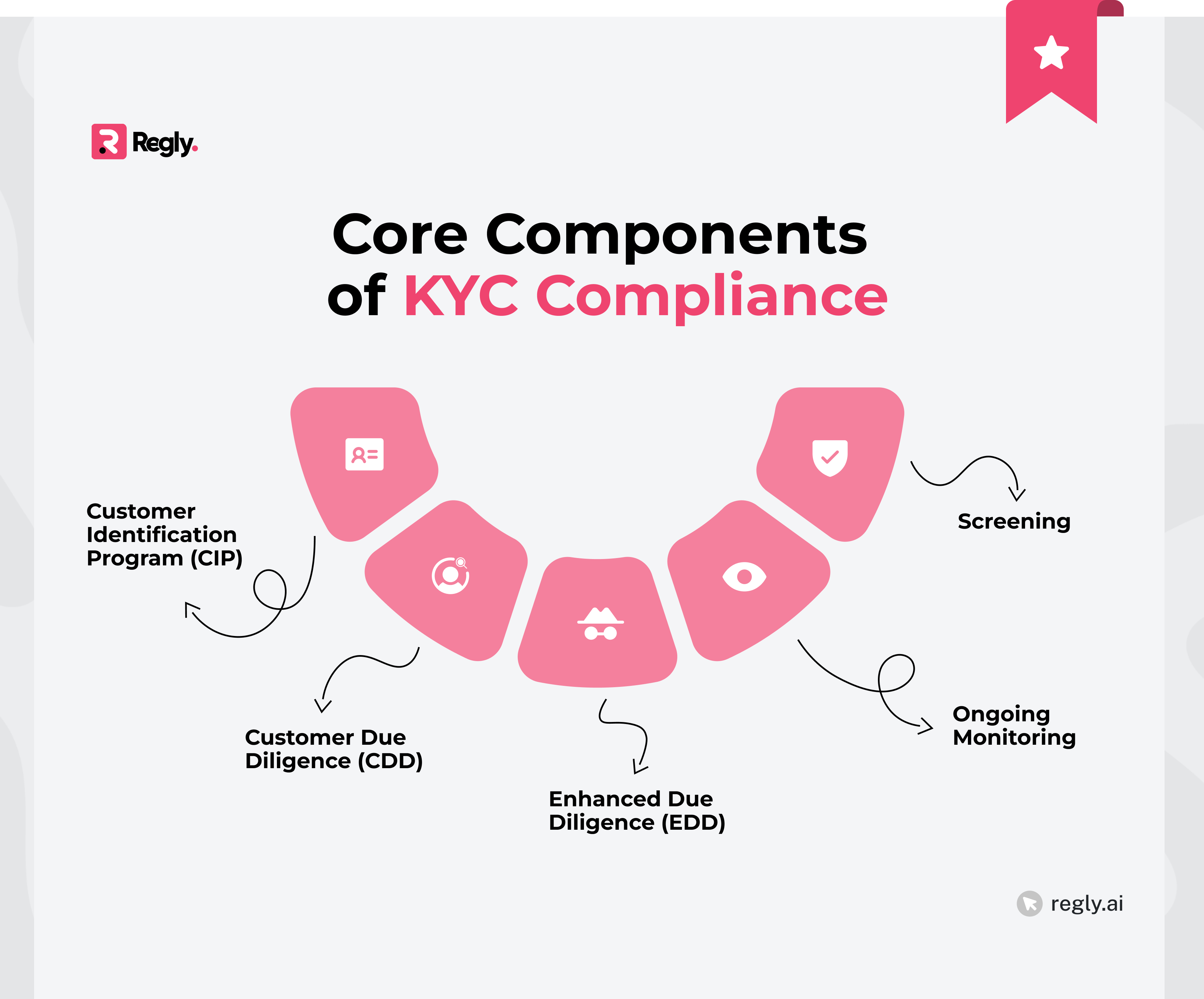
1. Customer Identification Program (CIP)
The Customer Identification Program is the starting point of KYC compliance. It defines what information you collect from customers and how you confirm that the information is valid before they can access your product.
Most regulations set a baseline for identity collection. For individuals, this usually includes:
Name
Date of birth
Address
A government-issued identification number
For businesses, it can extend to registration details, ownership structure, and information about beneficial owners. The goal is to gather enough data to form a clear and verifiable identity.
Once you've collected the information, you have to verify it. That happens a few different ways: checking documents, running database lookups, using biometric tools, or some mix of the three. Some firms lean on automated verification like Regly’s KYC tool, while others layer in manual review when a case looks higher risk. What you choose usually comes down to your product, who your customers are, and how much risk they carry.
Basic data collection and verification aren’t going to cut it for a well-defined CIP. You need to establish clear onboarding standards, outline what happens when checks bounce, and create a consistent process across customer segments. For fintech teams, this is especially important since onboarding flows are often fast and fully digital.
Read our practical guide to Customer Identification Program (CIP) →
2. Customer Due Diligence (CDD)
Customer Due Diligence builds on the information collected during CIP. Once you know who the customer is, the next step is to understand the level of risk they bring and how they’re likely to use your product.
This starts with risk profiling. Customers are typically grouped into risk categories based on factors like:
Location
Occupation
Business activity
Expected transaction behavior
A low-risk individual using a simple payment product will be treated differently from a business operating across multiple jurisdictions.
CDD also focuses on understanding customer activity.
What’s the purpose of the account? What kind of transactions should you expect? Having this baseline makes it easier to spot activity that doesn’t align with the customer’s profile later on.
For fintech teams, this often comes down to balancing speed with good judgment. You need enough information to properly assess risk, but not so much friction that onboarding slows to a crawl. The goal is to build a process that scales based on the level of risk involved, instead of putting every customer through the exact same level of review.
Explore the differences between CDD and EDD in fintech compliance →
3. Enhanced Due Diligence (EDD)
Enhanced Due Diligence applies to customers who present a higher level of risk. This could include Politically Exposed Persons (PEPs), customers in high-risk jurisdictions, or businesses with complex ownership structures.
EDD goes deeper than standard due diligence. You may need to:
Collect additional documentation,
Verify source of funds
Take a closer look at how the customer operates
The goal is to build a clearer picture of the risk and decide whether the relationship is acceptable.
It also comes with stronger monitoring. High-risk customers are usually reviewed more frequently, and their activity is watched more closely over time. For fintech teams, this often means having flexible processes that can scale up when risk increases, without slowing down the entire onboarding flow.
Learn more about Enhanced Due Diligence (EDD) →
4. Ongoing Monitoring
KYC doesn’t stop once a customer is onboarded. Ongoing monitoring is what keeps your understanding of that customer current as their behavior evolves.
This includes tracking transactions and looking for changes that don’t match the original risk profile. For example, a customer who starts sending large cross-border payments after months of low activity may need a closer review. These signals help teams catch potential issues early.
It also means revisiting customer data on a regular basis. People's circumstances change, so profiles can't sit untouched forever. Higher-risk customers tend to get reviewed more frequently, while lower-risk ones move through on a lighter schedule.
For fintech teams, operations can get complex here. Large volumes of transactions and fast-moving products make it harder to spot meaningful changes without the right systems in place.
5. Sanctions, PEP, and Adverse Media Screening
Screening is one of the core pieces of KYC compliance. It helps firms identify potential risks before a customer is onboarded and continues monitoring for issues throughout the relationship.
That process usually includes checking sanctions lists, politically exposed persons (PEPs), and adverse media. Sanctions screening looks for matches against government watchlists. PEP screening helps flag individuals with political influence or close ties to public officials who may present elevated risk.
Screening doesn’t happen just once. It runs at onboarding and continues over time as lists and customer activity change. Alerts need to be reviewed, and matches need to be assessed carefully to avoid both false positives and missed risks.
How Does KYC Compliance Work in Fintech Environments?
KYC compliance tends to look very different in fintech than it does at traditional financial institutions. Faster onboarding, digital-first products, and layered vendor relationships all influence how these programs are built and managed.
How KYC Differs for Fintech vs. Traditional Institutions
Fintech companies usually operate with faster onboarding and fully digital user journeys. That changes how KYC compliance is applied. Instead of in-person checks, identity verification relies on digital documents, data sources, and automated workflows.
Traditional institutions often have more established processes and longer onboarding timelines. Fintech teams, on the other hand, need to balance speed with control. A slow onboarding flow can hurt growth, but weak checks can increase risk and attract regulatory attention.
Fintech products also vary a lot more. A payment app, a trading platform, and a crypto service each carry their own risk profile. So KYC can't be one-size-fits-all. It has to adapt to:
The product
The customer type
How the service is used
Embedded Finance, BaaS, and Shared Responsibilities
In fintech, KYC compliance often involves more than one party. If you’re operating through a banking partner or a BaaS provider, responsibilities are usually split across multiple entities.
For example, the bank may own the regulatory obligation, while the fintech handles parts of onboarding and customer interaction. That creates a shared model where both sides need clear roles and aligned processes. If something goes wrong, regulators will still expect accountability.
This setup can get complicated quickly. Data flows, verification steps, and monitoring controls need to be coordinated across systems and teams. Without clear ownership, gaps can appear between what’s documented and what actually happens.
Crypto and Digital Asset Considerations
A fresh new set of KYC compliance challenges is faced by crypto and digital asset businesses. Now you’ve got transactions moving at lightning speed, pseudonymous wallets, and cross-border activity.
This makes identity verification and risk assessment more complex. You still need to collect and verify customer information, but you may also need to connect that identity to wallet activity and understand how funds move on-chain.
There’s also more focus on transaction behavior. Patterns like rapid transfers, mixing services, or interaction with high-risk wallets can raise flags. Monitoring tools often need to combine traditional data with blockchain analytics to give a clearer picture.
KYC Compliance Requirements Across Key Jurisdictions
KYC compliance requirements vary by region, but the core expectations are broadly aligned. Most regulators focus on identity verification, risk assessment, and ongoing monitoring, with some local differences in how those rules are applied.
United States
KYC compliance in the United States is shaped by the Bank Secrecy Act (BSA), with oversight from FinCEN, and additional expectations from regulators like the SEC and FINRA. Together, they define both what firms need to do and how well those controls need to function in practice.
Identity collection and verification (CIP): Firms must collect key customer details such as name, date of birth, address, and identification number before account opening. That information needs to be verified using reliable methods, which can include documents or trusted data sources.
Risk assessment and customer profiling (CDD): Beyond identity, firms are expected to understand the purpose of the relationship and assign a risk level. This includes identifying expected activity and, for business accounts, capturing beneficial ownership information.
Focus on how the program works in reality: SEC and FINRA don’t just look at written policies. They assess whether KYC processes are applied consistently and whether teams can explain their decisions.
Documentation and audit readiness: Firms need clear records of onboarding checks, risk classifications, and any follow-up actions. Gaps in documentation are a common issue during exams.
Ongoing oversight and testing: KYC controls should be reviewed regularly through internal checks and independent testing to show the program is active and up to date.
For fintech teams, this often means staying closely involved even when a partner bank is part of the setup. Regulators still expect a clear understanding of how KYC is handled end-to-end.
European Union
In the European Union, a series of AML directives and ongoing regulatory updates oversee KYC compliance. The focus is consistent with other regions, but the rules continue to evolve, especially with new frameworks and digital asset regulation.
AML directives and upcoming AML package: AML directives and the upcoming EU AML package require firms to carry out identity verification, risk assessment, and ongoing monitoring. The new framework also introduces a centralized AML authority (AMLA) and a single rulebook aimed at creating more consistent requirements across member states.
Stronger transparency requirements: Firms are expected to collect detailed customer information, including beneficial ownership for legal entities. Access to central registers has made this process more structured, though still operationally complex.
Crypto and payment transparency rules: Regulations like the Transfer of Funds Regulation and MiCA introduce stricter requirements for crypto firms. For example, firms must collect and share sender and recipient information, even for digital asset transfers.
Cross-border considerations: Many fintechs operate across multiple EU countries. While the framework is shared, local regulators may apply rules slightly differently, which adds another layer of coordination.
For fintech teams, staying aligned with EU requirements often means building fluid KYC processes that adapt to changing regulations.
United Kingdom and Other Key Markets
In the United Kingdom and other major markets, KYC compliance follows a similar structure but comes with its own regulatory expectations and supervision style.
FCA expectations in the UK: The Financial Conduct Authority (FCA) wants firms to take a risk-based approach to KYC. That means clear customer identification, ongoing monitoring, and being able to explain why you made a given risk decision. The emphasis is on how your controls hold up in real situations, not just how good they look on paper.
Alignment with global standards: Many jurisdictions follow guidance from the Financial Action Task Force (FATF). This creates a level of consistency across regions, especially around risk-based approaches, due diligence, and monitoring.
Local variations still matter: Even with global alignment, each country can apply rules differently. Requirements around documentation, reporting, and review timelines may vary, which can affect how KYC processes are set up.
Increased focus on digital and cross-border activity: Regulators are paying closer attention to fintech models, especially those operating across borders or offering digital-first services. This often means closer scrutiny of onboarding flows and transaction monitoring.
For fintech teams operating in multiple regions, the challenge is staying consistent while adapting to local expectations. A flexible, well-documented KYC framework makes that easier to manage.
How to Build an Effective KYC Compliance Program
Building a KYC compliance program isn’t just about meeting regulatory requirements. It’s about creating a system that fits how your product works and can handle risk as you grow.
Step-by-Step Framework
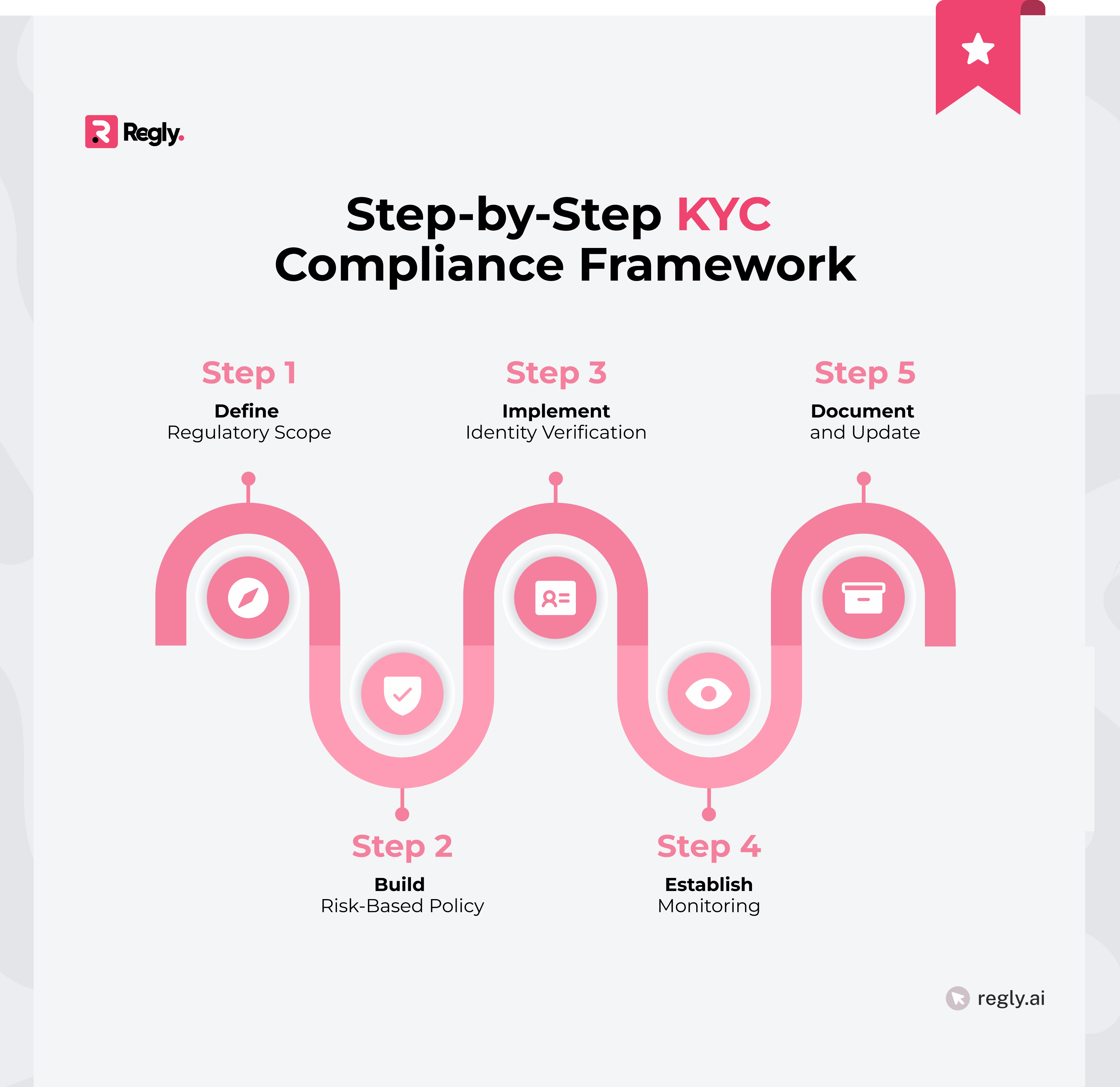
Building a KYC compliance program works best when you break it down into clear steps. Each one builds on the last and helps create a process that’s both structured and practical.
Define your regulatory scope: Start by understanding which regulations apply to your business. This depends on your product, customer base, and where you operate. Without this clarity, it’s easy to miss key requirements or overbuild controls that don’t apply.
Build a risk-based KYC policy: Your policy should outline how you assess and manage customer risk. This includes defining risk categories, required checks, and how decisions are made. The goal is to apply the right level of scrutiny based on risk, not to treat every customer the same.
Implement identity and verification controls: Set up your onboarding process to collect and verify customer information. This includes choosing verification methods, handling failed checks, and deciding when manual review is needed.
Establish monitoring and review processes: KYC doesn’t stop at onboarding. You need systems to track customer activity, flag unusual behavior, and trigger reviews when risk changes. This step connects KYC to your broader AML program.
Document, test, and update regularly: Keep clear records of how your program works and how decisions are made. Regular testing helps identify gaps, and updates keep your program aligned with regulatory changes and product growth.
For fintech teams, the challenge is making all of this work without slowing down operations. That’s where a structured, process-driven approach can make a big difference, especially when supported by tools designed for real-world compliance workflows.
What Regulators Actually Look For
Regulators don’t just review your KYC policy. They look at how your program works day to day and whether it holds up under real conditions.
Program design vs real-world execution: It’s not enough to have a well-written policy. Regulators want to see that your team follows it consistently. If your process says one thing but your operations show another, that gap will stand out.
Clear documentation and decision trails: Every step in your KYC process should be traceable. That includes how customer information was verified, how risk was assigned, and how alerts were handled. If something can’t be explained or backed up, it becomes a risk point.
Consistent handling of edge cases: Exceptions happen, especially in fintech. What matters is how you handle them. Regulators will often look at outliers to see if decisions are made in a structured way or on an ad hoc basis.
Ongoing testing and updates: KYC programs should evolve as your product and risk exposure change. Regulators expect to see regular reviews, internal testing, and updates that reflect current operations.
For fintech teams, this usually comes down to one thing. Can you clearly show how your KYC process works from start to finish, and can your team explain the decisions behind it?
KYC Compliance Checklist for Fintech Teams
If you’re building or reviewing your KYC compliance program, it helps to break it down into a simple checklist. This gives you a quick way to spot gaps and understand where improvements are needed.
Do You Collect the Right Customer Information at Onboarding?
Start with the basics. Your onboarding process should capture all required identity information for both individuals and businesses.
For individuals, this usually includes name, date of birth, address, and identification number. For legal entities, it should also cover business details and beneficial ownership. Missing or incomplete data at this stage creates problems later, especially during audits or investigations.
Are Your Identity Verification Methods Reliable and Consistent?
Collecting information isn’t enough. You need to confirm that it’s accurate using reliable verification methods.
This can include document checks, database lookups, or biometric tools. What matters is consistency. Every customer should go through a defined process, and there should be clear steps for handling failed or inconclusive results.
Do You Assign and Document Customer Risk Levels?
Each customer should be assigned a risk level based on factors like geography, activity, and product usage.
More importantly, that decision should be documented. If you can’t explain why a customer was classified as low or high risk, it becomes difficult to justify your controls. Risk scoring should follow a clear logic that your team can apply consistently.
Can You Explain Expected Customer Behavior?
KYC isn’t just about who the customer is. It’s also about how they’re expected to use your product.
You should have a baseline for normal activity based on customer type. This helps your team identify transactions that don’t align with expectations and decide when a review is needed.
Are High-Risk Customers Subject to Enhanced Due Diligence?
High-risk customers require a deeper level of review. This includes collecting additional information and applying closer monitoring.
Your program should clearly define when EDD is triggered and what steps are required. Without that structure, high-risk cases can be handled inconsistently, which often raises concerns during regulatory reviews.
Do You Screen for Sanctions, PEPs, and Adverse Media?
Screening should be built into your onboarding and ongoing monitoring processes.
This includes checking customers against sanctions lists, identifying politically exposed persons, and reviewing adverse media. Alerts need to be reviewed carefully, with clear documentation of how decisions were made.
Is Ongoing Monitoring in Place and Working?
KYC doesn’t end after onboarding. You need systems to track customer activity and flag changes over time.
Monitoring should be tied to the customer’s risk level. Higher-risk customers should receive closer attention, while lower-risk ones can follow a lighter approach. What matters is that unusual activity is identified and reviewed.
Are Records and Audit Trails Easy to Access?
Documentation is a major part of KYC compliance. Every step, from onboarding to monitoring, should be recorded and easy to retrieve.
If your team struggles to pull records or explain past decisions, it creates friction during audits. Clear audit trails make it easier to show how your program works in practice.
Do You Review and Update Your Program Regularly?
KYC programs need to evolve as your business grows and regulations change.
Regular reviews help identify gaps and keep your controls aligned with current risks. This includes updating policies, refining processes, and testing how your program performs under different scenarios.
How Technology Supports KYC Compliance
KYC compliance gets harder as you grow. More customers, more data, more edge cases. That’s where the right technology starts to make a real difference.
Platforms like Regly bring these workflows into one place, helping teams manage onboarding, risk scoring, and ongoing monitoring without relying on fragmented tools.
Automates repetitive tasks: Identity checks, document validation, and screening can be handled automatically. This reduces manual work and helps your team move faster without losing consistency.
Applies risk logic in real time: Systems can assign and update risk scores based on customer data and activity. When something changes, alerts are triggered so your team can take a closer look.
Keeps everything in one place: KYC often involves multiple steps and teams. A centralized system makes it easier to track cases, review decisions, and avoid losing information across tools.
Improves collaboration across teams: Compliance, operations, and legal teams all play a role. Shared workflows and clear case histories help everyone stay aligned and make better decisions.
Supports audit readiness: Good systems automatically log actions, decisions, and changes, setting a foundation for responding to audits and explaining how your KYC process works.
Automation is just part of the goal for fintech teams. They strive to develop a setup that supports how their product operates. Tools like Regly are designed with that in mind, combining structured workflows with practical controls so compliance can scale without becoming a bottleneck.
Common KYC Compliance Challenges
KYC compliance isn’t just about knowing what to do. Most teams run into challenges when trying to apply these requirements in real operations, especially as they scale.
Balancing speed and control: Fast onboarding is critical for growth, but stricter checks can slow things down. Finding the right balance between user experience and risk control is a constant challenge.
Managing false positives in screening: Sanctions and PEP screening often generate large volumes of alerts. Many of them turn out to be false matches, but they still need to be reviewed. This can quickly overwhelm compliance teams.
Handling fragmented systems and data: KYC processes often rely on multiple tools and data sources. When systems aren’t connected, it becomes harder to track customer information, review cases, and maintain consistency.
Keeping up with regulatory changes: Rules continue to evolve across jurisdictions. For fintechs operating in multiple regions, staying aligned with different requirements can be resource-intensive.
Scaling operations without increasing headcount: As customer volumes grow, manual processes don’t hold up. Teams need ways to handle more cases without adding significant operational overhead.
Maintaining clear documentation and audit trails: Even when processes are in place, documentation can fall behind. Missing or incomplete records are one of the most common issues flagged during audits.
These challenges are common across fintech teams. The key is building processes that are flexible, well-documented, and supported by the right tools so they can scale with the business.
—
KYC compliance is a core part of how fintech companies manage financial crime risk. It touches onboarding, risk assessment, monitoring, and reporting. When it’s done well, it gives your team a clear view of who your customers are and how they use your product.
The challenge isn’t understanding the rules. It’s applying them in a way that fits your operations and holds up as you grow. That means building processes that are consistent, risk-based, and easy to explain when regulators ask questions.
For fintech teams, the focus should be on practicality. Clear workflows, strong documentation, and the right use of technology can make KYC more manageable without slowing down the business.
Ready to Get Started?
Schedule a demo today and find out how Regly can help your business.