How to Turn Regulatory Updates Into Clear Obligations for Your Team
Published on
Sep 24, 2026
18
min read
Regulatory updates arrive constantly. New rules, amended requirements, exam priorities, enforcement actions, guidance, and supervisory reports can all affect how a fintech operates. Often, the challenge is in understanding what it actually means for your business and who needs to do something about it.
That process often involves far more than compliance. Product teams, engineers, marketers, operations staff, and executives may all have a role to play.
This article provides a framework for moving from regulatory awareness to execution. We'll discuss how to evaluate updates, identify obligations, assign responsibilities, document decisions, and keep implementation efforts organized as requirements evolve.
Why Regulatory Updates Create Operational Problems for Fintechs
Regulatory updates are rarely the problem by themselves. Most compliance teams have no shortage of newsletters, regulator alerts, legal updates, webinars, and industry publications. The difficulty begins after the update is identified.
For many firms, the real work begins once a regulatory development lands on their radar. Understanding that a rule, guidance document, or exam priority matters is one thing. Determining what needs to change is another. A single update can affect customer disclosures, onboarding processes, product functionality, internal controls, or vendor oversight. Someone has to connect the regulatory requirement to the day-to-day operation of the business.
This challenge is particularly common in fintech. Many companies combine activities that have traditionally existed in separate parts of the financial services industry. Payments, investing, lending, banking partnerships, and digital assets may all exist within the same organization. As a result, even a relatively narrow regulatory development can create questions across multiple products and teams.
The process can slow down further when ownership is unclear. Compliance may identify the issue, but the actual changes may need to be implemented elsewhere. Without a designated owner, discussions can continue for weeks while the underlying work remains untouched.
As companies scale, coordination becomes harder. Teams use different tools, follow different priorities, and often work from different assumptions. Without a consistent process, regulatory decisions made in one area of the business may never reach the teams expected to act on them.
Regulators, auditors, and business partners increasingly expect firms to show how regulatory developments were handled. It is no longer enough to demonstrate awareness. Firms are often expected to show who reviewed the change, what decisions were made, what actions were taken, and when those actions were completed.
Learn how Regly Monitor helps fintechs track and prioritize regulatory updates →
What Counts as a Regulatory Update?
A regulatory update is any development that may affect a firm's compliance obligations, supervisory expectations, or operational requirements. This can include new rules, amendments to existing regulations, regulatory guidance, examination priorities, enforcement actions, and other communications issued by regulators.
The sections below cover the most common types of regulatory updates and why they matter to fintech firms:
Binding Rules and Formal Requirements
New rules tend to attract the most attention, but they are only one part of the picture. Changes to existing regulations, finalized rulemaking initiatives, and certain enforcement or consent orders can be just as significant from a compliance perspective. Depending on the subject matter, these developments may require firms to revisit procedures, disclosures, controls, reporting processes, or supervisory practices.
Many compliance teams naturally focus on major regulatory announcements. Smaller amendments often receive less attention, even though they can still require operational changes. A revised requirement buried within an existing rule may ultimately have a greater day-to-day impact than a widely publicized proposal.
Enforcement actions deserve attention for a different reason. They provide a window into regulatory expectations and frequently highlight the types of deficiencies regulators are finding during examinations and investigations.
Regulatory Update Type | Why It Matters |
|---|---|
Final Rules | Establish new regulatory requirements or formally modify existing ones. Firms may need to evaluate applicability and update policies, procedures, controls, or disclosures. |
Amendments | Revise existing regulations, sometimes in ways that can significantly affect day-to-day operations. Even minor amendments may require changes to compliance processes or documentation. |
Enforcement Orders | Provide insight into how regulators apply and enforce existing requirements. Often highlight control failures, supervisory weaknesses, or conduct that regulators consider problematic. |
Consent Decrees | Formal settlement agreements that may impose specific obligations, corrective actions, reporting requirements, or compliance enhancements on the affected firm. They can also provide valuable lessons for firms facing similar risks. |
Supervisory Signals That Still Matter
Many regulatory updates do not change the rules at all.
Every year, regulators publish exam priorities, oversight reports, risk alerts, speeches, and guidance documents. These publications generally do not create new compliance obligations, but they often reveal where regulators are seeing problems across the industry.
Take the SEC exam priorities as an example. The document does not establish new requirements. However, it can provide insight into the areas exam staff are likely to focus on during upcoming examinations. The same is true for FINRA's Annual Regulatory Oversight Report, CFPB circulars, and various regulator risk alerts.
For compliance teams, these publications are often valuable because they provide an early indication of supervisory focus. A topic may appear in speeches, reports, and guidance for months or years before any formal rulemaking activity occurs.
Regulatory Update Source | Why It Matters |
|---|---|
SEC Exam Priorities | Highlights the areas the SEC plans to focus on during examinations. Provides insight into emerging risks, compliance weaknesses, and topics receiving increased regulatory attention. |
FINRA Oversight Reports | Summarizes FINRA's observations from examinations, investigations, and industry reviews. Often identifies recurring compliance deficiencies and supervisory issues affecting broker-dealers. |
CFPB Circulars and Guidance | Explains how the CFPB interprets consumer financial protection requirements and how it views certain business practices. Can provide insight into enforcement priorities and regulatory expectations. |
Risk Alerts and Regulator Speeches | Often signal areas of concern before formal rulemaking occurs. Can reveal examination trends, common compliance failures, and topics receiving increased regulator scrutiny. |
Regulatory Updates That Change Timelines, Not Rules
Sometimes the requirement stays the same, but the timeline changes.
Regulators regularly delay implementation dates, extend compliance deadlines, reopen comment periods, or postpone certain requirements while additional review takes place. Courts can also temporarily halt rules while legal challenges are being resolved. These developments may not change what firms are ultimately required to do, but they can affect when action needs to be taken.
For compliance teams, timing can be almost as important as the requirement itself. A six-month extension may affect budgets, staffing decisions, technology projects, and implementation schedules. A shorter deadline can create the opposite problem, forcing firms to move faster than originally anticipated.
Proposed rulemaking often creates uncertainty. The proposal may provide a reasonable indication of where regulation is headed, but the final version can look very different after the comment process concludes. That’s why many firms track proposals closely without treating them as active obligations.
A useful first step is confirming the status of the development. Is it a proposal? A final rule? A delayed implementation date? The answer often determines how aggressively a firm should respond.
The Regulators That Fintech Teams Need to Monitor
Regulatory updates come from many different sources. Depending on the business model, a fintech may need to monitor federal regulators, state agencies, and self-regulatory organizations.
SEC and FINRA
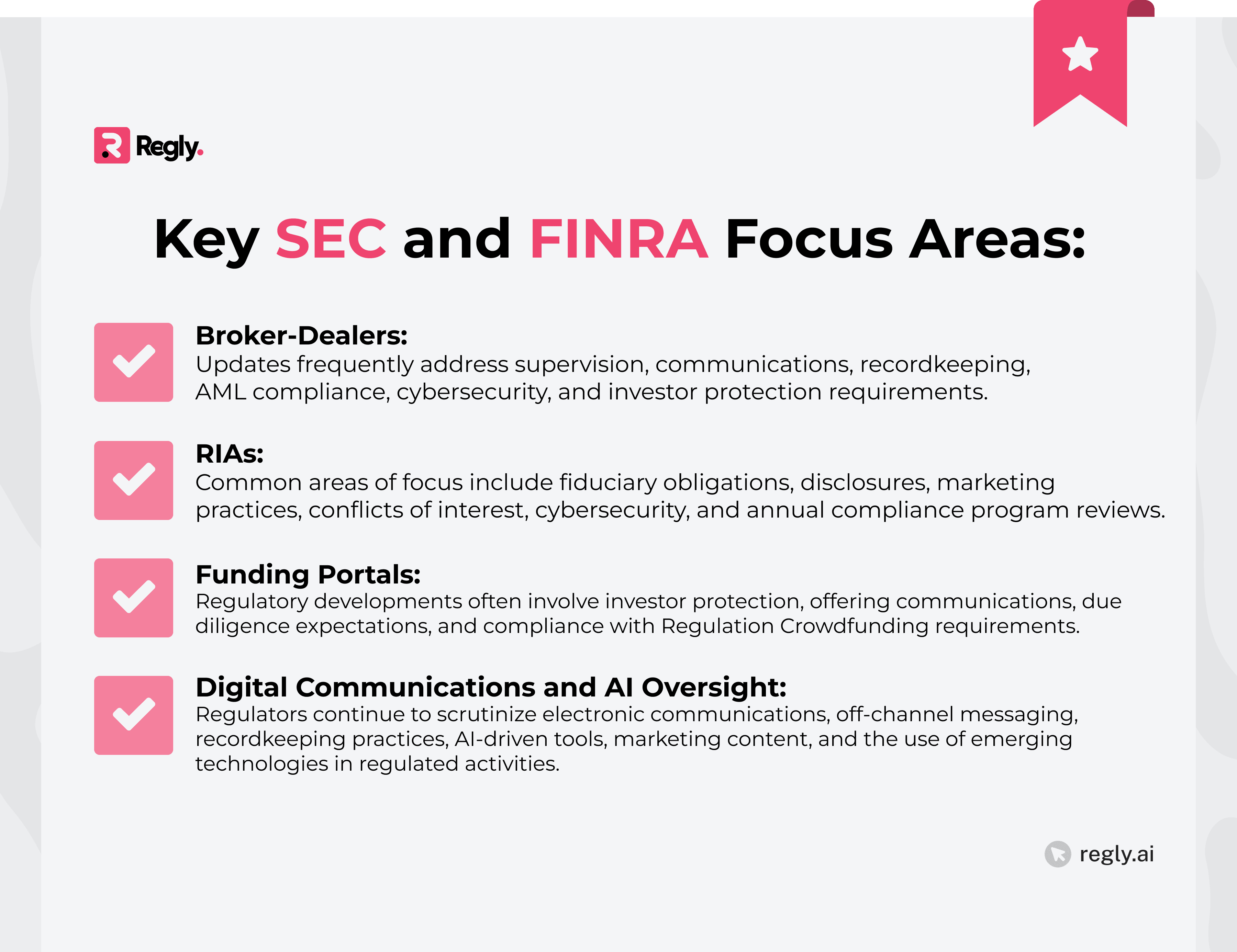
For broker-dealers, registered investment advisors, funding portals, and many fintech firms operating in the securities industry, the SEC and FINRA are often among the most important sources of regulatory updates.
The SEC publishes rule proposals, final rules, risk alerts, enforcement actions, and annual examination priorities. These developments can affect a wide range of areas, including disclosures, marketing practices, cybersecurity, digital assets, artificial intelligence, recordkeeping, and investor protection.
FINRA plays a different role. In addition to maintaining its rulebook, it regularly publishes oversight reports, notices, examination findings, and other guidance that can provide insight into supervisory expectations and common compliance deficiencies. Many broker-dealers view FINRA's Annual Regulatory Oversight Report as a key source of information about examination priorities and emerging risks.
Firms operating in securities-related markets should pay attention not only to new rules but also to examination trends and enforcement activity. In many cases, regulatory focus areas become visible through examinations, guidance, and enforcement actions before major rule changes occur.
CFPB
For fintech companies involved in consumer finance, the Consumer Financial Protection Bureau (CFPB) is another important source of regulatory updates.
The CFPB regularly publishes rules, circulars, advisory opinions, guidance, supervisory highlights, enforcement actions, and research reports. These publications often provide insight into how the agency views consumer protection obligations and emerging risks within financial services.
Consumer protection remains at the center of most CFPB activity. Recent updates have frequently touched on areas such as lending, consumer disclosures, data access, advertising practices, complaint handling, and the growing use of technology in financial services.
These developments are relevant to a broad range of fintech business models. A firm does not need to be a traditional lender to feel the impact of CFPB guidance, enforcement activity, or supervisory findings.
FinCEN and OFAC
FinCEN and OFAC are two of the most important sources of regulatory updates related to financial crime compliance.
The Financial Crimes Enforcement Network (FinCEN) regularly publishes guidance, rulemakings, advisories, enforcement actions, and other communications related to anti-money laundering (AML), suspicious activity reporting, beneficial ownership requirements, and broader Bank Secrecy Act (BSA) obligations.
OFAC plays a different role. The agency administers and enforces US economic and trade sanctions programs. Regulatory updates may include new sanctions programs, changes to sanctions lists, compliance guidance, enforcement actions, and advisories related to emerging sanctions risks.
Key FinCEN and OFAC Focus Area | Why It Matters |
|---|---|
AML Obligations | Updates may affect customer identification procedures, customer due diligence requirements, suspicious activity monitoring, beneficial ownership processes, and overall AML program expectations. |
Sanctions Screening | Regulatory developments can impact screening requirements, watchlist management, risk-based controls, and the identification of sanctioned individuals, entities, jurisdictions, or digital asset wallets. |
Crypto and Payment Monitoring | Guidance and enforcement activity often focus on transaction monitoring, money movement risks, digital asset activity, cross-border payments, and controls designed to detect suspicious or prohibited transactions. |
For fintech companies, AML and sanctions obligations often extend across onboarding, transaction monitoring, customer screening, payments, digital assets, and vendor relationships. As a result, developments from FinCEN and OFAC can affect multiple parts of the business at the same time.
These updates are particularly relevant for money transmitters, payment companies, crypto businesses, neobanks, and other firms that move or facilitate the movement of funds. Even relatively narrow guidance or enforcement activity can influence how firms approach customer due diligence, sanctions screening, monitoring controls, and risk assessments.
OCC, FDIC, and Federal Reserve
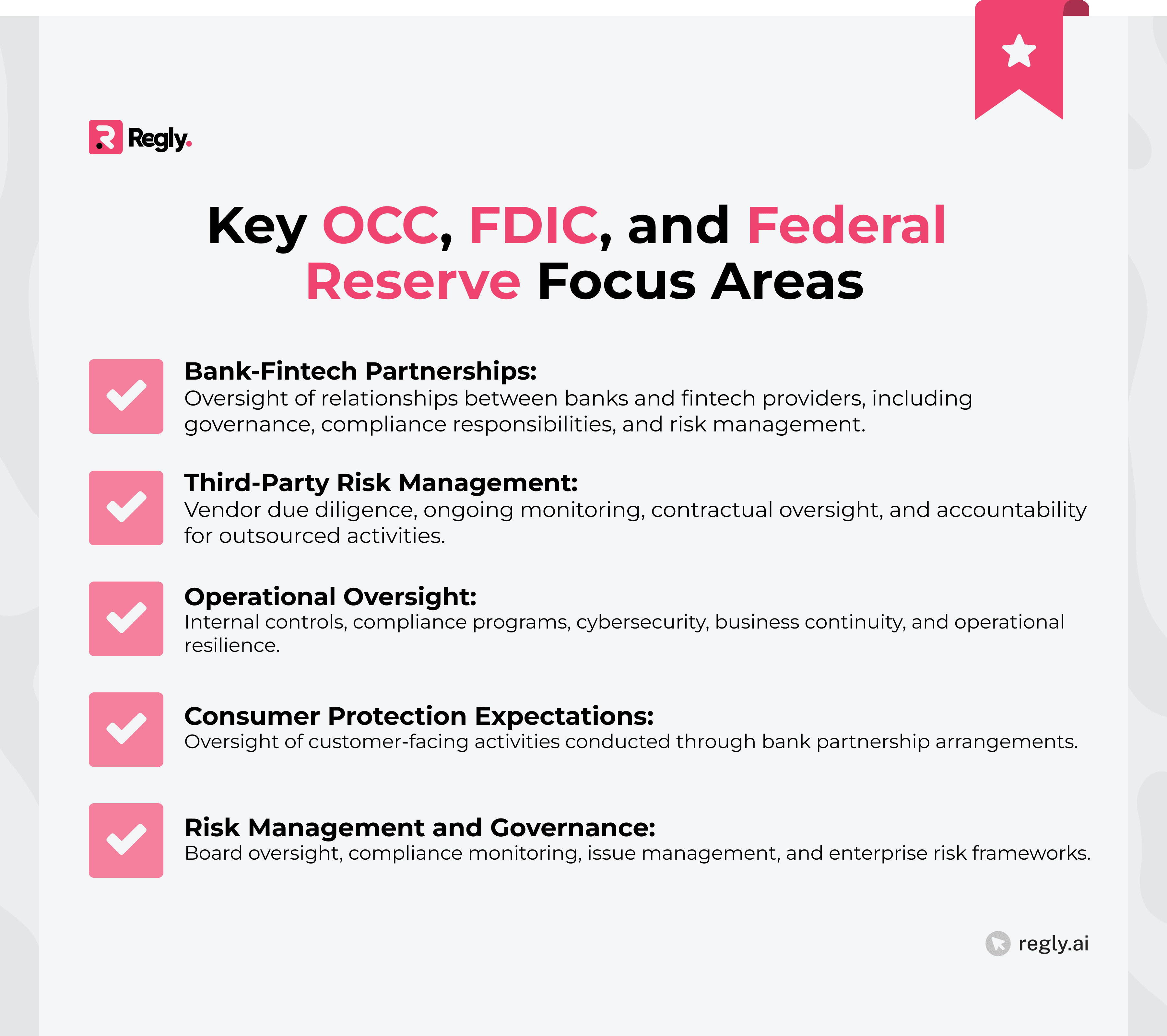
Fintech companies that work with banks should pay close attention to regulatory updates from the OCC, FDIC, and Federal Reserve. While many fintechs are not directly supervised by these agencies, their bank partners often are.
These regulators regularly publish guidance, examination findings, enforcement actions, and other communications addressing risk management, third-party oversight, governance, compliance, operational resilience, and technology-related risks. Updates directed at banks frequently influence the expectations placed on fintech partners.
This is particularly true in areas such as vendor management, compliance oversight, customer protection, BSA/AML compliance, and risk management. In recent years, regulators have devoted significant attention to bank-fintech partnerships and the controls surrounding those relationships.
See how Regly helps fintechs manage and assess vendor relationships →
As a result, regulatory developments affecting banks can quickly become operational requirements for fintech companies that rely on those partnerships to deliver products and services.
State Regulators
Federal regulators receive most of the attention, but state agencies are often just as important for fintech companies.
Many financial activities are regulated at the state level, particularly money transmission, consumer lending, and certain digital asset activities. As a result, regulatory updates may originate from dozens of different state regulators rather than a single federal agency.
Requirements can vary significantly from one jurisdiction to another. A licensing change, new guidance, examination finding, or enforcement action in one state may not apply elsewhere. For firms operating nationally, tracking state-level developments can be one of the most challenging aspects of regulatory monitoring.
New York often receives particular attention because of the NYDFS and its oversight of licensed financial institutions and virtual currency businesses. However, fintech companies should avoid focusing exclusively on one state. State regulatory developments frequently emerge long before similar requirements appear at the federal level.
This is especially relevant for money transmitters, digital asset companies, lending platforms, and other businesses that maintain state licenses or registrations. Changes to state requirements can affect licensing obligations, disclosures, reporting requirements, examinations, and ongoing compliance responsibilities.
Focus Area | Why It Matters |
|---|---|
Money Transmission | State regulators frequently update licensing requirements, reporting obligations, permissible investment rules, and examination expectations for money transmitters and payment companies. |
Crypto and Digital Assets | State-level developments may affect licensing, custody requirements, consumer disclosures, reserve obligations, and compliance expectations for virtual asset businesses. |
Consumer Lending | Regulatory updates can impact lending licenses, disclosure requirements, servicing practices, fee limitations, and borrower protection obligations. |
State Examinations and Reporting | Changes to reporting requirements, examination procedures, remediation expectations, and supervisory communications can affect ongoing compliance responsibilities. |
NYDFS and Specialized State Frameworks | Certain states, particularly New York, maintain specialized regulatory frameworks that can influence licensing, cybersecurity, virtual currency activities, and risk management expectations. |
Why Most Teams Fail to Operationalize Regulatory Updates
Moving from regulatory awareness to implementation requires coordination across multiple teams, clear ownership, and a repeatable process. Without those elements, important regulatory updates can lose momentum long before any meaningful action takes place.
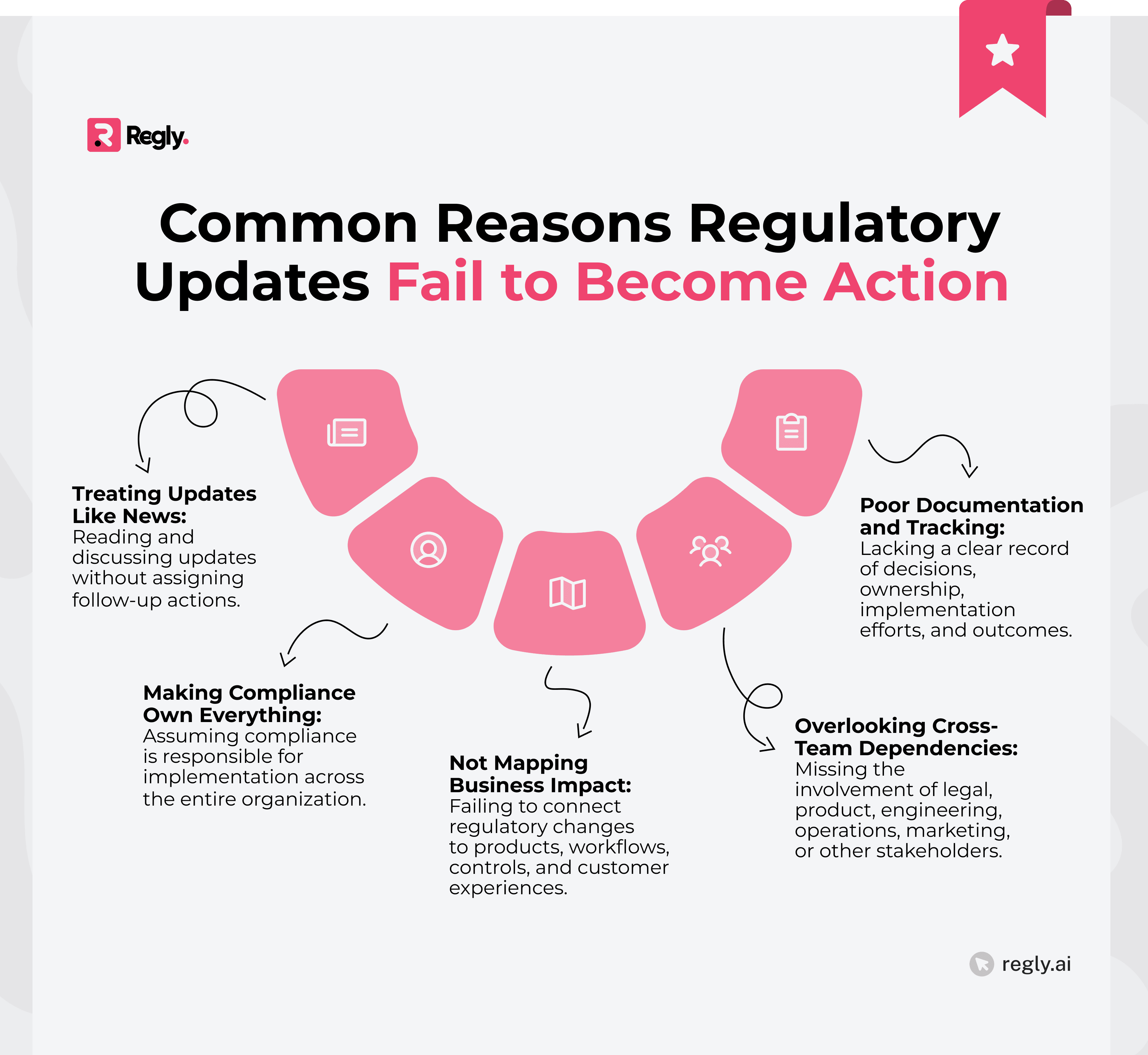
Treating Updates Like News, Not Action Items
Many organizations consume regulatory information the same way they consume industry news.
Teams subscribe to newsletters, attend webinars, read legal summaries, and monitor regulator announcements. The information is useful, but collecting information is not the same as responding to it.
The question that often goes unanswered is simple: "What are we supposed to do with this?" Until someone answers that question, the update has not really entered the compliance process.
Assuming Compliance Owns Everything
Many regulatory developments begin with the compliance team, but very few end there.
A new requirement may ultimately require changes to a product feature, customer communication, onboarding workflow, marketing campaign, vendor relationship, or engineering process. Compliance can identify the issue and help interpret the requirement, but implementation often depends on other parts of the organization.
Problems arise when regulatory changes are treated as compliance-only projects. Work stalls, priorities compete for attention, and necessary updates never materialize because the teams responsible for execution were not fully engaged.
Failing to Map Updates to Products and Workflows
Reading a regulatory update is one task. Determining where it applies is another.
A fintech may operate several products, serve different customer segments, or hold multiple licenses. When a regulatory development arrives, the immediate question should be: which parts of the business could be affected?
Too often, that analysis never happens. The update is reviewed, but nobody traces it back to the products, processes, controls, or customer interactions that may need to change.
Missing Cross-Functional Dependencies
Very few regulatory changes affect only one team.
A disclosure update may require input from legal, compliance, product, marketing, and engineering. A new AML requirement may involve compliance, operations, technology, and vendor management. The more complex the business, the more likely it is that implementation will span multiple departments.
Problems arise when those dependencies are identified too late. One team completes its work, only to discover another team was expected to make related changes that were never planned or prioritized.
Weak Documentation and Audit Trails
Implementation is only part of the process. Firms also need a record of how decisions were made.
When regulators, auditors, investors, bank partners, or internal stakeholders review a compliance program, they often want to understand how a regulatory development was evaluated and what actions followed. In many organizations, that information is scattered across emails, meeting notes, spreadsheets, and messaging platforms.
The work may have been completed correctly, but without documentation, it can be difficult to demonstrate who reviewed the update, what conclusions were reached, and whether required changes were ultimately implemented.
How to Turn Regulatory Updates Into Clear Obligations
Identifying a regulatory development is only the starting point. The real challenge is translating that development into decisions, tasks, owners, timelines, and documented outcomes.
While every organization approaches regulatory change differently, most successful programs follow a similar process from initial review through implementation:
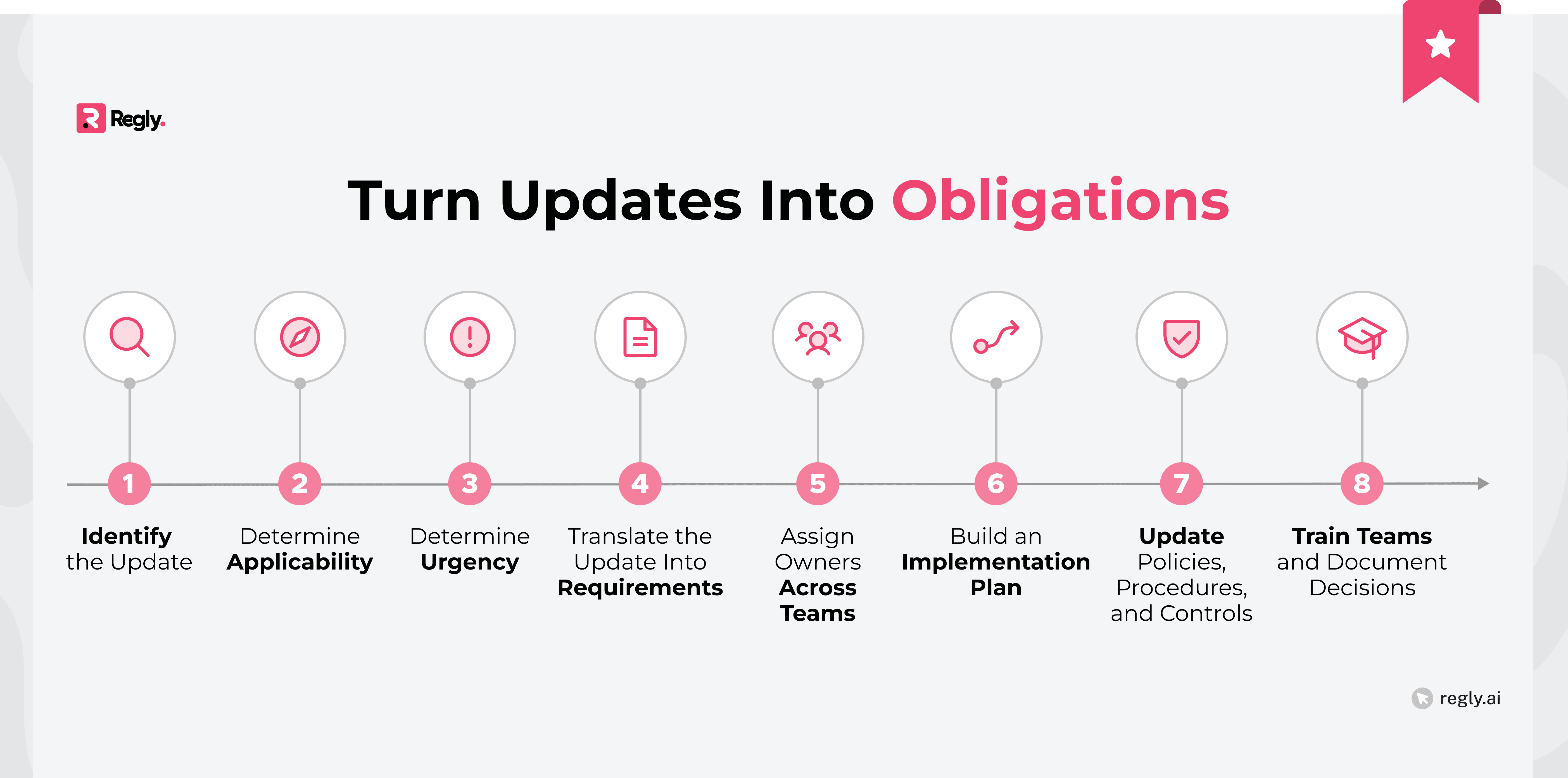
Step 1: Identify the Update
Every process starts with visibility. Before a firm can evaluate a regulatory development, it needs to know that the development exists.
Updates may come from regulators, outside counsel, compliance consultants, industry associations, trade publications, bank partners, or regulatory monitoring tools. The source matters, but the source alone is not enough.
The first task is determining whether the development is relevant to the business. Not every rulemaking, enforcement action, guidance document, or examination report requires further review. The goal is to separate developments that could affect the organization from those that are simply worth monitoring.
Step 2: Determine Applicability
Once a regulatory development has been identified, the next question is straightforward: does it apply to the business?
That assessment is not always as simple as it sounds. A fintech may operate under multiple licenses, serve different customer groups, offer several products, and operate across numerous jurisdictions. An update may affect one part of the business while having little or no impact on another.
Before assigning work or discussing implementation, firms should understand which entities, products, customers, and regulatory frameworks are actually affected. A clear applicability assessment can prevent unnecessary work while reducing the risk that important obligations are overlooked.
Step 3: Determine Urgency
Not every regulatory update belongs at the top of the priority list.
A final rule with a near-term implementation deadline will usually require a different response than a proposed rule, examination report, or industry guidance document. Both may be important, but they don’t necessarily require the same level of urgency.
Determining urgency helps organizations allocate resources appropriately and avoid situations where critical compliance projects compete with lower-priority regulatory developments.
Step 4: Translate the Update Into Plain-English Requirements
Regulators write for legal and regulatory audiences. Most employees are not legal or compliance professionals.
For that reason, regulatory requirements often need to be translated into language that business teams can understand and act on. A product manager should not have to interpret regulatory text to understand what needs to change. The same is true for engineers, marketers, operations teams, and vendors.
The most effective compliance teams focus on converting regulatory requirements into practical instructions:
What process needs to change?
What control needs to be added?
What disclosure needs to be updated?
What evidence needs to be retained?
Those questions are often more useful than lengthy regulatory summaries.
Step 5: Assign Owners Across Teams
A requirement without an owner is just a suggestion.
Once the impact of a regulatory update has been defined, responsibility should be assigned to the teams responsible for the affected processes. In many cases, ownership will extend beyond compliance.
Compliance may coordinate the effort, but implementation often sits with product, engineering, operations, marketing, legal, or vendor management teams. Assigning ownership early helps reduce confusion and creates accountability for follow-through.
Step 6: Build an Implementation Plan
Once ownership has been established, the focus shifts to execution.
Most regulatory changes involve more than a single task. Procedures may need to be revised. Controls may need to be updated. Technology changes may require development time, testing, approvals, and deployment planning. Training may need to be scheduled. Vendors may need to be engaged.
Breaking the work into specific tasks, deadlines, dependencies, and milestones makes implementation easier to manage. It also provides visibility into potential delays before they become larger problems.
Step 7: Update Policies, Procedures, and Controls
Regulatory obligations eventually need a permanent home inside the organization.
That often means updating written supervisory procedures, AML programs, compliance manuals, customer disclosures, review processes, training materials, and operational controls. The exact documents will vary depending on the nature of the requirement.
The objective is to make the new process part of normal operations rather than a one-time compliance project.
Step 8: Train Teams and Document Decisions
A regulatory change is not fully operationalized until the people affected by it understand their responsibilities.
Depending on the nature of the update, that may involve formal training, targeted communications, updated procedures, team meetings, or process walkthroughs. The objective is to make sure employees understand what changed and how their day-to-day responsibilities may be affected.
Documentation is equally important. Firms should maintain a record of how the regulatory development was evaluated, what decisions were made, who approved those decisions, and what actions were ultimately taken. That information often becomes valuable during examinations, audits, due diligence reviews, and internal assessments.
How Technology Helps Teams Manage Regulatory Updates
Technology cannot replace regulatory judgment, but it can help teams organize information, track obligations, coordinate implementation efforts, and maintain documentation as regulatory requirements evolve.
Centralized Obligation Tracking
Regulatory change management often becomes fragmented over time.
A compliance team may track updates in a spreadsheet, assign implementation work through a project management platform, store supporting documents in shared folders, and discuss decisions through email or chat. When information is spread across multiple locations, understanding the status of a regulatory obligation becomes much more difficult.
Centralizing that information makes it easier to understand what has been reviewed, what actions are underway, who is responsible, and what work remains outstanding.
Automated Workflows and Reminders
Many regulatory projects fail because follow-up work gets lost among competing priorities.
A task is assigned during a meeting. A deadline is discussed. Everyone agrees on the next steps. Several weeks later, the work is still sitting in someone's queue because no formal tracking or follow-up process existed.
Automated workflows and reminders help keep implementation activities visible, particularly when multiple teams, deadlines, and dependencies are involved.
Collaborative Review Processes
Most regulatory updates require input from more than one department.
Compliance may interpret the requirement. Legal may review the implications. Product may assess customer impact. Engineering may evaluate technical changes. Operations may determine how new procedures fit into existing workflows.
When those conversations happen through long email chains and disconnected meetings, decisions can become difficult to track. Collaborative review tools help bring stakeholders together and create visibility into comments, approvals, questions, and next steps.
Reporting and Audit Trails
Questions about regulatory implementation rarely disappear after a project is completed.
An auditor may ask when a change was implemented. A regulator may want to understand how a requirement was evaluated. A bank partner may request evidence that a control was updated. Months later, finding those answers can become difficult if the information was never documented in a structured way.
Reporting tools and audit trails help preserve that history by capturing decisions, approvals, implementation activities, and supporting documentation in a format that can be reviewed later.
AI-Assisted Risk Flagging
Reviewing regulatory updates manually can be time-consuming, particularly when firms are monitoring multiple regulators, jurisdictions, and business lines at the same time.
AI tools can help by identifying themes, categorizing updates, highlighting potentially relevant developments, and surfacing regulatory changes that may warrant additional review. This can help compliance teams focus their attention on higher-priority items.
The final determination still belongs to the business. Technology may help identify potential risks, but applicability assessments, implementation decisions, and regulatory interpretations remain human responsibilities.
Regly Monitor
Regly Monitor is designed for the first stage of regulatory change management: understanding which updates deserve attention.
The platform tracks regulatory updates across relevant regulators, ranks them by relevance, and evaluates their potential impact. That helps compliance teams move more quickly from "a regulator published something" to "this may matter to our business."
Regly Monitor can also be customized around a firm's specific products, licenses, regulators, and risk profile. For fintech companies, that context matters. A development that is critical for one business model may be irrelevant to another.
—
Regulatory updates are inevitable. The challenge is determining what they mean for the business and translating them into action.
A structured process can help firms evaluate developments, identify obligations, assign ownership, and track implementation. Without that process, implementing critical updates can easily lose momentum.
As regulatory expectations continue to evolve, technology can help teams focus on the most relevant developments and keep actionable efforts organized.
Ready to Get Started?
Schedule a demo today and find out how Regly can help your business.