If you’re building a fintech company, you’re also building a compliance program, whether you realize it or not. The moment you accept funds, onboard customers, or advertise financial products, you have entered a regulated space.
Regulators don’t distinguish between “startup” and “established” when it comes to compliance expectations, while investors, partners, and banks increasingly want to see structure and accountability from the outset.
In this article, we’ll walk through how to meet those expectations by building a scalable compliance program from day one. You’ll learn how to map your regulatory landscape, assess risk, design a practical framework, and use technology to automate routine tasks.
What Is a Compliance Program?
A compliance program is the framework your company uses to follow the laws and regulations that apply to its operations. It’s the system that keeps policies, controls, and oversight organized so your business can grow without crossing regulatory lines.
For fintechs, this includes everything from how you verify customer identities to how you manage data, communicate with clients, and report suspicious activity. A good compliance program isn’t about paperwork; it’s about building repeatable processes that prevent risks before they become regulatory issues.
Core Components of a Scalable Compliance Program
A compliance program that actually works becomes woven into how your company operates day to day. It shapes product decisions, influences how teams handle data, and determines what gets documented and when.
The program needs several key pieces to function properly:
Leadership and Accountability Structure
Someone needs to own compliance, and that person needs real authority to make it stick. A compliance officer who can't access decision-makers or influence product development won't get far. The founder and executive team have to treat compliance as core to the business, not a box-checking exercise that legal handles on the side.
Policies and Procedures
Written policies turn regulatory requirements into clear, actionable steps. They define how your company manages AML/KYC, marketing reviews, consumer disclosures, data protection, and more. These documents should be concise, current, and tailored to your specific products, not copied from another firm’s template.
Learn more about policy management in our article →
Internal Controls and Reporting Lines
Controls are the checkpoints that detect and prevent problems. This includes transaction monitoring, complaint tracking, access management, and escalation workflows.
Reporting lines should be clear so that compliance findings move upward quickly and transparently. Documentation matters, and if it’s not recorded, regulators will assume it didn’t happen.
Difference Between Compliance, Legal, and Risk Management
Compliance helps the company follow existing laws and regulations.
Legal interprets those laws and advises on obligations.
Risk management identifies and mitigates operational, financial, and reputational risks that extend beyond regulatory scope.
In a fintech startup, these functions often overlap. But a strong compliance program usually bridges all three, creating structure around accountability while keeping the business agile.
Function | Primary Focus | Typical Activities | How It Connects to a Compliance Program |
|---|---|---|---|
Compliance | Adhering to laws, regulations, and internal policies | Implementing AML/KYC procedures, monitoring transactions, maintaining records, and training employees | Forms the operational core and translates regulations into daily controls and reporting |
Legal | Interpreting laws and advising on obligations | Reviewing contracts, assessing regulatory applicability, managing licensing and disclosures | Guides compliance on what rules apply and how they should be interpreted |
Risk Management | Identifying and mitigating threats to operations, finances, or reputation | Conducting risk assessments, scenario planning, and control testing | Works with compliance to prioritize high-risk areas and allocate resources effectively |
Why Fintechs Need a Compliance Program From Day One
In 2026, every fintech needs a compliance program that scales with its growth. Here are the reasons your fintech should consider building its compliance program now:
Fintechs face full regulatory scrutiny from day one. Even at launch, activities like onboarding customers, transferring funds, or handling data fall under financial and consumer protection laws.
Early compliance signals credibility. Investors, partner banks, and payment processors now expect fintechs to have defined oversight, policies, and accountability before doing business. Without it, many partnerships stall or fail.
Delaying compliance creates regulatory debt. Startups that postpone compliance often spend months revising products, updating contracts, or recreating records to satisfy regulators later. Building early avoids costly rework.
Compliance protects growth, not just reputation. A clear framework helps keep innovation aligned with regulatory expectations, allowing the company to scale without the risk of interruptions.
Real consequences follow late compliance. Fines, partnership terminations, and reputational damage are common when compliance lags behind operations. Rebuilding trust later takes significantly more effort than establishing credibility from the beginning.
What Happens When Compliance Comes Too Late
When compliance is an afterthought, the consequences are serious.
Regulatory penalties: Several fintechs have faced enforcement actions for failing to register, maintain AML programs, or protect customer data. These cases often start small but can quickly escalate into multimillion-dollar fines.
Lost partnerships: Banks and payment processors are required to monitor the fintechs they work with. If your compliance program doesn’t meet their standards, they can terminate your agreement with little warning.
Damaged credibility: Regulators and investors remember the companies that cut corners. Once trust is lost, rebuilding it takes far more time and effort than setting up compliance correctly from the start.
In short, early investment in compliance isn’t a luxury or a distraction from growth. It’s what keeps growth possible. Many startups mistakenly treat compliance as something only well-funded companies can afford, pushing it off until Series A or beyond.
But that mindset misses the point: compliance costs multiply when retrofitted onto existing operations. The fintechs that view compliance as part of their business model, not a post-launch fix, are the ones positioned to scale sustainably.
They avoid the expensive scramble of trying to untangle non-compliant processes while simultaneously satisfying regulators and nervous investors.
Step 1: Map Your Regulatory Landscape
Before you build a compliance program, you need to understand which rules actually apply to your business. Fintech regulations aren’t one-size-fits-all; they depend on your activities, business model, and where you operate. Mapping your regulatory landscape is the foundation of every scalable compliance program.
Missing one early can mean costly licensing delays or enforcement risks later.
Identify Which Laws and Regulators Apply to Your Business Model
Start by identifying the financial services you provide. Are you transmitting funds, providing investment advice, lending, or issuing digital assets?
Each activity triggers different regulatory frameworks and oversight bodies, helping you acknowledge which laws and regulators apply to you:
Key US Regulators
Fintechs in the US may fall under multiple regulators at once, including:
SEC: Oversees investment advisors, broker-dealers, and securities offerings.
FINRA: Supervises broker-dealers and registered representatives.
CFTC: Regulates derivatives and certain crypto assets considered commodities.
CFPB: Focuses on consumer financial protection and fair lending.
FinCEN: Enforces anti-money laundering (AML) and Know Your Customer (KYC) obligations under the Bank Secrecy Act.
OCC, FDIC, and Federal Reserve: Supervise banks and their fintech partners.
State regulators: Oversee money transmission, lending, and other state-licensed activities.
Fintechs operating through bank partnerships must also meet the bank’s own regulatory expectations. Partner banks often extend their compliance requirements to fintechs, creating an additional layer of scrutiny.

Global Counterparts
If your fintech serves customers outside the US, equivalent regulators apply in each jurisdiction. Examples include:
FCA (UK): Regulates consumer credit, payments, and digital assets.
ESMA and local EU regulators: Enforce PSD2, MiCA, and GDPR compliance.
MAS (Singapore): Oversees fintech payments, digital token services, and e-money institutions.
ASIC (Australia): Regulates consumer finance, markets, and digital financial services.
FINMA (Switzerland): Supervises crypto asset service providers and payment institutions.
Global compliance can be complex because rules differ across borders. For example, GDPR applies even if your company isn’t based in the EU but processes EU customer data.
Build Your Regulatory Roadmap
Once you’ve identified your applicable regulators, build a simple regulatory roadmap. This should include:
Licenses and registrations that are required in each jurisdiction
Reporting obligations (e.g., suspicious activity, financial disclosures, consumer complaints)
Core compliance domains such as AML/KYC, data privacy, consumer protection, and cybersecurity
Key deadlines or renewal cycles for filings or audits
Documenting this roadmap early creates clarity and saves time later when your compliance program scales. Compliance software like Regly can help map and update these obligations automatically, so teams stay aligned as new rules, jurisdictions, or product lines are added.
Step 2: Conduct a Compliance Risk Assessment
Once you understand which regulations apply, the next step is to identify where your business is most exposed. A compliance risk assessment helps you prioritize what matters most, so you can allocate resources effectively instead of spreading them too thin.
Identify and Categorize Your Core Compliance Risks
Start by mapping out each area of your business that touches regulation. For each, define:
What could go wrong (e.g., incomplete KYC, misleading marketing, system breaches)
How likely it is to happen
The potential impact on financial, legal, or reputational grounds
Then assign a risk level (low, medium, high) and link it to existing or planned controls. This process gives you a clear view of where your compliance program should focus first.
Common Fintech Risk Areas
Every fintech operates differently, yet the same risk areas keep surfacing across the industry:
AML and KYC: Weak customer verification or transaction monitoring can lead to serious enforcement actions.
Consumer protection: Inaccurate disclosures, hidden fees, or unfair practices can trigger investigations by regulators like the CFPB.
Data privacy: Mishandling customer data violates both domestic and global privacy laws such as GLBA, GDPR, and CCPA.
Cybersecurity: Insufficient system controls expose customer assets and personal information.
Vendor and partnership risk: Outsourced functions still fall under your regulatory responsibility because partners are extensions of your compliance environment.
Marketing and communications: Claims that misrepresent product risks or guarantees are frequent causes of regulatory scrutiny.
Prioritize Risk Mitigation for Limited Startup Resources
Startups rarely have the staff or budget to address every risk at once. Focus first on high-impact areas where failure could lead to regulatory or operational shutdowns, typically:
AML/KYC
Data protection
Consumer fairness
Once those foundations are in place, expand gradually. Build controls, document your reviews, and create evidence of oversight. Even a simple, well-documented risk matrix can demonstrate to investors and partner banks that you’re managing compliance methodically.
Step 3: Design Your Compliance Program Framework
After identifying your regulatory requirements and risk areas, the next step is to build a framework that connects policies, controls, reporting, and oversight into one coherent system. This framework becomes the backbone of your compliance program, guiding how your team operates day to day.
Start small but be intentional. Your goal is to create a structure that’s strong enough to meet current obligations yet flexible enough to scale as your product and footprint grow. Over-engineering too early slows execution, while under-building leaves gaps that can turn into regulatory issues later.
A practical compliance framework should include:
Governance structure: Define who owns compliance, who approves policies, and how decisions are documented.
Policies and procedures: Translate legal requirements into clear, operational steps.
Monitoring and reporting processes: Establish how compliance performance is tracked and reported to leadership.
Training and awareness: Build a consistent understanding of obligations across the company.
Escalation protocols: Set clear paths for identifying, reporting, and resolving potential issues.
Document each component in a compliance manual or digital hub so new team members, auditors, or partners can easily understand how your company manages regulatory obligations.
Step 4: Build the Right Compliance Culture
Even the best-designed compliance program fails without the right culture behind it. Start at the top. Founders and executives set the tone through what they prioritize, how they communicate, and where they allocate resources.
When leadership treats compliance as integral to product and strategy discussions, teams naturally follow. Conversely, if compliance is seen as a legal formality, employees will too.
Here are some practical steps to build a culture of compliance:
Integrate compliance into onboarding. Every new hire, whether technical, operational, or customer-facing, should understand the company’s regulatory obligations and ethical standards.
Communicate regularly. Keep compliance visible through company updates, team briefings, and accessible reporting channels.
Make compliance approachable. Encourage employees to ask questions or raise concerns without fear of retaliation. A simple, confidential escalation channel often prevents bigger issues later.
Recognize good behavior. Acknowledge when teams follow compliance best practices. Positive reinforcement builds engagement and accountability.
Culture is built through consistency. When compliance expectations are reinforced in daily operations, employees begin to internalize them as part of “how we work.”
Learn more about best practices for employee compliance →
Step 5: Encourage Internal Reporting and Whistleblowing With Training
An effective compliance program depends on visibility. You can’t address issues you don’t know about, which is why internal reporting and training are essential to building scalable compliance from day one.
Employees should have a clear, confidential way to report potential compliance concerns. That can include:
Anonymous web-based reporting tools or hotlines
Direct access to a compliance officer or designated manager
Clear policies protecting employees from retaliation
Visibility matters. Teams are far more likely to speak up if they trust that their report will be handled seriously and discreetly. Regulators, including the SEC and FINRA, specifically review whether firms maintain and promote credible internal reporting systems during examinations.
Compliance training shouldn’t be a once-a-year formality. It should equip employees with the context and judgment they need to make the right decisions in real situations. Keep it:
Role-specific: Tailor content to what different teams actually face (e.g., AML for onboarding, marketing compliance for growth teams).
Scenario-driven: Use real examples of fintech compliance failures and how they could have been prevented.
Short and ongoing: Deliver training in digestible sessions throughout the year instead of one long presentation.
Regular refreshers reinforce awareness and keep compliance expectations aligned with business changes.
Regly can help automate this process by centralizing training, tracking participation, and maintaining audit-ready records of reports and responses. That structure makes it easier for small compliance teams to stay proactive as the company scales.
Step 6: Use Automation and Compliance Technology
As your fintech grows, manual compliance processes eventually reach their limit. Tracking policies, audits, and filings across multiple systems quickly becomes unmanageable. That’s where you’ll need to automate and bring in compliance software for your fintech.
Automation doesn’t replace compliance judgment, but it strengthens it. The right tools handle the operational load, allowing compliance officers to focus on higher-value work like interpreting new rules or assessing complex risks.
Here are some of the tasks that compliance platforms can help you with:
Monitoring and surveillance: Tools can automatically flag unusual transactions, risky communications, or policy exceptions.
Recordkeeping: Centralized systems store version-controlled policies, approvals, and audit trails that are easy to retrieve during reviews.
Training and certifications: Automated reminders keep staff certifications and learning modules on track.
Regulatory reporting: Some platforms generate pre-formatted reports and track filing deadlines to prevent missed submissions.
Workflow management: Automated case management helps track investigations, vendor reviews, and compliance requests from start to finish.
But how can you tell if a compliance platform actually works for your business model? Look for these three qualities in any compliance software worth considering:
How To Choose Your Compliance Platform | ||
|---|---|---|
Configurability | Integration | Transparency |
Adapts workflows to your compliance needs | Connects with existing tools like CRM, HR, and monitoring | Provides clear audit trails and real-time dashboards |
Platforms like Regly can automate repetitive compliance tasks while keeping oversight transparent. The result is a compliance program that grows efficiently alongside your operations.
Step 7: Monitor, Test, and Adapt Your Program
To truly know if your compliance program is scalable, you must monitor and test it. Once your framework is in place, ongoing monitoring and testing keep it effective and credible in the eyes of regulators, partners, and auditors.
Set Up Ongoing Monitoring and Internal Audits
Establish a regular cadence for reviewing compliance activities. This can include checking transaction alerts, policy adherence, and documentation quality. For fintechs working with banks or payment partners, internal reviews help prepare for external audits and examinations.
Keep records of what you review, who conducted it, and what actions followed. Regulators value documented evidence of consistent oversight.
Test Controls and Document Evidence Regulators Expect
Don’t wait for a problem to test your program. Simulate common compliance scenarios like a suspicious transaction, a customer complaint, or a data access request to see if your controls respond as expected. Testing reveals weak spots before they turn into violations.
Record every test result and remediation step. In regulatory reviews, the ability to show data-backed evidence of your program’s effectiveness often matters more than the format of your policies.
Adapt To New Laws and Business Changes
As your fintech grows or enters new markets, your compliance obligations shift. Schedule regular program reviews quarterly or biannually to update policies and controls. Assign ownership for tracking regulatory changes so updates don’t fall through the cracks.
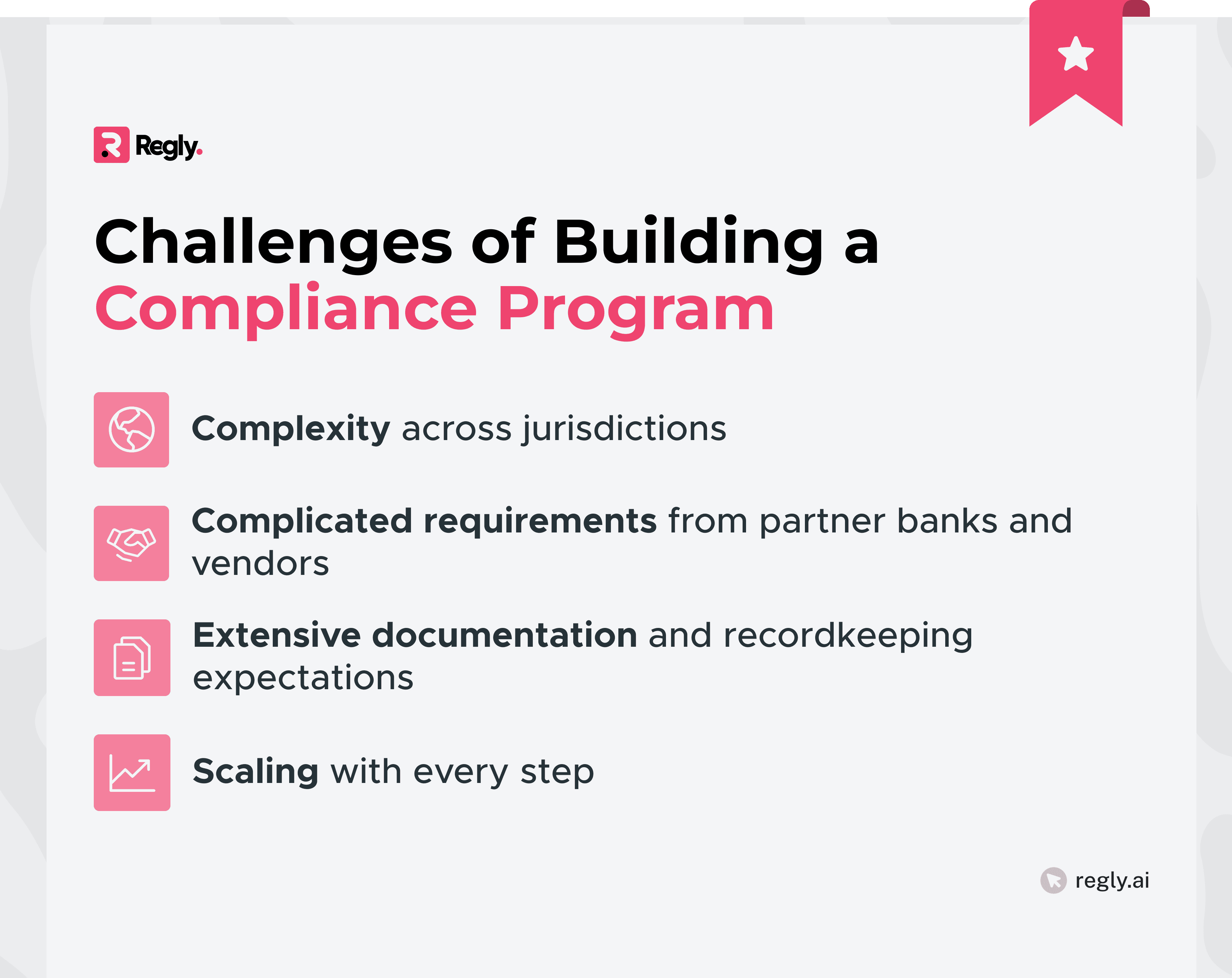
Common Challenges of a Compliance Program
Even the most well-structured compliance program comes with practical challenges. Recognizing these hurdles early helps you plan around them instead of reacting under pressure.
Multi-Jurisdictional Complexity
Operating across states or countries multiplies compliance requirements. Each region may define money transmission, data handling, or consumer protection differently. What’s compliant in one market might raise red flags in another.
Tip: Maintain a regulatory matrix to track rules by jurisdiction and update it as you expand.
Partner Bank and Vendor Oversight Requirements
Most fintechs depend on partner banks, processors, and vendors to deliver services. Those partners face regulatory pressure to closely monitor your compliance posture. Expect audits, documentation requests, and ongoing due diligence. Having clear records, current policies, and evidence of oversight keeps these reviews smooth and reduces business interruptions.
Documentation and Recordkeeping Under Pressure
Startups often underestimate the volume of documentation regulators expect:
Training logs
Approval records
Customer communications
Missing evidence can make even compliant actions appear noncompliant. Keep a consistent filing process and use centralized tools to store records in an accessible, audit-ready format.
Scaling Compliance Alongside Rapid Product Development
As your fintech launches new features, compliance must evolve in step. A new payment flow, marketing campaign, or customer segment can trigger different regulatory obligations. Embed a compliance review in your product and marketing cycles early. That prevents last-minute delays when launching updates or new offerings.
Key US Updates on Compliance Programs
Fintech regulation in the US continues to evolve, tightening expectations for how companies structure and maintain their compliance programs. Staying current with these developments helps your fintech anticipate changes instead of reacting to them:
Expanding AML and KYC Requirements
FinCEN has broadened its scope under the Bank Secrecy Act, extending anti-money laundering (AML) obligations to more sectors. Recent proposals and guidance would bring certain investment advisors and fintech intermediaries under AML rules for the first time.
Startups handling funds or digital assets should plan for more robust KYC programs and transaction monitoring as part of their compliance framework.
Beneficial Ownership Reporting
Recent legal developments have significantly changed which companies must report Beneficial Ownership Information (BOI) to FinCEN under the Corporate Transparency Act (CTA).
Following the latest court ruling, most US domestic companies are now exempt from BOI reporting requirements. This includes the majority of early-stage startups and small U.S.-formed businesses that previously expected to file.
However, certain entities may still be required to report their beneficial owners, depending on their structure and activities. The purpose of BOI reporting remains the same: to support national efforts to combat money laundering, terrorist financing, and the misuse of opaque corporate structures.
Because the regulatory landscape continues to evolve, fintech founders should verify whether they fall into an exempt category and monitor FinCEN's updates closely.
Stablecoin and Digital Asset Regulation
Stablecoin and digital asset regulation in the US has materially advanced with the passage of the GENIUS Act. This law establishes the first comprehensive federal framework for stablecoins, creating clear requirements for issuers, custodians, and platforms offering digital asset services.
Under the GENIUS Act, stablecoin issuers must now meet specific standards, including:
Full reserve backing with high-quality, highly liquid assets
Mandatory disclosures to ensure users understand risks and redemption rights
Strict operational, governance, and auditing requirements to safeguard customer funds
Clear protections for consumers in the event a platform fails or becomes insolvent
For fintech firms interacting with stablecoins or digital assets, whether issuing, custodying, or facilitating transactions, compliance expectations are now more defined. You will need to reassess how you structure reserves, manage custody, and communicate risks to users to align with the new federal rules.
Heightened Focus on Consumer Protection
The CFPB continues to expand oversight of digital financial products, focusing on fairness, transparency, and data privacy. Fintechs offering lending, credit-building, or payments products should review their marketing materials, fees, and customer communication for compliance with UDAAP (unfair, deceptive, or abusive acts or practices) standards.
These updates signal a shift toward broader accountability across all financial innovators, not just traditional institutions.
Global Developments
Fintech regulation is expanding beyond the US, with new frameworks emerging across Europe, the UK, and Asia to increase transparency, consumer protection, and operational resilience.
Europe: MiCA and DORA
The Markets in Crypto-Assets Regulation (MiCA) introduces licensing and disclosure requirements for crypto service providers in the EU. It brings digital assets under a single regulatory framework, requiring companies to hold sufficient reserves, disclose risks, and protect client assets.
Alongside MiCA, the Digital Operational Resilience Act (DORA) focuses on technology risk management. It requires financial entities, including fintechs, to demonstrate that their systems and third-party vendors can withstand disruptions and cyberattacks.
United Kingdom: Consumer Duty
The FCA’s Consumer Duty, effective since 2023, raises the standard for how financial products are designed, marketed, and supported. It requires firms to demonstrate that their offerings lead to fair, positive outcomes for customers. This pushes compliance programs to focus not just on adherence, but on measurable customer results.
Asia-Pacific: Increasing Alignment With Global Standards
Regulators in Singapore, Australia, and Hong Kong are tightening fintech oversight through licensing, AML, and consumer protection requirements.
Singapore’s MAS now mandates licensing for digital payment token services and applies strict AML expectations. Australia’s ASIC has also expanded its focus on misleading marketing in financial products, particularly among digital lenders and investment apps.
Global convergence around transparency, resilience, and consumer outcomes means fintechs must build compliance programs capable of adapting across jurisdictions. The trend is clear: regulators want to see not just compliance policies, but proof that they work in practice.
How to Future-Proof Your Compliance Program
Regulatory expectations and business models are fluid. A future-proof compliance program is one that adapts quickly to new rules, markets, and technologies without needing a complete rebuild with every change:
Embedding Adaptability into Policies and Tools
Write policies that define principles, not just procedures. Instead of locking in rigid processes, describe the standards your company upholds. Then use technology to update workflows as regulations change. Centralized compliance tools make this easier by tracking rule changes and automatically mapping them to affected policies.
Tracking Regulatory Change Efficiently
Assign ownership for monitoring new regulations and enforcement trends. This could be a compliance officer, a regulatory affairs lead, or an external consultant. Create a simple change log or dashboard showing:
New or proposed rules
Impacted products or teams
Required actions and due dates
This keeps your compliance program current and prevents missed updates.
Aligning Compliance Maturity with Business Milestones
As your fintech scales, your compliance program should scale with it. Set milestones such as seed stage, Series A, Series B, and define what maturity looks like at each stage. For example, early-stage fintechs might focus on core AML and consumer protection controls, while later stages add internal audit and independent testing functions.
Turning Compliance into a Competitive Advantage
A well-documented, proactive compliance program signals reliability to regulators, banks, and investors. It speeds up partnership approvals and reduces time spent on due diligence. Over time, this maturity becomes a business differentiator, showing that your fintech can innovate responsibly and operate sustainably.
—
In a market where regulation is tightening worldwide, compliance has become a measure of credibility. Fintechs that integrate compliance early move faster, build stronger partnerships, and earn more trust from regulators and customers alike.
A good compliance program doesn’t need to be large or expensive; it needs to be structured, consistent, and adaptable. Start with clear ownership, document your processes, use automation where it adds value, and keep your framework updated as your business evolves.
That’s how you build a scalable compliance program.
Ready to Get Started?
Schedule a demo today and find out how Regly can help your business.