During the exam request review, examiners often ask for evidence that a customer disclosure issue identified six months ago was fully remediated. The compliance team knows the issue was discussed internally, but the supporting documentation is scattered across emails, spreadsheets, and meeting notes. No one can clearly show who owned the remediation, what actions were taken, or whether the problem was ever resolved.
Situations like this are why compliance issue management has become a critical function for regulated financial services firms. The challenge is creating a repeatable process to identify issues, track corrective actions, and demonstrate progress when regulators, auditors, or senior management ask questions.
This article explains how compliance issue management works, how firms can build an effective issue-tracking process, what information should be documented, and the common mistakes that cause remediation efforts to stall. It also covers practical approaches fintechs can use to manage compliance issues as they grow and face increasing regulatory expectations.
What Is Compliance Issue Management?
Compliance issue management is the process of identifying, documenting, investigating, remediating, and tracking compliance-related deficiencies throughout their lifecycle. The goal is not to eliminate every issue before it occurs. Instead, it is to create a structured framework for responding to issues consistently and demonstrating that appropriate corrective actions were taken.
In financial services and fintech, compliance issues can originate from many sources. A failed AML control, an inaccurate regulatory filing, a customer disclosure error, a cybersecurity weakness, or an exception identified during testing may all become compliance issues that require formal tracking and remediation.
An effective compliance issue management process answers several important questions:
What happened?
How significant is the issue?
What caused it?
Who is responsible for fixing it?
When must it be resolved?
How will the firm verify that remediation was effective?
Many firms already track compliance issues in some way. The real difference comes down to their size and the approach they use:
Firm size | Common compliance issue tracking methods |
|---|---|
Small | Spreadsheets, email threads, shared folders |
Medium | Centralized spreadsheets, project management tools, and basic compliance software |
Large | Dedicated compliance management systems or GRC systems |
Enterprise | Integrated GRC platforms with automated workflows, reporting, and audit trails |
Compliance Issue vs. Compliance Risk vs. Audit Finding
The terms compliance issue, compliance risk, and audit finding are often used interchangeably. While they are related, they describe different stages of a compliance problem. The table below shows clear differences between the three:
Term | Definition | Example |
|---|---|---|
Compliance Risk | The possibility that a firm may violate a law, regulation, or internal policy. | A fintech launches a new product without fully assessing applicable licensing requirements. |
Compliance Issue | A known deficiency, failure, or control breakdown that has already occurred. | A required regulatory disclosure was omitted from customer communications. |
Audit Finding | An observation identified during an audit, examination, review, or testing activity. | An internal audit finds that disclosure reviews were not consistently documented. |
A useful way to think about these concepts is that compliance risks can lead to compliance issues, and compliance issues are often discovered through audit findings, regulatory examinations, testing activities, or other monitoring processes.
Not every compliance risk becomes an issue. Likewise, not every audit finding identifies a regulatory violation. However, all three should be connected within a firm's broader compliance management framework.
How Compliance Issues Are Identified
Compliance issues are easy to discover when you have an effective compliance program in place. These programs use multiple channels to detect issues before they become larger regulatory concerns.
Some issues are uncovered through formal reviews, while others emerge from customer complaints, employee reports, transaction monitoring alerts, or operational incidents. Here are some of the most common ways compliance issues are identified within fintech and financial services organizations:
Internal Audits and Compliance Testing
Internal audits and compliance testing evaluate whether policies, procedures, and controls are operating as intended and whether the firm is meeting its regulatory obligations. While the two functions are closely related, they serve different purposes.
Compliance testing typically focuses on specific regulatory requirements or controls, whereas internal audits provide a broader and more independent assessment of a firm's compliance framework.
Common issues identified through audits and testing include:
Incomplete or inaccurate regulatory filings
Missing customer disclosures
Deficiencies in AML or sanctions controls
Inadequate recordkeeping practices
Gaps in supervisory procedures
Failure to follow internal policies and procedures
Many regulatory examinations begin by reviewing the findings generated through a firm's own testing and audit activities. Regulators often want to see not only what issues were identified, but also how those issues were documented, remediated, and monitored through closure.
For that reason, audit and testing results should feed directly into the firm's compliance issue management process rather than being tracked separately.
Regulatory Examinations and Inquiries
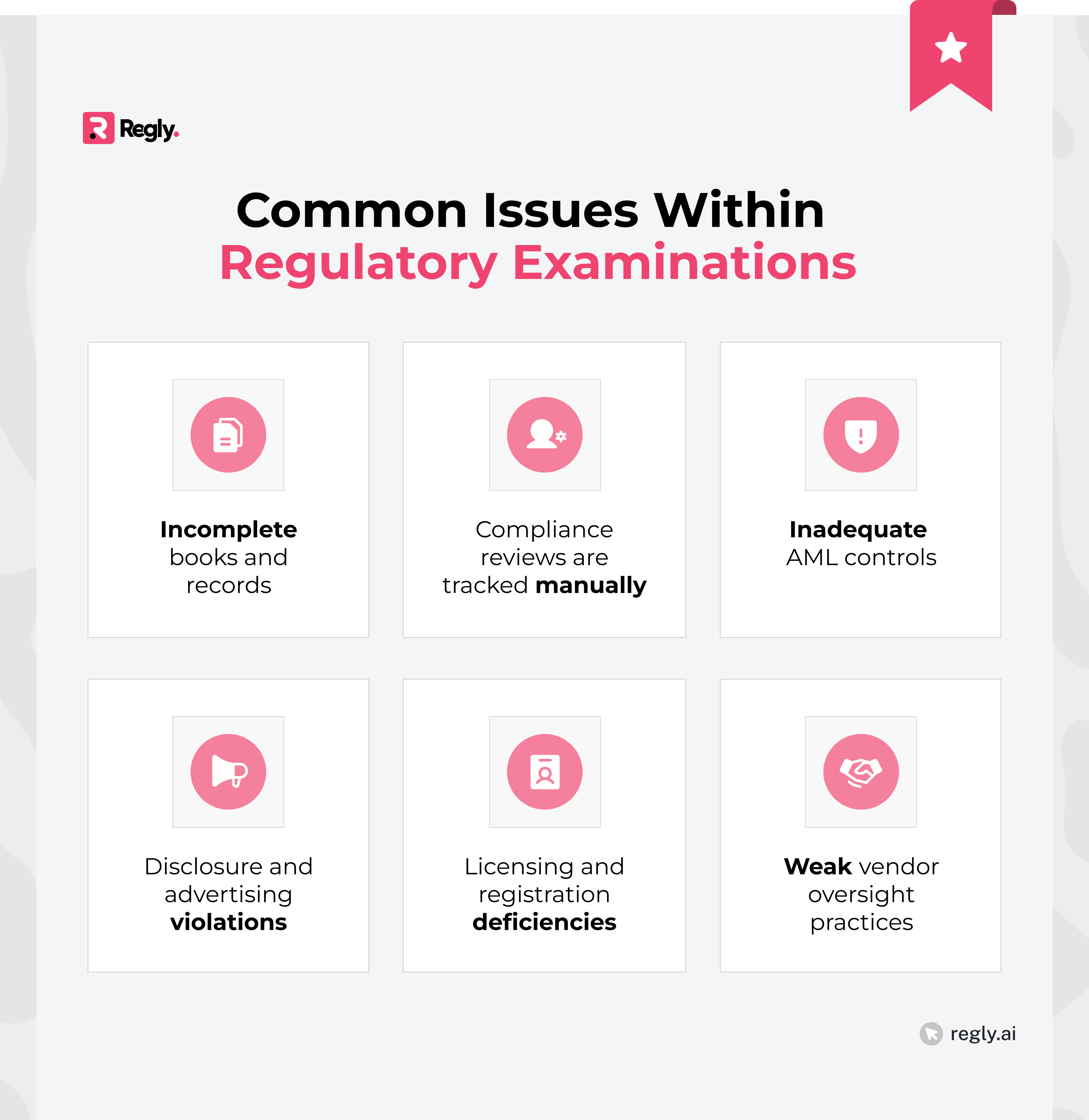
Examiners often review policies, procedures, records, customer communications, training materials, and evidence of supervisory oversight to determine whether a firm is meeting its regulatory obligations.
In many cases, regulators are less concerned with isolated mistakes than with systemic weaknesses. A single documentation error may not raise significant concerns. However, repeated deficiencies, weak controls, or a lack of remediation can result in findings that require corrective action.
Regulatory findings should be formally documented and incorporated into the firm's compliance issue management process. This allows management to track remediation efforts, monitor deadlines, and demonstrate progress during regulatory requests.
Customer Complaints and Dispute Trends
Customer complaints often provide an early warning sign that a compliance issue exists. For example, multiple complaints regarding account access, fee disclosures, transaction processing, or marketing representations may reveal deficiencies that require investigation and remediation.
Compliance teams should look beyond individual complaints and analyze trends over time. Useful questions include:
Are similar complaints occurring repeatedly?
Are complaints concentrated around a particular product or service?
Has complaint volume increased recently?
Do complaints suggest a regulatory or consumer protection concern?
Many regulators expect firms to maintain complaint management processes and to investigate complaints that may indicate compliance failures. When complaint trends reveal a broader problem, the matter should be escalated and tracked as a formal compliance issue.
Employee Escalation and Whistleblower Reports
Employees are often among the first people to recognize compliance concerns. They interact directly with customers, systems, vendors, and operational processes, giving them visibility into issues that may not appear in testing reports or audit reviews.
Effective compliance programs encourage employees to report concerns through established escalation channels. Depending on the organization, reports may be submitted to compliance teams, managers, legal departments, ethics hotlines, or whistleblower programs.
Not every report will result in a compliance issue. However, each report should be reviewed, documented, and assessed to determine whether further investigation is necessary.
Transaction Monitoring and AML Alerts
For firms subject to anti-money laundering requirements, transaction monitoring systems generate a significant number of potential compliance issues. These systems are designed to identify unusual activity that may warrant additional review, investigation, or escalation.
Most alerts do not ultimately result in a compliance finding. However, the review process often reveals weaknesses in controls, procedures, customer due diligence practices, or monitoring configurations.
Common issues identified through AML monitoring include:
Incomplete customer due diligence records
Deficiencies in sanctions screening processes
Delayed alert reviews
Suspicious activity that was not escalated appropriately
Transaction monitoring scenarios that are poorly calibrated
When compliance teams identify recurring alert management problems, the issue should be tracked beyond the individual case. The underlying control weakness often presents a greater regulatory concern than the alert itself.
Vendor and Third-Party Oversight Reviews
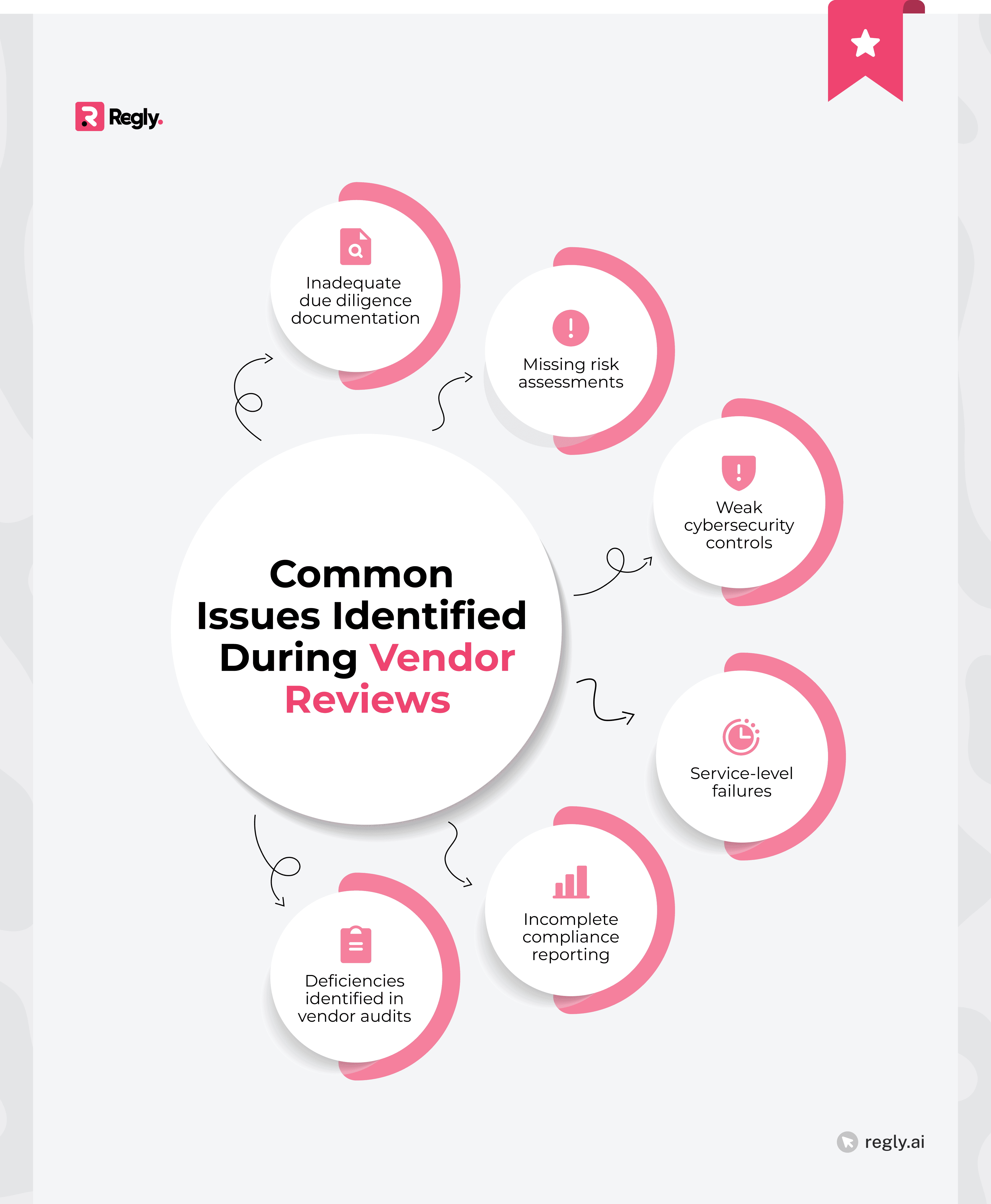
Many fintechs rely heavily on third-party providers for payments, banking services, identity verification, cloud infrastructure, compliance technology, and customer support functions. As a result, vendor oversight reviews frequently uncover compliance issues that originate outside the organization.
A vendor may fail to meet contractual obligations, maintain required controls, or comply with applicable regulatory requirements. These failures can create regulatory exposure for the fintech even when the underlying activity is outsourced.
Regulators increasingly expect firms to maintain effective third-party risk management programs. Any material vendor-related deficiency should be documented and incorporated into the firm's compliance issue management framework.
Incident Response and Cybersecurity Investigations
Cybersecurity incidents often expose compliance issues that extend beyond information security. A data breach, unauthorized system access event, or operational disruption may reveal gaps in governance, policies, controls, training, or regulatory reporting processes.
For regulated financial services firms, compliance teams are often involved in assessing whether an incident triggered reporting obligations, customer notification requirements, or broader remediation efforts.
Even when an incident does not result in customer harm, the findings should be evaluated for potential compliance implications. Formal issue tracking helps firms monitor remediation efforts, assign accountability, and document corrective actions for future examinations or audits.
The Cost of Poor Compliance Issue Management
When firms fail to manage compliance issues effectively, the consequences can reach well past regulatory concerns. The following are common consequences of weak compliance issue management:
Repeat Findings and Unresolved Deficiencies
One of the clearest signs of a weak issue management process is the recurrence of the same finding over multiple reviews, audits, or examinations.
Regulators and auditors often pay close attention to repeat findings because they may indicate that the original root cause was never properly addressed. A recurring issue can suggest weaknesses in governance, oversight, or remediation practices.
For example, if an examination identifies deficiencies in AML documentation and the same problem appears during the next review cycle, regulators may question whether management took appropriate corrective action.
Increased Regulatory Scrutiny
Regulators generally expect firms to identify issues, document remediation efforts, and monitor corrective actions through completion.
When a firm cannot demonstrate how issues were addressed, examiners may expand the scope of their review, request additional documentation, or conduct more detailed testing. In some cases, unresolved findings can lead to supervisory actions, enforcement investigations, or mandated remediation programs.
The issue itself is not always the primary concern. Regulators often focus on how management responded after the issue was identified.
Weak Documentation and Audit Trails
A remediation effort that is not properly documented can be difficult to defend during an examination or audit.
Compliance teams should be able to show:
When the issue was identified
Who was assigned responsibility
What corrective actions were taken
When remediation was completed
How the effectiveness of remediation was validated
Without a clear audit trail, firms may struggle to demonstrate that corrective actions were completed as intended.
Operational Disruption and Remediation Costs
The longer compliance issues remain unresolved, the more resources are typically required to address them.
Teams may need to revisit historical transactions, conduct extensive reviews, engage outside consultants, or dedicate significant staff time to remediation projects. What begins as a manageable compliance deficiency can eventually become a costly operational initiative.
Poor issue tracking can also create duplicate work when multiple teams attempt to solve the same problem independently.
Reputational and Investor Impact
Compliance failures can affect more than regulatory relationships. Investors, banking partners, customers, and strategic counterparties often evaluate a firm's compliance maturity when making business decisions.
A pattern of unresolved issues may raise concerns about governance, risk management, and operational discipline. This can become particularly important during fundraising, partnership discussions, licensing applications, or acquisition due diligence.
Personal Accountability for Compliance Officers and Executives
Senior management and compliance leaders are increasingly expected to maintain visibility into significant compliance issues and remediation efforts.
While accountability structures vary across jurisdictions and regulatory frameworks, regulators often expect leadership teams to understand material compliance risks and monitor remediation progress. Failure to address known issues can raise questions about oversight and governance practices.
For that reason, effective compliance issue management is not solely a compliance function. It is a management responsibility that often requires coordination across legal, operations, risk, technology, and executive leadership teams.
Core Components of a Compliance Issue Management Framework
An effective compliance issue management framework provides a consistent process for identifying, assessing, remediating, and monitoring issues across the organization. Together, these components create accountability, improve visibility into outstanding issues, and help management prioritize remediation efforts based on risk:
Centralized Issue Intake
Issues should be captured through a standardized process regardless of how they are identified. Whether an issue originates from an audit, examination, customer complaint, AML alert, or employee report, it should enter the same tracking framework.
A centralized intake process helps create consistency and reduces the likelihood that issues will be overlooked or tracked in separate systems.
Risk Classification and Severity Scoring
Not all compliance issues carry the same level of risk. Some deficiencies can be addressed through routine corrective actions, while others may require immediate escalation and management attention.
Risk classification helps firms prioritize remediation efforts and allocate resources effectively. Common factors considered during severity assessments include:
Regulatory impact
Consumer or customer impact
Financial exposure
Operational disruption
Likelihood of recurrence
Reputational risk
Root Cause Analysis
Addressing symptoms without understanding the underlying cause often leads to repeated findings.
Root cause analysis helps firms determine why an issue occurred in the first place. The objective is to identify the process, control, governance, staffing, technology, or training weakness that contributed to the problem.
A well-documented root cause analysis often makes remediation efforts more effective and easier to defend during future examinations.
Corrective Action Planning
Once the root cause has been identified, firms should develop a remediation plan that outlines how the issue will be addressed.
Corrective action plans generally include:
Specific remediation tasks
Assigned owners
Target completion dates
Required resources
Success criteria
The plan should be practical and proportionate to the severity of the issue.
Ownership and Accountability
Every compliance issue should have a clearly designated owner responsible for driving remediation efforts.
Without clear ownership, issues can remain unresolved for extended periods while teams assume someone else is responsible for addressing them.
Issue owners are typically responsible for coordinating corrective actions, providing status updates, maintaining documentation, and reporting delays when necessary.
Escalation Procedures
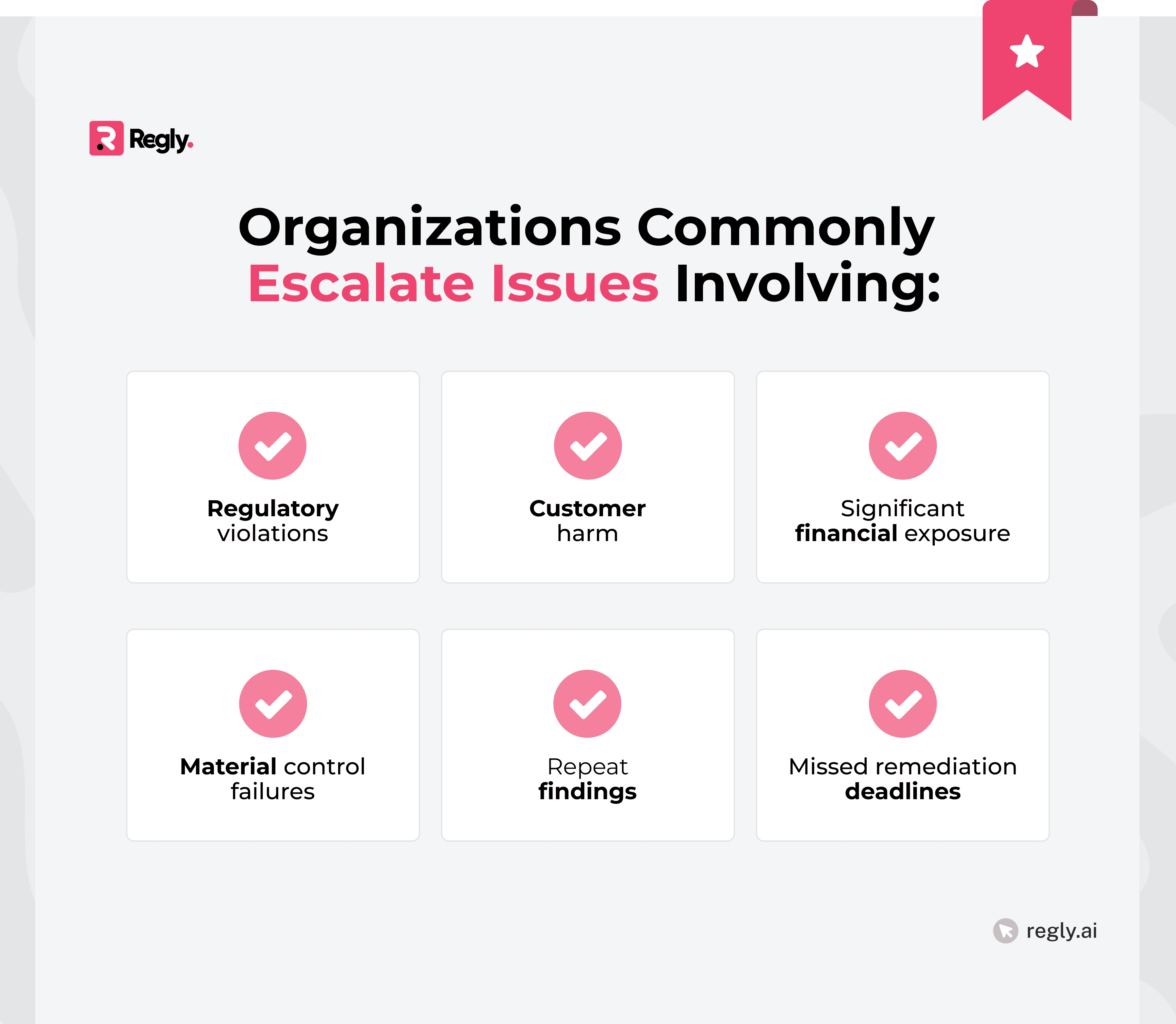
Certain issues require visibility beyond the immediate remediation team. High-risk findings, regulatory matters, repeat deficiencies, and overdue remediation efforts may need to be escalated to senior management, compliance committees, risk committees, or the board. Defined escalation procedures help firms respond consistently when issues exceed established risk thresholds.
Validation and Issue Closure
An issue should not be considered resolved simply because remediation activities have been completed.
Before closure, firms should verify that corrective actions have been implemented and that the underlying problem has been addressed. This may involve testing controls, reviewing documentation, or conducting follow-up assessments. Validation helps mitigate the risk of recurring issues and repeated findings.
Ongoing Monitoring and Reporting
Issue management does not end once an issue is closed. Management should maintain visibility into open issues, remediation timelines, aging reports, and recurring trends.
Regular reporting allows compliance teams and leadership to identify emerging risks, monitor remediation performance, and allocate resources where they are needed most. Over time, this reporting can provide valuable insight into broader control weaknesses and compliance program effectiveness.
How to Build a Compliance Issue Management Process
A compliance issue management framework establishes the structure. The process defines how issues move from identification to resolution. Here’s how to build an effective compliance issue management system in 7 easy steps:
Step 1: Identify and Document the Issue
The first step is to formally record the issue as soon as it is identified. Delays in documentation can lead to incomplete records, inconsistent reporting, and confusion about ownership.
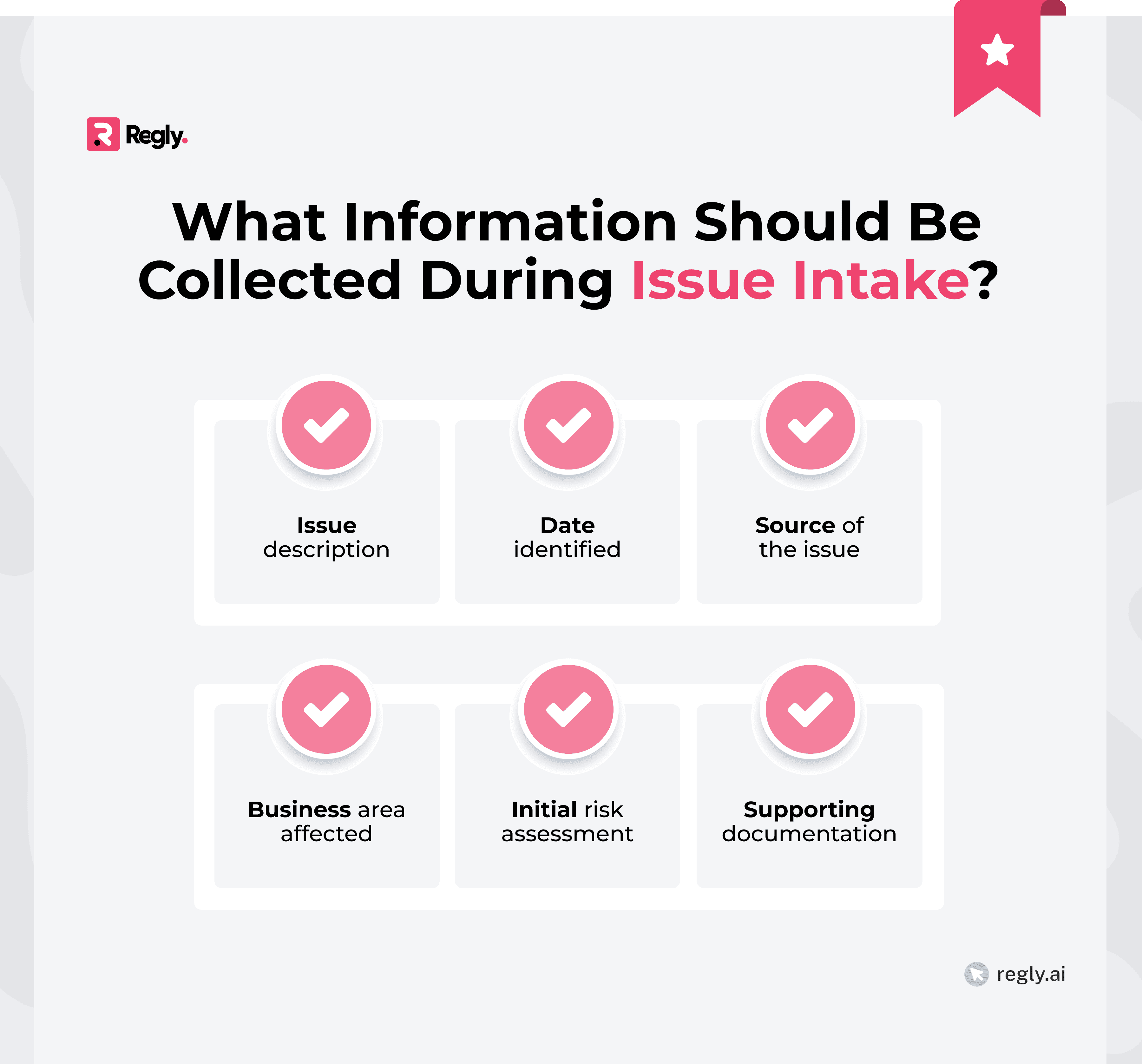
At a minimum, firms should capture:
A description of the issue
The date it was identified
The source of the issue
The affected business area
Relevant supporting evidence
Any immediate actions taken
The goal at this stage is accuracy rather than analysis. Root causes and remediation plans can be developed later.
Step 2: Assess Severity and Regulatory Impact
Once documented, the issue should be evaluated to determine its significance.
Not every issue requires the same level of attention. A minor procedural deficiency may warrant routine remediation, while a potential regulatory violation may require immediate escalation.
Factors commonly considered include:
Regulatory implications
Customer impact
Financial exposure
Operational disruption
Reputational considerations
Likelihood of recurrence
The outcome of this assessment often determines remediation timelines, reporting requirements, and escalation obligations.
Step 3: Perform Root Cause Analysis
Before corrective actions are assigned, firms should understand why the issue occurred. The objective is to address the underlying cause, not just the visible outcome.
Many compliance issues are symptoms of broader weaknesses rather than isolated mistakes. If remediation focuses only on the immediate problem, similar issues may reappear later.
Root cause analysis may identify deficiencies involving:
Policies and procedures
Internal controls
Training programs
Technology systems
Vendor management
Governance and oversight
Step 4: Develop a Remediation Plan
After identifying the root cause, the firm should establish a documented remediation plan. The plan should clearly define what actions will be taken, who is responsible, and when those actions are expected to be completed.
A typical remediation plan includes:
Element | Description |
|---|---|
Action Item | Specific corrective measures to be implemented |
Owner | Individual or team responsible for execution |
Due Date | Target completion date |
Priority Level | Risk-based urgency of the action |
Status | Current remediation progress |
Well-defined plans make it easier to track progress and identify delays before deadlines are missed.
Step 5: Track Remediation Progress
Remediation efforts should be actively monitored until all corrective actions are completed.
This often involves periodic status reviews, management reporting, and follow-up meetings with issue owners. Tracking helps maintain accountability and provides visibility into overdue or stalled remediation efforts.
Many firms use centralized issue trackers or compliance management platforms to monitor progress and maintain documentation throughout the remediation lifecycle. For growing fintechs, remediation tracking often becomes one of the most resource-intensive parts of the compliance process.
Step 6: Validate Corrective Actions
Completing a remediation task does not necessarily mean the issue has been resolved. Before closure, firms should verify that corrective actions were implemented as intended and that the underlying deficiency has been addressed.
Depending on the issue, validation may involve testing controls, reviewing updated procedures, examining supporting evidence, or conducting follow-up reviews.
Step 7: Close the Issue and Retain Records
Once remediation has been validated, the issue can be formally closed. The closure record should document the remediation activities performed, the validation completed, and the rationale for closure. Supporting evidence should be retained according to the firm's recordkeeping requirements.
Maintaining complete records allows firms to demonstrate how issues were managed if questions arise during future audits, examinations, or regulatory inquiries.
What a Compliance Issue Tracker Should Include
A compliance issue management process is only as effective as the information being tracked. Whether you’re using spreadsheets, GRC systems, or a compliance management platform, your tracker should ideally include the following:
Field | Purpose |
|---|---|
Issue ID | Unique reference number for tracking and reporting |
Issue Description | Summary of the identified issue |
Date Identified | Date the issue was first discovered |
Source | Where the issue originated, such as an audit, examination, complaint, or monitoring review |
Business Area | Department or function affected |
Risk Rating | Severity classification assigned to the issue |
Root Cause | The underlying reason the issue occurred |
Issue Owner | The individual responsible for remediation |
Remediation Plan | Summary of corrective actions to be completed |
Target Completion Date | Expected remediation deadline |
Current Status | Open, in progress, pending validation, or closed |
Validation Evidence | Documentation supporting remediation effectiveness |
Closure Date | Date the issue was formally closed |
In addition to these core fields, firms often maintain supporting documentation within the tracker or linked repositories. This may include audit reports, regulatory correspondence, testing results, meeting notes, screenshots, policy updates, and evidence of completed corrective actions.
As compliance programs grow, maintaining this information across spreadsheets, email threads, and shared folders can become increasingly difficult.
Compliance Issue Severity Levels Explained
Not every compliance issue presents the same level of risk. While classification frameworks vary between organizations, most firms categorize issues into low, moderate, and high-risk levels:
Low-Risk Issues
Low-risk issues typically have limited regulatory, operational, or customer impact. These deficiencies are often isolated, easily remediated, and unlikely to result in significant regulatory concerns if addressed promptly.
Some of the most common low-risk issues are minor documentation errors, administrative recordkeeping deficiencies, isolated procedural deviations, and incomplete internal approvals. Although these issues may appear insignificant, they should still be documented and tracked. Repeated low-risk issues can indicate broader process weaknesses over time.
Moderate-Risk Issues
Moderate-risk issues have a greater potential to affect compliance obligations, customer outcomes, or operational processes. These issues often require management attention and formal remediation plans, but may not present an immediate threat to the organization.
Examples include:
Inconsistent application of compliance procedures
Delays in required regulatory filings
Gaps in employee training programs
Weaknesses identified during compliance testing
Repeated policy exceptions
If left unresolved, moderate-risk issues can develop into larger compliance concerns.
High-Risk and Critical Issues
High-risk issues involve significant regulatory exposure, customer harm, financial impact, or control failures. These matters typically require immediate escalation and active oversight from senior management.
Examples include:
Material AML compliance deficiencies
Regulatory reporting failures
Significant cybersecurity incidents
Unlicensed regulated activity
Widespread disclosure violations
Findings identified by regulators during examinations
Many firms establish specific escalation requirements for high-risk issues, including reporting to executive leadership, compliance committees, risk committees, or the board.
Root Cause Analysis in Compliance Issue Management
Remediating a compliance issue without understanding why it occurred often leads to repeat findings. The immediate problem may be corrected, but the underlying weakness remains.
A root cause analysis helps firms move beyond surface-level fixes and identify the factors that contributed to the issue. This process is particularly important for recurring deficiencies, regulatory findings, and high-risk compliance events.
For example, a missed regulatory filing may initially appear to be an employee error. A deeper review might reveal inadequate procedures, unclear ownership, insufficient training, or a lack of oversight controls. Addressing the filing itself resolves the symptom, while addressing the underlying weakness reduces the likelihood of recurrence.
Process Failures vs. Control Failures
Most compliance issues can be traced back to either a process failure, a control failure, or a combination of both. Understanding the difference is important because each type of issue typically requires a different remediation approach:
The table below highlights the key differences:
Quality | Process Failure | Control Failure |
|---|---|---|
What It Is | Weakness in the workflow, procedure, or operational process | Weakness in a safeguard designed to prevent, detect, or escalate issues |
Primary Cause | Poorly designed, outdated, or inconsistently followed processes | Ineffective, missing, or improperly functioning controls |
Typical Indicators | Employees perform tasks differently, have unclear responsibilities, and experience inconsistent outcomes | Issues are not detected, reviewed, approved, or escalated as expected |
Common Examples | Outdated procedures, unclear employee responsibilities, inconsistent escalation processes, inadequate training, and manual workflows prone to error | Ineffective compliance monitoring, inadequate supervisory reviews, missing approval checkpoints, weak transaction monitoring rules, and incomplete vendor oversight controls |
Business Impact | Increased operational inefficiencies and higher likelihood of errors | Increased risk that compliance issues go undetected or unaddressed |
Typical Remediation | Policy updates, workflow redesign, process standardization, employee training | Enhanced oversight, additional testing, automation, monitoring improvements, stronger review controls |
The distinction matters because the remediation approach is often different. Improving a process may require policy updates or workflow redesign, while correcting a control failure may involve strengthening oversight mechanisms, implementing additional monitoring, or enhancing existing controls.
Compliance Issue Management Roles and Responsibilities
Compliance issue management works best when responsibilities are clearly defined. Without established ownership, issues can remain unresolved, remediation efforts can stall, and accountability can become difficult to demonstrate during audits or examinations.
The table below outlines the primary responsibilities typically assigned to each group.
Role | Primary Responsibilities |
|---|---|
Compliance Team | Document and track issues, perform risk assessments, coordinate root cause analysis, monitor remediation progress, escalate significant findings, and provide reporting to management. |
Legal and Regulatory Counsel | Assess legal and regulatory implications, advise on reporting obligations, support regulatory inquiries, and review remediation strategies involving regulatory risk. |
Business and Operational Teams | Investigate operational impacts, implement corrective actions, update procedures, provide remediation evidence, and meet remediation deadlines. |
Internal Audit | Independently assess remediation efforts, validate issue closure, evaluate recurring findings, and review the effectiveness of the issue management framework. |
Senior Management | Allocate resources, oversee remediation efforts, review significant issues, and monitor progress on high-risk findings. |
Board of Directors or Committees | Maintain oversight of material compliance issues, review significant trends, and monitor major remediation initiatives when appropriate. |
Regardless of organizational structure, every compliance issue should have a clearly designated owner. Firms that struggle with issue management often discover that the problem is not a lack of remediation activity, but a lack of accountability for driving remediation to completion.
Using Technology for Compliance Issue Management
As organizations grow, managing compliance issues through spreadsheets, email threads, and shared folders becomes increasingly difficult. Information becomes fragmented, remediation deadlines are easier to miss, and reporting often requires significant manual effort.
Technology can help centralize issue management activities and provide greater visibility into remediation efforts. The goal is not simply to replace spreadsheets. It is to create a consistent process for documenting issues, assigning ownership, tracking progress, and maintaining supporting evidence.
Manual Tracking vs. Dedicated Platforms
Dedicated compliance platforms provide a more structured and scalable approach to compliance issue management. Rather than relying on disconnected spreadsheets, emails, and shared folders, organizations can manage the entire issue lifecycle within a centralized system.
Shifting to a dedicated platform has significant benefits, such as:
A single source of truth for issue records and remediation activities
Consistent documentation and issue classification across teams
Clear ownership and accountability for corrective actions
Automated reminders, escalations, and workflow management
Centralized storage of supporting evidence and remediation records
Real-time visibility into issue status and remediation progress
Simplified reporting for management, auditors, and regulators
These capabilities can help organizations improve oversight, reduce administrative effort, and maintain a more complete audit trail throughout the remediation process.
Workflow Automation and Task Management
One of the primary benefits of technology is the ability to automate routine administrative tasks. Examples of this could be assigning issue owners, sending deadline reminders, escalating overdue remediation items, tracking status changes, and maintaining activity logs.
Automation can reduce manual follow-up efforts and improve accountability throughout the remediation process.
Centralized Evidence Collection
Supporting documentation is often spread across multiple systems, making it difficult to demonstrate remediation efforts during audits or examinations.
Centralized issue management tools allow firms to maintain records such as audit reports, regulatory correspondence, testing results, policy updates, and meeting notes. Having documentation connected directly to the issue record creates a more complete remediation history.
Reporting and Audit Readiness
Management, auditors, and regulators frequently want visibility into outstanding compliance issues and remediation progress.
Technology can simplify reporting by providing access to:
Open and closed issue counts
Overdue remediation items
High-risk findings
Aging reports
Repeated findings
Remediation trends over time
This information helps leadership understand where compliance resources may be needed and where recurring weaknesses exist.
Integration with GRC and Compliance Systems
As compliance programs mature, issue management often becomes connected to broader governance, risk, and compliance processes. For example, a compliance issue may originate from:
A risk assessment
A compliance test
An internal audit
A vendor review
An AML investigation
Integrated systems allow firms to connect these activities and maintain a more complete view of compliance risks and remediation efforts.
Common Implementation Mistakes
As compliance programs mature, issue management often becomes connected to broader governance, risk, and compliance processes. For example, a compliance issue may originate from:
Automating poorly defined workflows. Technology can make processes more efficient, but it cannot fix unclear responsibilities, inconsistent procedures, or weak governance. Automating compliance reporting or any flawed process often causes problems to scale more quickly rather than disappear.
Using inconsistent issue classifications. When different teams apply different severity ratings or issue categories, reporting becomes unreliable, and management may struggle to identify the organization's most significant compliance concerns.
Failing to assign ownership. Every issue should have a clearly designated owner responsible for driving remediation efforts to completion. Without accountability, issues can remain open indefinitely or fall between departments.
Maintaining duplicate tracking systems. Some organizations track issues across multiple spreadsheets, ticketing systems, and departmental records. This can create conflicting information, duplicate work, and uncertainty about which record is authoritative.
Closing issues without validation. Remediation activities should be verified before an issue is formally closed. If corrective actions are not tested or reviewed, the underlying problem may persist and lead to repeat findings during future audits, examinations, or compliance reviews.
Before implementing any technology solution, firms should establish clear governance, remediation procedures, escalation requirements, and reporting expectations.
For many fintechs, the most effective approach is a process-driven one. Technology should support a well-defined compliance issue management framework rather than act as a substitute for one.
Compliance Issue Management Metrics and KPIs
Tracking compliance issues is important. Measuring how those issues are managed is equally important. Metrics and key performance indicators (KPIs) help compliance teams evaluate remediation performance, identify recurring weaknesses, and provide management with visibility into the overall health of the compliance program.
The most useful metrics focus on trends rather than isolated data points. A single overdue issue may not indicate a problem. A growing backlog of overdue issues across multiple departments may signal broader concerns around resources, accountability, or governance.
Common compliance issue management KPIs include:
Open vs. Closed Issues: Measures the number of active issues compared to those that have been resolved. Monitoring this trend helps organizations determine whether remediation efforts are keeping pace with newly identified findings. A consistently growing number of open issues may indicate capacity constraints or ineffective remediation processes.
Issue Aging: Measures how long issues remain open before they are resolved. Many firms categorize aging into periods such as 0–30 days, 31–60 days, 61–90 days, and more than 90 days. Older unresolved issues often receive greater management attention because they may indicate stalled remediation efforts or elevated compliance risk.
Overdue Remediation Items: Tracks issues that remain unresolved beyond their target completion dates. A high volume of overdue items may suggest unrealistic remediation timelines, resource limitations, weak accountability, or insufficient management oversight. Many organizations monitor overdue items separately for high-risk findings.
Repeat Findings: Occur when the same issue reappears during subsequent audits, examinations, testing activities, or reviews. This is often one of the most valuable indicators of remediation effectiveness because recurring findings may indicate that root causes were not properly addressed or that corrective actions were not adequately validated.
Average Remediation Time: Measures the time from issue identification to closure. This metric can help organizations identify bottlenecks in their remediation process and establish realistic expectations for future remediation efforts. However, remediation speed should not come at the expense of quality. Closing issues quickly is less valuable than resolving them effectively.
High-Risk Issue Trends: Tracks findings with the greatest potential regulatory, operational, or reputational impact. Organizations often monitor the number of open high-risk issues, newly identified high-risk issues, high-risk issues nearing deadlines, and overdue high-risk issues. These metrics help management focus attention on the areas of greatest concern.
Metrics should support decision-making rather than serve as reporting exercises. The most effective compliance programs use KPI reporting to identify trends, allocate resources, improve remediation processes, and monitor recurring control weaknesses.
Compliance Issue Management Best Practices
Building an effective compliance issue management process requires more than documenting findings and assigning remediation tasks. Organizations must create a framework that promotes accountability, consistency, and visibility throughout the issue lifecycle. The following practices can help firms strengthen their approach to compliance issue management:
Standardize Issue Classification
Issues should be categorized and rated using consistent criteria across the organization. Without a standardized framework, similar issues may receive different risk ratings, remediation timelines, or escalation treatment.
Standardization improves reporting accuracy and helps management compare issues across business units.
Create Documented Remediation Workflows
Every issue should follow a defined process from identification through closure. Documented workflows help establish clear expectations regarding:
Issue intake and documentation
Risk assessment procedures
Ownership assignments
Escalation requirements
Remediation timelines
Validation and closure activities
A consistent workflow reduces confusion and makes it easier to demonstrate compliance program effectiveness during audits and examinations.
Use Risk-Based Escalation Procedures
Not every issue requires executive or board-level attention. Escalation should be based on the significance of the issue rather than applying the same process to every finding. Risk-based escalation helps leadership focus on the issues that present the greatest potential impact.
Maintain Defensible Documentation
Documentation is often just as important as the remediation itself. Organizations should maintain records that clearly demonstrate:
How the issue was identified
Who was responsible for remediation
What corrective actions were taken
When remediation was completed
How the effectiveness was validated
Strong documentation creates a more complete audit trail and simplifies responses to regulatory inquiries.
Conduct Periodic Issue Reviews
Compliance issues should not disappear from view once remediation begins. Periodic reviews help organizations:
Monitor remediation progress
Identify overdue items
Reassess issue severity
Detect recurring patterns
Escalate emerging concerns
Regular review meetings can also improve coordination between compliance, legal, operations, and business teams.
Test Remediation Effectiveness Before Closure
A corrective action should not be considered complete simply because a task has been marked finished. Before closing an issue, organizations should verify that the remediation addressed the underlying root cause and that the problem is unlikely to recur under normal operating conditions.
Depending on the issue, validation may involve testing controls, reviewing documentation, conducting follow-up assessments, or performing targeted compliance testing.
Keep Management and Boards Informed
Leadership teams should have visibility into significant compliance issues and remediation efforts.
Regular reporting helps management understand:
High-risk open issues
Overdue remediation activities
Repeat findings
Emerging compliance trends
Resource constraints affecting remediation efforts
Clear reporting supports informed decision-making and reinforces accountability across the organization.
Organizations that consistently apply these practices are often better positioned to manage compliance issues proactively, demonstrate remediation progress, and respond effectively to audits, examinations, and regulatory inquiries.
—
Effective compliance issue management helps firms identify problems early, prioritize remediation efforts, and maintain clear accountability throughout the issue lifecycle. As regulatory expectations continue to evolve, having a structured and well-documented process can make audits, examinations, and ongoing compliance oversight more manageable.
Ready to Get Started?
Schedule a demo today and find out how Regly can help your business.