An employee attestation gives compliance teams a structured way to gather information they can’t easily observe. It asks employees to confirm their actions, disclose potential conflicts, and acknowledge key policies.
For fintech firms, where operations change quickly, this input helps bridge the gap between written procedures and actual behavior.
In reality, a lot of attestation programs fall short. Annual forms are completed, filed away, and rarely revisited. There’s often no consistent follow-up or escalation when something is disclosed. What should be a control ends up being a formality, and that gap is usually exposed during exams.
This guide breaks down how to structure an effective employee attestation program, with a clear focus on what to ask quarterly versus annually. It also explains how attestations fit into real regulatory expectations, where firms commonly make mistakes, and how to design a process that holds up under scrutiny.
What Is an Employee Attestation in Compliance?
An employee attestation is a formal confirmation from an employee about specific compliance-related facts. It can cover actions taken, activities involved in, or an understanding of internal policies. The goal of employee attestations is to collect direct input from employees that compliance teams cannot independently verify in real time.
In practice, employee attestations are used to capture disclosures and acknowledgments across key risk areas. These often include personal trading, outside business activities (OBAs), gifts, communications, and policy adherence. Instead of relying only on supervision or surveillance, firms use attestations to ask employees directly.
The value of an employee attestation is in the record it creates. Each response becomes part of the firm’s compliance evidence. During audits or exams, this documentation helps show what the firm asked, how employees responded, and whether issues were identified and addressed.
Employee attestations also introduce accountability. When employees are required to confirm information in writing, it changes how they approach compliance obligations. It creates a clear expectation that disclosures must be accurate and complete, and that omissions carry consequences.
Employee Attestation vs. Certification vs. Acknowledgment
These terms are often used interchangeably, but they serve different purposes in a compliance program. Understanding the distinction helps structure a more effective employee attestation process and avoids gaps during audits.
At a high level, the difference comes down to what the employee is confirming and how broadly that confirmation applies. Some inputs are narrow and factual. Others are broader and tied to overall compliance responsibilities.
Term | What It Means | Typical Use Case |
|---|---|---|
Employee Attestation | Confirmation of specific facts or activities | Ongoing risk monitoring |
Certification | Broader confirmation of compliance over a period of time | Annual or role-based obligations |
Acknowledgment | Confirmation of receipt or understanding of a policy | Policy distribution and training |
An employee attestation is usually narrower and more frequent, focused on capturing changes, disclosures, or specific behaviors. It is often tied to quarterly or event-driven processes.
A certification, on the other hand, is broader. It typically reflects a higher-level statement about compliance over a defined period. Firms often use certifications annually or for senior personnel who have oversight responsibilities.
Acknowledgments are the simplest form. They confirm that an employee received and reviewed a policy or training. While they are important, they do not capture whether the employee actually complied with the policy in practice.
Why Employee Attestations Exist in Regulated Fintechs
Employee attestation programs exist because many compliance risks sit with employees, not systems. Firms are expected to monitor those risks, but activities like outside business interests or personal trading are not always visible without direct input.
Employee attestations turn that employee knowledge into documented compliance data. They give firms a structured way to ask the right questions and capture responses that can be reviewed later. In fintech environments, where roles and products evolve quickly, that visibility becomes more important.
Without this process, firms often rely on assumptions about employee behavior. That gap tends to surface during exams, when regulators expect clear evidence of how employee-level risks are identified and tracked.
How Attestations Function as Audit Evidence
An employee attestation becomes part of the firm’s compliance record and is often reviewed during audits and regulatory exams. When regulators assess a program, they are looking for evidence of what the firm asked, how employees responded, and what actions followed.
Employee attestations create a documented trail of compliance activity. Each response shows that the firm requested specific information and that the employee provided a formal answer. Over time, this builds a record that can demonstrate how the firm monitors employee-level risks.
That record matters most when something goes wrong. If an issue surfaces, firms are expected to show whether the risk was disclosed, how it was handled, and whether follow-up occurred. Without documented attestations, it becomes harder to explain how the firm identified or missed the issue.
The value of employee attestation as evidence depends on what happens after submission. Regulators focus not only on collection, but also on review and escalation. If responses are gathered but not analyzed or acted on, the control loses much of its value during an exam.
For that reason, attestations should be tied to a clear process. Someone reviews responses. Exceptions are flagged. Follow-up is documented. That’s what turns a simple questionnaire into a defensible compliance control.
See how Regly helps fintechs track employee attestations →
Where Employee Attestations Fit Into Financial Regulation
Employee attestation supports core regulatory expectations around monitoring employee activity and maintaining records. It allows firms to ask targeted questions and document responses in a way that aligns with supervisory obligations.
SEC Expectations
In an advisor context, employee attestations are tied to Code of Ethics obligations such as personal trading disclosures, holdings reports, and policy acknowledgments.
The underlying issue is managing conflicts and monitoring access to sensitive information. Firms need to track employee activity and confirm that disclosures are complete. Most programs handle this through recurring attestations supported by annual reviews.
If the process is informal, it can be difficult to demonstrate that reporting is consistent or that employees have acknowledged updated requirements.
FINRA Expectations
For broker-dealers, employee attestation is embedded in the firm’s supervisory framework. This includes oversight of outside business activities, private securities transactions, and other employee-driven risks.
Annual compliance questionnaires are a common example of employee attestation in this context. Firms use them to collect disclosures, confirm policy understanding, and identify potential issues across the organization.
FINRA expectations are not limited to collecting information. Firms are expected to review responses and take action where needed, which makes the structure of the attestation process just as important as the questions themselves.
AML and Cybersecurity Frameworks
AML and cybersecurity requirements depend heavily on employee input, even if attestations are not explicitly mentioned. Employees are expected to understand their roles, complete training, and escalate issues when needed.
Employee attestations help capture that information in a structured way. They can be used to confirm training completion, awareness of escalation procedures, and disclosure of potential concerns.
For fintech firms, these obligations often intersect. A single attestation process may need to cover securities compliance, AML responsibilities, and cybersecurity expectations at the same time.
Area | What Regulators Expect | Where Employee Attestation Fits |
|---|---|---|
SEC (Advisors) | Track conflicts, personal trading, and policy acknowledgment | Quarterly and annual disclosures from employees |
FINRA (Broker-Dealers) | Supervise employee activity and outside business activities, and private securities transactions | Annual questionnaires and event-driven disclosures |
AML (BSA/FinCEN) | Employee training and awareness, escalation of suspicious activity | Training confirmations and role-based attestations |
Cybersecurity (NYDFS, others) | Employee training, awareness, and incident reporting | Training attestations and policy acknowledgments |
Why Employee Attestations Matter in Exams and Enforcement
Employee attestation programs often come into focus during exams. Regulators are not just reviewing policies. They are looking at how firms gather information from employees and how that information is used in practice.
How Regulators Evaluate Attestations During Exams
During an exam, regulators look at both how the employee attestation program is designed and the records it produces. They focus on the types of questions asked, how frequently they are issued, and how responses are handled once submitted.
Firms may be asked to demonstrate:
How frequently are attestations distributed
What types of disclosures are captured
Who reviews the responses, and how exceptions are handled
If a disclosure is made, regulators often trace what happened next. They look for evidence of follow-up, documentation, and resolution.
Common Deficiencies
Many findings are not about the absence of attestations, but about how they are managed. Programs can exist on paper but still fall short in execution.

In some cases, firms collect responses but can’t easily produce them during an exam. In others, the questions have not been updated to reflect changes in the business model or regulatory expectations.
The Risk of False or Incomplete Attestations
Employee attestations also introduce risk if the information provided is inaccurate. Regulators expect firms to have a reasonable basis for relying on employee responses, but not to accept them without question.
False or incomplete attestations can create exposure for both the employee and the firm. If a disclosure is missed and later uncovered, regulators may look at whether the firm had a process in place to detect or follow up on inconsistencies.
This is particularly relevant in areas like outside business activities, private transactions, and off-channel communications. These are not always visible through systems, which makes the accuracy of employee attestations more important.
For that reason, many firms pair attestations with other controls, such as surveillance or periodic reviews. The goal is to compare responses against available data and identify gaps that require further investigation.
Quarterly vs. Annual Employee Attestation: What’s the Difference?
The difference between quarterly and annual employee attestation comes down to timing and scope. One focuses on ongoing activity. The other captures a complete view of compliance.
Category | Quarterly Employee Attestation | Annual Employee Attestation |
|---|---|---|
Purpose | Capture changes and new risks | Confirm full disclosure and policy understanding |
Scope | Narrow, focused on specific activities | Broad, covers overall compliance obligations |
Frequency | Every quarter or more frequently | Once per year |
Typical Content | Updates to trading, OBAs, and communications | Policy acknowledgment, full disclosures, certifications |
Regulatory Value | Ongoing monitoring and supervision | Formal record of compliance and awareness |
Quarterly Employee Attestation: What to Ask
Quarterly employee attestation is designed to capture what has changed since the last review. The goal is not to reconfirm everything, but to surface new risks, updates, or activities that require attention.
This makes quarterly attestations more targeted. Questions should focus on areas where employee behavior can shift quickly and where delayed visibility creates risk.
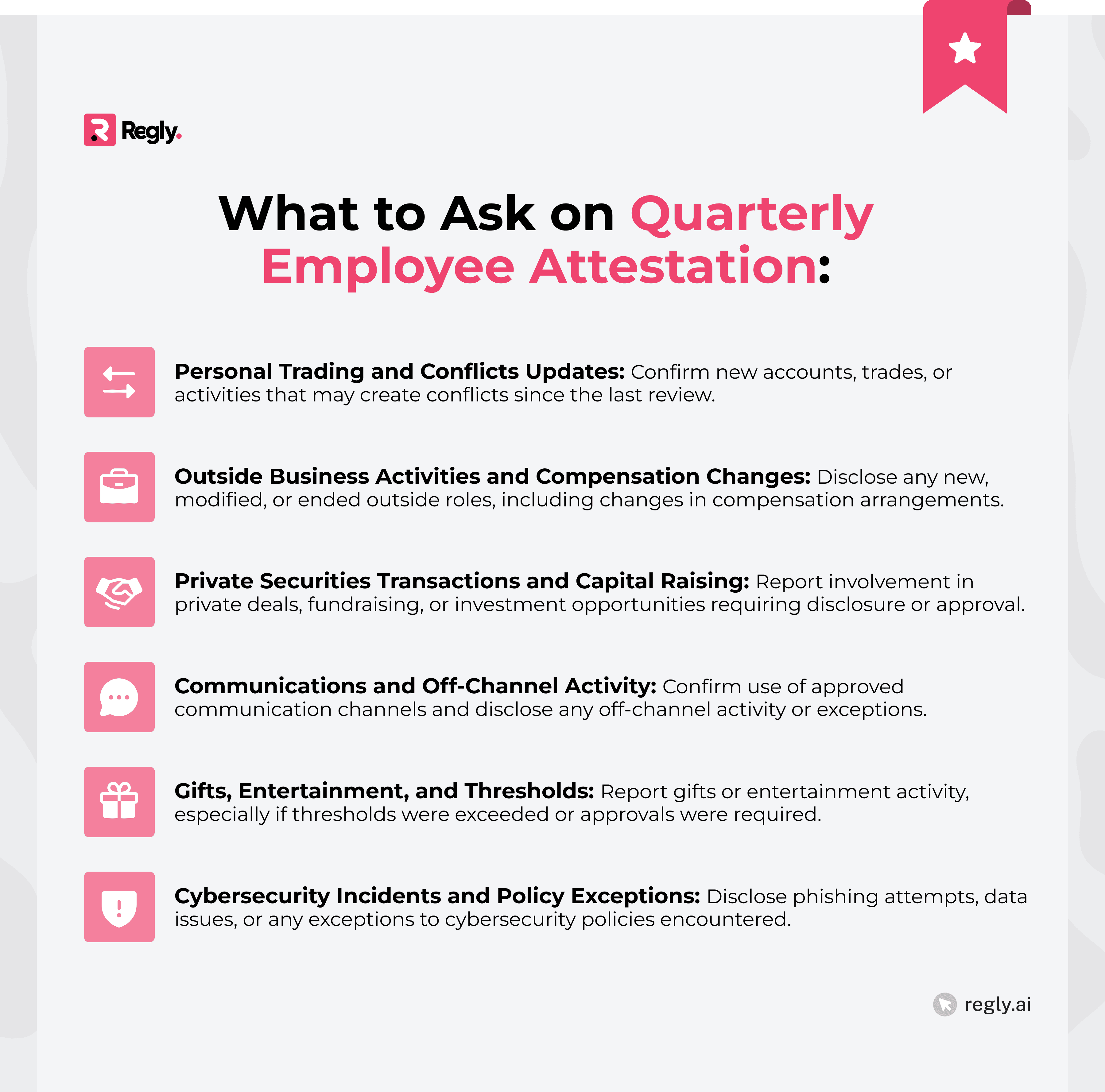
Personal Trading and Conflicts Updates
Personal trading is one of the most common areas covered in quarterly employee attestation. Employees are typically asked to confirm whether they opened new accounts, executed trades, or engaged in activity that could create conflicts.
The focus is on changes, not restating prior disclosures. This helps compliance teams identify new risks without reprocessing the same information each quarter.
Outside Business Activities and Compensation Changes
Outside business activities can change at any time, especially in fintech environments where employees may be involved in startups, advisory roles, or side projects.
Quarterly employee attestation should ask whether employees have started, modified, or ended any outside activity, and whether compensation arrangements have changed. Even small updates can trigger review requirements depending on the firm’s supervisory obligations.
Learn more about outside business activities →
Private Securities Transactions and Capital Raising
Employees may get involved in private deals, capital raises, or investment opportunities outside the firm.
These situations often fall under private securities transaction rules and typically require prior disclosure or approval.
Quarterly employee attestation helps surface this activity in real time. Instead of finding out after the fact, firms can identify involvement early and assess whether additional review or restrictions are needed.
Communications and Off-Channel Activity
Use of unapproved communication channels remains a focus area for regulators. Employees may shift to personal devices or messaging apps that fall outside firm oversight.
Quarterly employee attestation can be used to confirm whether employees are using only approved channels and to disclose any exceptions.
This is particularly relevant given recent enforcement trends around off-channel communications.
Gifts, Entertainment, and Thresholds
Gifts and entertainment activities can fluctuate throughout the year. Quarterly attestations help capture whether employees exceeded thresholds or engaged in activity that requires reporting.
This is especially relevant for client-facing roles. Capturing this information regularly makes it easier to track patterns and identify outliers.
Learn more about gifts and entertainment policies →
Cybersecurity Incidents and Policy Exceptions
Cybersecurity incidents are not always formally reported through technical systems. Employees may encounter phishing attempts, data handling issues, or policy exceptions that need to be disclosed.
Quarterly employee attestation provides a structured way to ask about these events. This helps bridge the gap between technical monitoring and employee awareness.
Annual Employee Attestation: What to Ask
Annual employee attestation serves a different purpose than quarterly reviews. Instead of focusing on recent changes, it looks at the full picture. The goal is to confirm that all required disclosures have been made and that employees understand their compliance obligations.
This makes annual attestations broader in scope. They are typically tied to policy acknowledgment, training, and overall certification of compliance over the past year.
Area | What to Confirm Annually |
|---|---|
Code of Ethics | Acknowledgment and understanding of policies |
Holdings and Accounts | Full disclosure of financial accounts and positions |
Training | Completion of required compliance training |
Cybersecurity | Awareness of responsibilities and policies |
Certification | Accuracy and completeness of all disclosures |
Conduct and Reporting | Understanding of escalation and reporting obligations |
Code of Ethics and Policy Acknowledgments
As part of the annual employee attestation process, employees are asked to confirm that they have reviewed core policies. This often includes the Code of Ethics, compliance procedures, and any changes made during the year.
Simply sending policies is not enough. Firms are expected to track whether employees actually received and reviewed them. This is where attestation plays a role, by creating a clear record tied to each individual.
The objective is to capture both acknowledgment and accountability. It shows that employees were informed of their obligations and formally recognized them.
See how Regly’s employee compliance features help fintechs manage forms and attestations →
Holdings Reports and Account Disclosure
Employees are typically required to disclose all relevant financial accounts and holdings on an annual basis. This provides a complete snapshot that complements the incremental updates captured throughout the year.
This is where firms establish a baseline of employee financial activity. It allows compliance teams to compare disclosures over time and identify gaps or inconsistencies.
Annual Compliance Training and Participation
Annual attestations often include confirmation that required training has been completed. This may cover topics such as AML, Code of Ethics, cybersecurity, and firm-specific procedures.
The goal is not just completion, but documentation. Firms need evidence that employees participated in required training and understood the material.
Learn how to create an employee compliance training program →
Cybersecurity Awareness and Responsibilities
Employees should confirm their understanding of cybersecurity policies and their role in protecting the firm’s data. This includes recognizing threats, following access controls, and reporting incidents.
This reinforces that cybersecurity is not only a technical function, but also an employee responsibility.
Annual attestation helps document that awareness across the organization.
Certification of Completeness and Accuracy
One of the most important components of annual employee attestation is the final certification. Employees are asked to confirm that their responses are complete and accurate to the best of their knowledge.
This creates accountability and strengthens the reliability of the information provided. It also gives firms a clearer basis for relying on employee disclosures.
Conduct, Reporting Obligations, and Escalation Expectations
Annual employee attestation should also cover conduct expectations and reporting responsibilities. Employees are typically asked to confirm that they understand when issues need to be escalated and what channels should be used.
This is especially important in areas where judgment is involved. Situations like conflicts of interest, suspicious activity, or potential policy breaches are not always clear-cut. Firms rely on employees to recognize these scenarios and take appropriate action.
The purpose is to document that employees know both when and how to report concerns. This creates a record that expectations were communicated and acknowledged across the organization.
How to Design an Effective Employee Attestation Program
An effective employee attestation program is built around risk. Questions should match actual activities, and responses should lead somewhere. Without review and follow-up, attestations become passive data rather than a usable control.
Aligning Attestations to Specific Regulatory Risks
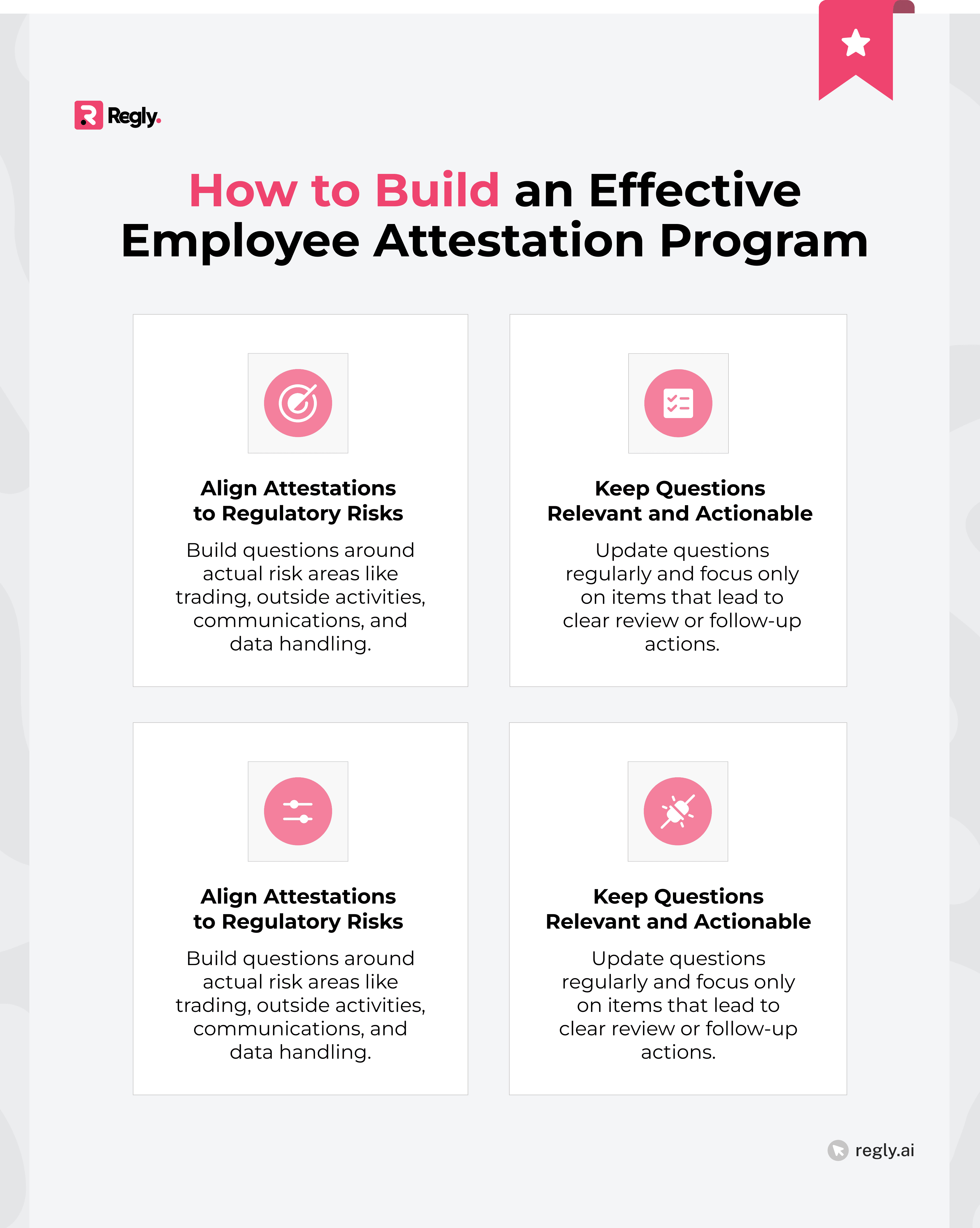
Employee attestation should map directly to the firm’s regulatory exposure. A broker-dealer, RIA, or crypto firm will have different risk areas, even if some topics overlap.
Start by identifying where employee behavior creates risk. This usually includes trading activity, outside roles, communications, and handling of sensitive data. Attestation questions should be built around these areas, not generic templates.
Firms that take a risk-based approach tend to have more focused programs. The questions are easier to answer, and the responses are easier to act on.
Keeping Questions Relevant and Actionable
Over time, attestation questionnaires can become outdated. New products, partnerships, or workflows introduce risks that older questions don’t capture.
Questions should be reviewed regularly and updated to reflect current operations. If a question does not lead to a clear action when answered, it may not belong in the process.
Clear wording improves the quality of responses and reduces follow-up. Employees should understand what’s being asked without needing interpretation.
Avoiding Survey Fatigue While Maintaining Coverage
One common challenge is balancing coverage with usability. Too many questions can lead to rushed or incomplete responses. Too few can leave gaps.
The goal is to keep attestations focused without losing visibility. Quarterly cycles should prioritize changes, while annual cycles can handle broader confirmations.
Some firms rotate certain questions or tailor them by role. This keeps the process relevant without overloading employees.
Integrating Attestations Into Daily Compliance Workflows
Employee attestation should not operate in isolation. It needs to connect with how the compliance function runs on a daily basis.
Responses should feed into reviews, approvals, and investigations where needed. Exceptions should be tracked. Outcomes should be recorded. This is what turns employee attestation into an active control rather than a periodic task.
For fintech firms, this often means integrating attestations into existing tools and workflows. Teams need visibility into responses without switching between systems or relying on manual tracking.
Building an Audit-Ready Employee Attestation Framework
An employee attestation program is judged by how clearly it can be explained and supported. Firms need documented processes, traceable records, and consistent handling of responses.
Recordkeeping Expectations and Retention
Employee attestation records are part of the firm’s official compliance documentation. Regulators may request them during exams, sometimes going back several years, depending on the requirement.
The key is maintaining complete and accessible records. This includes the questions asked, employee responses, timestamps, and any follow-up actions taken. If records are scattered or incomplete, it becomes difficult to demonstrate how the program operates.
Retention requirements vary, but firms are generally expected to keep these records long enough to support supervisory obligations and exam requests.
Linking Attestations to Policies and Procedures
Attestations should not exist independently of the firm’s policies. Each question should tie back to a specific requirement, whether it relates to trading, outside activities, or communications.
This linkage helps explain why each question exists. When a policy changes, updating attestations is much simpler because each question is already linked to its underlying requirement.
During an exam, this alignment shows that the firm’s attestation program is grounded in its written supervisory procedures rather than built as a standalone process.
Preparing for Regulator Requests and Exams
When regulators request employee attestation records, they are usually looking for more than raw data. They want to understand how the program operates and how issues are handled.
Firms should be able to produce records quickly and explain the process behind them. This includes how attestations are distributed, who reviews responses, and how exceptions are tracked.
Preparation often comes down to organization. Clear records, consistent formats, and documented workflows make it easier to respond without scrambling.
Demonstrating Supervision and Follow-up
The strongest employee attestation programs show not only what was collected, but what was done with that information. Regulators focus on whether disclosures led to review, escalation, or resolution.
Follow-up is what turns employee attestation into a supervisory control. If an issue is disclosed, there should be a record of how it was reviewed and what decision was made.
Many programs fall short here. Responses are collected, but actions are not consistently documented. Closing that gap is critical for demonstrating effective oversight.
How to Manage Employee Attestations at Scale
As firms grow, employee attestation becomes harder to manage manually. More employees, more disclosures, and more regulatory requirements increase the volume of data that needs to be tracked. Spreadsheets and email-based processes can work early on, but they tend to break down over time.
From Spreadsheets to Centralized Systems
Many firms start with basic tools, but eventually reach a point where tracking attestations manually is no longer practical. Responses may be stored in different files, approvals handled over email, and updates tracked separately.
Centralizing employee attestation data creates a single place to manage the process. This includes distributing questionnaires, collecting responses, and storing records in a consistent format.
A centralized approach also makes it easier to maintain version control. Firms can track which questions were asked, when they were updated, and how responses changed over time.
Tracking Completion, Reminders, and Escalation
At scale, one of the main challenges is making sure employees complete attestations on time. Without a structured process, follow-ups can become manual and inconsistent.
Tracking completion status and automating reminders helps keep the process moving. It also provides visibility into who has responded, who has not, and where escalation may be required.
Escalation is just as important as completion. If an employee does not respond or disclose an issue, there should be a clear path for follow-up and resolution.
Creating a Single Source of Truth for Audits
When regulators request employee attestation records, they expect a complete and organized view. This becomes difficult if data is spread across multiple systems or stored in different formats.
A single source of truth simplifies audit preparation. It allows firms to produce records quickly, show historical responses, and demonstrate how issues were handled.
This is particularly important for fintech firms operating across multiple regulatory frameworks. A centralized record helps connect attestations to broader compliance obligations without relying on manual reconciliation.
How Regly Helps Fintechs
Regly centralizes employee attestation into a structured, trackable workflow. Firms can distribute questionnaires, collect responses, and maintain records in one place. Manual coordination drops significantly, and it becomes much easier to see what’s completed and what still needs attention.
Beyond the workflow itself, what sets Regly apart is the expertise behind it. Regly is built on the foundation of InnReg’s experience working with 100+ fintechs. Our platform is designed with fintech use cases in mind, including broker-dealers, RIAs, and crypto firms that operate across overlapping regulatory frameworks.
—
Employee attestation is a practical way to turn policies into something measurable. It gives firms visibility into employee activity, creates a record of disclosures, and supports how compliance is demonstrated during exams.
The difference comes down to how the process is built and managed. Quarterly attestations capture change. Annual attestations confirm the full picture. Together, they form a system that connects employee behavior to regulatory expectations.
Firms that treat employee attestation as an active control, not a periodic task, tend to have clearer records and fewer gaps when reviewed.
Ready to Get Started?
Schedule a demo today and find out how Regly can help your business.